
The year was 1993; my teacher walked into our classroom with a drill bit in his hand and announced, “For the next few hours, we are going to discuss drill bits“.
“What’s there to discuss for hours? Everyone knows what a drill bit is,” I thought to myself.
Little did I know that a couple of hours was not enough to cover the numerous types of drill bits and their use cases. Over the years in my professional career, I have come across lots of different drilling tools, some that I had never used before.
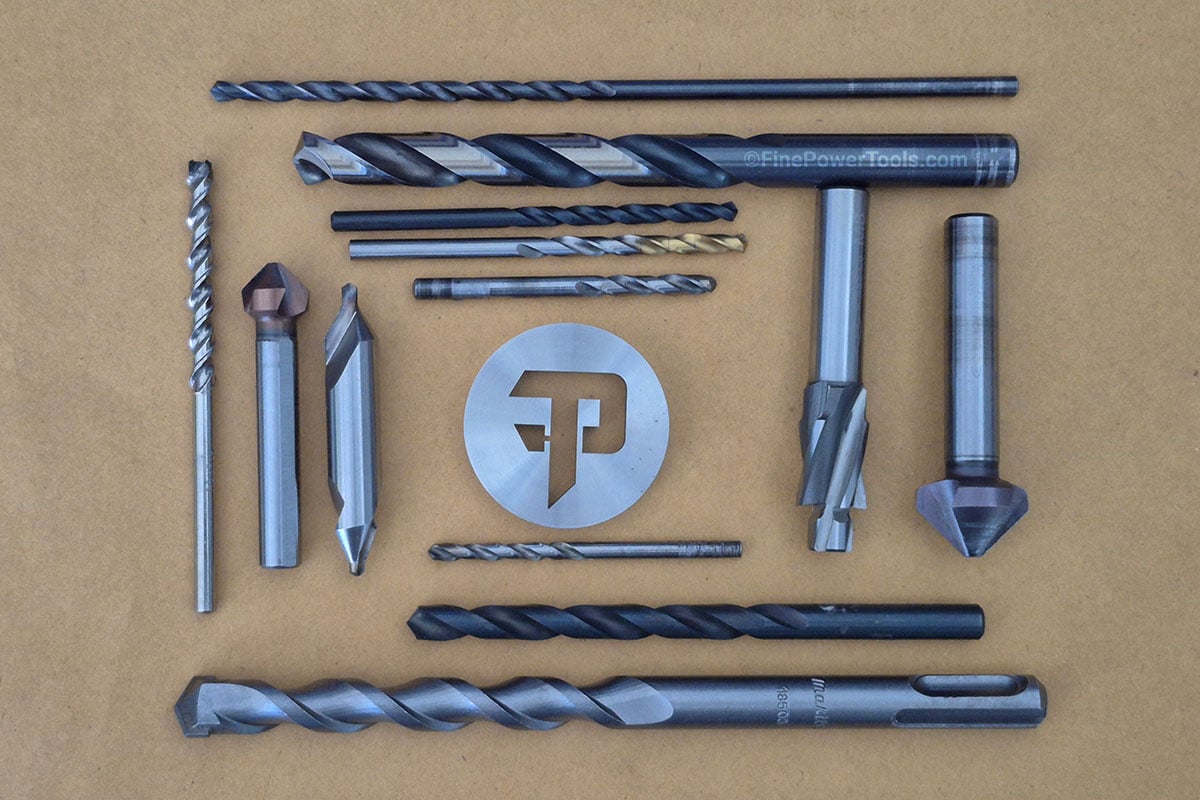
In this guide, I’ll cover over 40 drill bit types across seven categories: general purpose, wood, metal, masonry, specialty, shank types, and materials.
I will tell you what each bit does, what it’s best used for, which power tools it works with, and will share my pro tips on using the tool safely and effectively.
Category 1: General Purpose Bits
These are your everyday workhorses. These bits can be used for drilling holes in a wide variety of materials including wood, metal, plastic, composite, and more.
1. Twist Bit
Also Known As: Jobber Bit, Jobber Drill, Fluted Bit
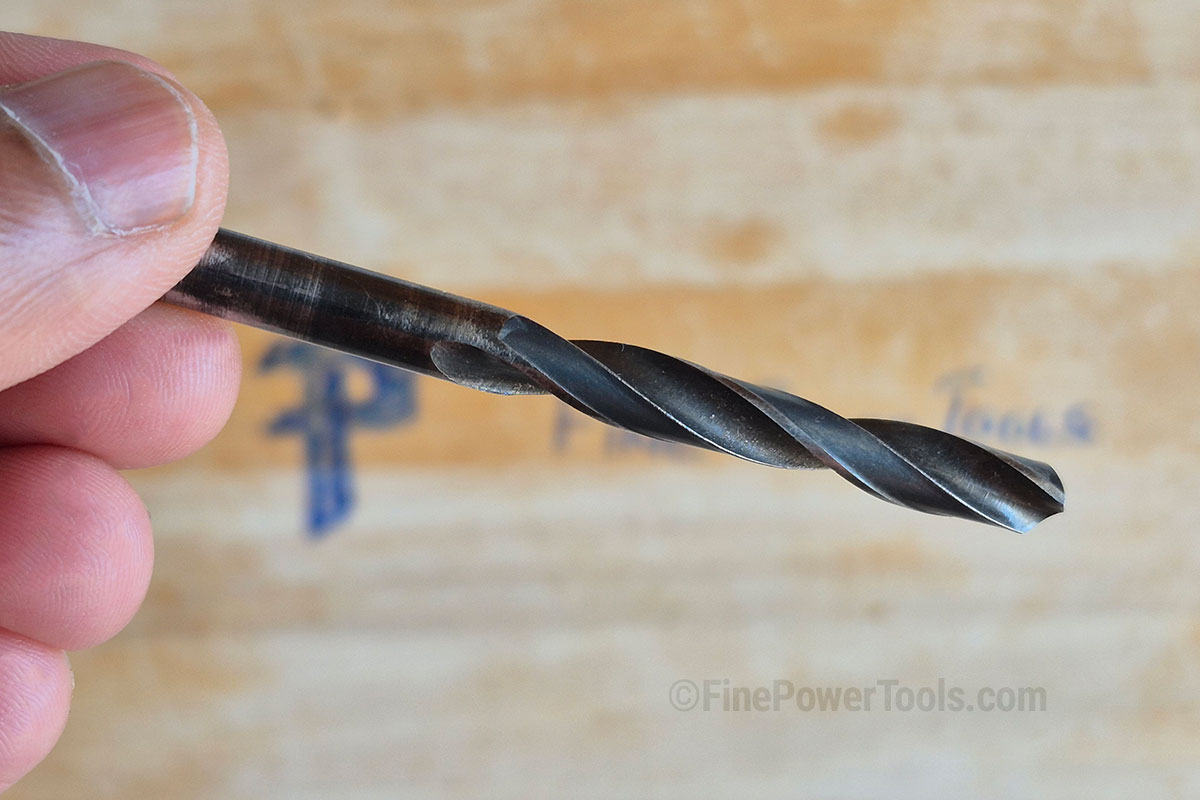
In 1861, Massachusetts mechanic Steven Morse got tired of flat spade drills that clogged mid-hole and invented the twist bit. A twist drill bit has two spiral flutes ground into a steel rod that cut and clear waste simultaneously. The patented design has barely changed in 160 years. The most common version has a 118° point angle, making it a capable performer across wood, metal, and plastic without being the absolute best at any one of them. Everyone must have a set of twist drill bits in his tool kit.
Best Used For: General-purpose drilling through wood, plastic, metal, and composites.
Works With: Cordless Drill, Corded Drill, Drill Press. Larger diameters with Morse Taper shanks mount on a Drill Press or Lathe.
Dan’s Pro Tip: When drilling on a smooth metal surface, like a steel block, tap a center punch dimple on your mark first, then drill. It keeps the bit on target and stops it from wandering.
📌 Related info: For a complete list of twist bits, see the drill bit size chart.
While a standard twist bit is my go-to bit for most of my work, it is not ideal for drilling holes in thin sheet metal such galvanized steel ducts. This is where I would need a unibit.
2. Step Bit (Unibit)
Also Known As: Unibit, Stepped Drill Bit, Staircase Bit
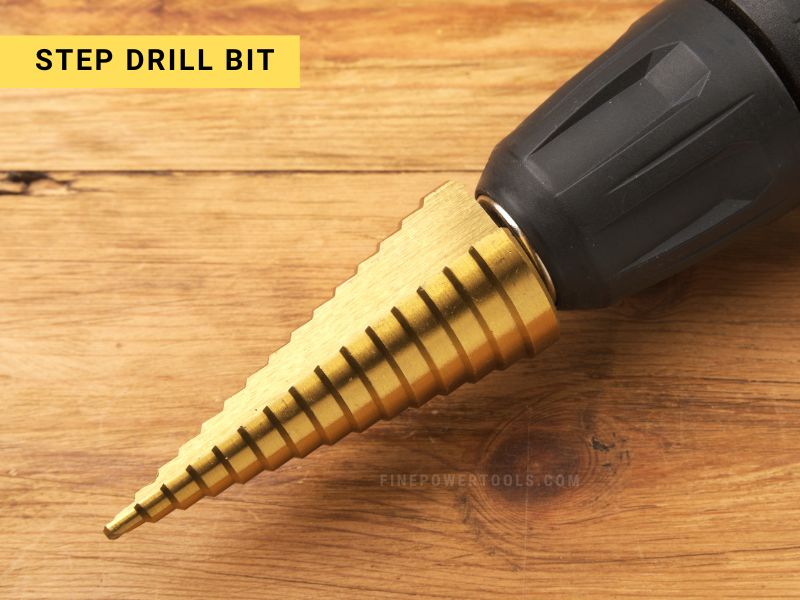
Patented in 1973, the step bit looks like a metallic Christmas tree, a single conical bit with graduated diameters stacked like a staircase. Step drill bits are used primarily for drilling holes in thin sheet metal, plastic sheets, etc.
Each step is a different hole size; you move up by drilling deeper. On thin sheet metal or plastic, standard twist bits grab and chatter dangerously. The step bit’s progressive geometry eliminates that, delivering smooth, clean holes without breakthrough violence. One bit replaces an entire set of twist bits for sheet work up to about 6 mm (¼”) thick.
Best Used For: Drilling and enlarging holes in thin sheet metal, electrical panels, and plastic sheet. A favourite of electricians and HVAC installers for conduit knock-outs. See the more uses of step drill bits.
Works With: Cordless Drill, Corded Drill, Drill Press.
Dan’s Pro Tip: I strongly recommend you clamp the workpiece firmly to prevent the from catching on to the bit and rotating the sheet metal into your hands. Also, use step bits on materials thinner than the height of a single step (usually 1/8 inch or less).
3. Hole Saw
Also Known As: Hole Cutter, Cup Saw, Holesaw
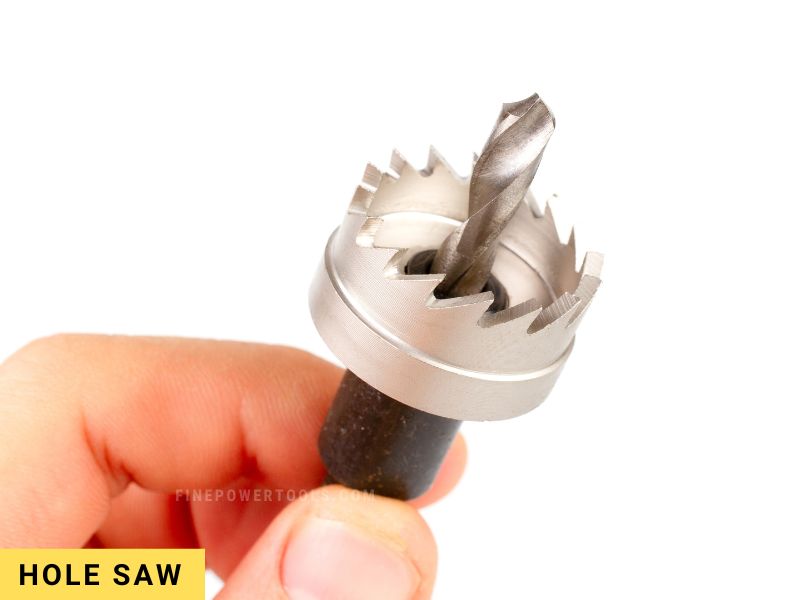
A hole saw is a cylindrical saw blade on an arbor, with a pilot twist bit at its centre to keep it on target. You can get holes saws in two types: arbored and non-arbored. Sizes run from 14 mm to well over 200 mm. Bi-metal versions handle wood and thin metal; carbide-tipped saws tackle harder metals; diamond-edge saws cut tile and stone.

Removing the the plug of material left inside the cylinder after cutting is the difficult part. Some manufactures, add ejection holes or prying slots in the side for easy removal of the slug. You can get a plug ejector, I normally use a flat-head screwdriver to push the plug out.
Best Used For: Large circular holes for door hardware, pipe and conduit pass-throughs, recessed lighting, and electrical back boxes.
Works With: Cordless Drill, Corded Drill. Large-diameter cuts should be done on a Drill Press for stability and control.
Dan’s Pro Tips: When you cut a board with hole saw, the bottom face usually will have rough edges/blowouts. I normally clamp my workpiece on a piece of scrap wood and drill through to get clean cuts on both faces of a board.
Another technique is to drill until the pilot bit just pokes through the back, then flip the board and complete the cut from the other side.
But when the job calls for drilling deep holes through thick framing wood, that’s where an auger bit comes in.
4. Auger Bit
Also Known As: Wood Auger, Ship Auger, Bellhanger Bit (long-shank variant)
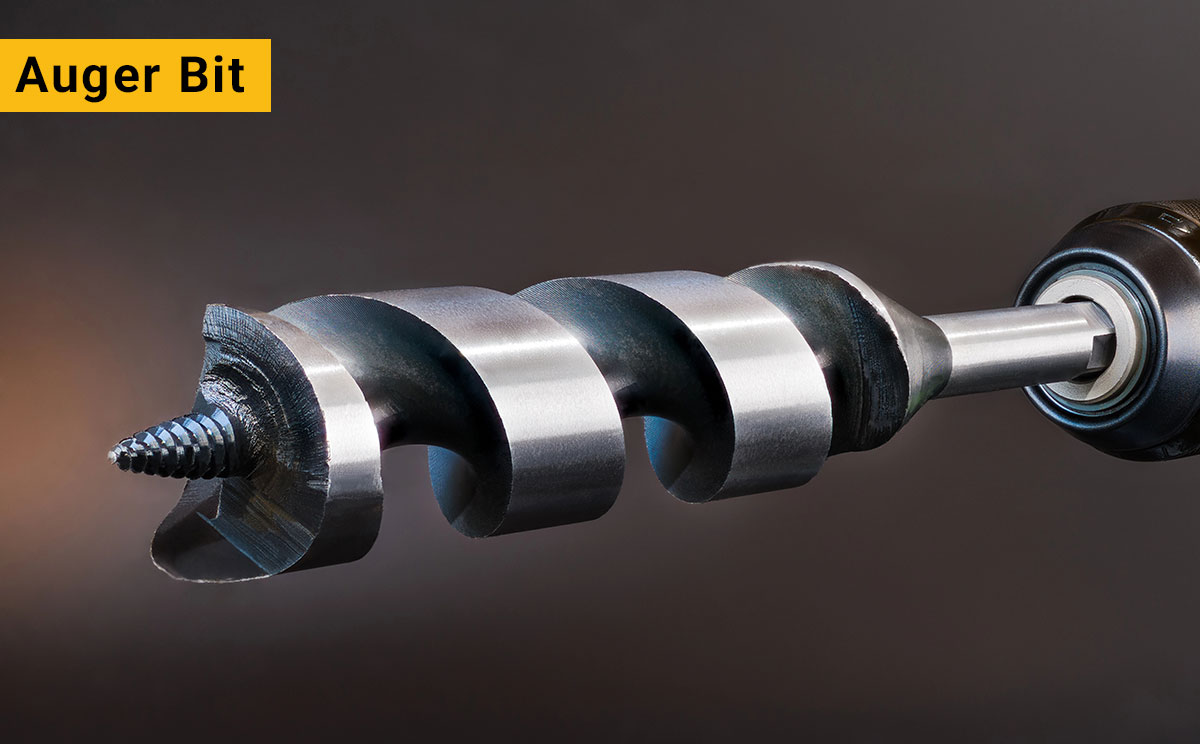
The auger’s defining feature is its screw tip. It has a threaded point tip that pulls the bit into the wood with each rotation so you apply almost zero downward pressure. Wide, deep spiral flutes lift thick shavings up and out continuously, which is why auger bits don’t clog on deep cuts where a standard twist bit would jam solid. They are the right tool for deep holes through thick timber, beams, and dense hardwood.
Note: We are talking about the woodworking auger bits here.
Earth augers, a completely different animal, attach to skid steers, tractors, or heavy-duty power tools for drilling post holes in soil.
Best Used For: Deep holes in timber framing, thick beams, and dense hardwood. Also used by electricians and plumbers running cable or pipe through structural timber.
Works With: Cordless drills, Corded Drills, Drill Press, Hand Brace.
Earth Auger: Skid Steer, Tractor PTO, Two-Person Petrol Earth Auger.
Pro Tip: Keep speed at around 600 RPM and let the screw tip do the feeding. If you push too hard or run too fast the bit might jam before the flutes can clear the waste.
What if your project involves drilling different types of material like masonry, wood, metal or composites? Stopping to swap gear each time will slow you down. That is why having a quality multi-material bit kit comes in handy.
5. Multi-Material Bit
Also Known As: Multi-Purpose Bit, Universal Bit, All-in-One Bit
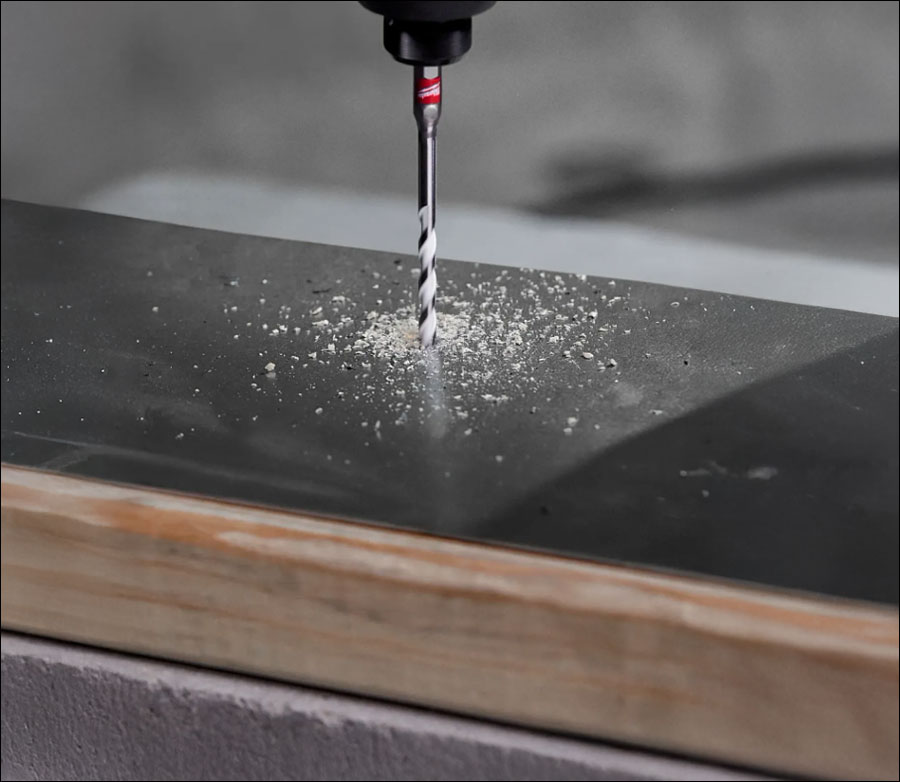
Image: A Multi-Material Drill Bit from Milwaukee
The multi-material bit uses a tungsten carbide tip ground to a multi-faceted geometry that handles the contradictory demands of wood, metal, masonry, tile, and plastic. THink of drilling in a single pass through a composite wall. The carbide tip is the key: hard enough to fracture masonry, sharp enough to cut metal cleanly, durable enough to handle wood without burning.
They are very useful in construction since modern construction is layered and consists of tile, adhesive, plasterboard, timber, brick. The multi-material bits allows you to drill through all these without replacing the tool. They are not substitution for dedicated bits on pure single-material jobs; for heavy or precise work, always reach for the right specialist bit.
Best Used For: Mixed-material and composite walls for renovation, fitout, and general contracting where the material stack is unknown or layered.
Works With: Cordless Drill, Corded Drill, Hammer Drill (rotation-only mode for tile), Impact Driver (hex-shank versions).
Pro Tip: Keep drill speed and feed lower than what you use normally. The multi-material bits generate more heat across material transitions, and excess heat would damage the carbide tip fast.
Category 2: Wood Bits
Dedicated wood bits exist for one reason: wood grain is unforgiving. A general-purpose bit wanders, splinters the exit face, and leaves ragged edges that take time to fix. The bits below are engineered specifically to slice wood fibres cleanly, hold their centre, and clear chips without clogging.
1. Brad Point Bit
Also Known As: Spur Point Bit, W-Point Bit, Dowel Bit
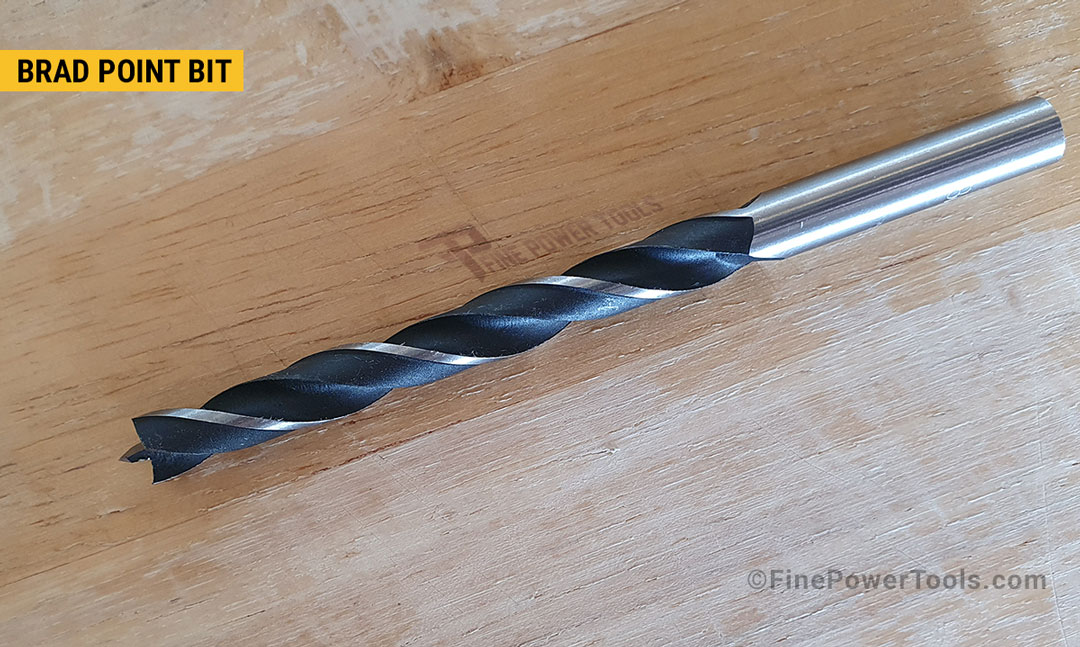
The brad point bit is the precision tool of wood drilling. A sharp pointy tip (brad) locks onto your mark instantly and starts drilling without walking, or skating. Two outer spurs score the perimeter of the hole before the cutting edges arrive, giving you a clean, tear-free entry every time. It outperforms a standard twist bit in wood across the board: better accuracy, cleaner edges, and less splintering, especially in plywood, MDF, and veneered sheet material.
Best Used For: Dowel holes, hinge pilot holes, shelf pin holes, and any woodworking joint where hole position and clean edges both matter.
Works With: Cordless Drill, Corded Drill, Drill Press.
Pro Tip: Brad point bits are wood-only. If you use it to drill metal or masonry and you’ll blunt the spurs instantly. Back your workpiece with a sacrificial board (scrap board) to eliminate exit-side tear-out completely.
While a brad point bit is great for drilling precise holes, a spade bit is the better choice when you need to quickly drill large holes through studs for wiring or pipes.
2. Spade Bit (Paddle Bit)
Also Known As: Paddle Bit, Flat Bit, Wood Boring Bit
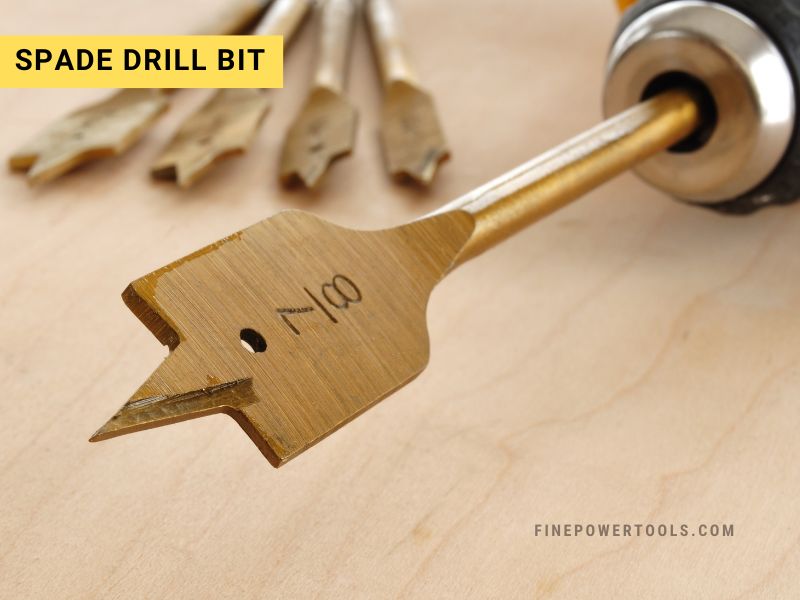
Fast, cheap, and aggressive; the spade bit is the mostly commonly used by a woodworker or a tradesperson’s workhorse for rough-in work. A flat paddle with a centre point and two cutting lips bores large holes through timber quickly. It produces a rough hole, not a pretty one, which is exactly why electricians and plumbers love it: the hole gets covered by a cable, pipe, or fitting anyway. Sizes run from ¼” up to 1½” (6 mm to 38 mm). Beyond 1½”, reach for a self-feed bit or hole saw instead.
Best Used For: Drilling through wall studs and floor joists for electrical cable, plumbing pipes, and conduit. Rough-in construction work where hole finish doesn’t matter.
Works With: Cordless Drill, Corded Drill. Large diameters benefit from a drill with a side handle and low gear for control.
Pro Tip: Spade bits produce serious blowout on the exit face. To avoid this, drill until the centre point just pokes through, then flip the board and finish from the other side for a cleaner result.
3. Self-Feed Bit
Also Known As: Self-Feed Wood Bit, Screw Tip Bit, Plumber’s Bit (large format)
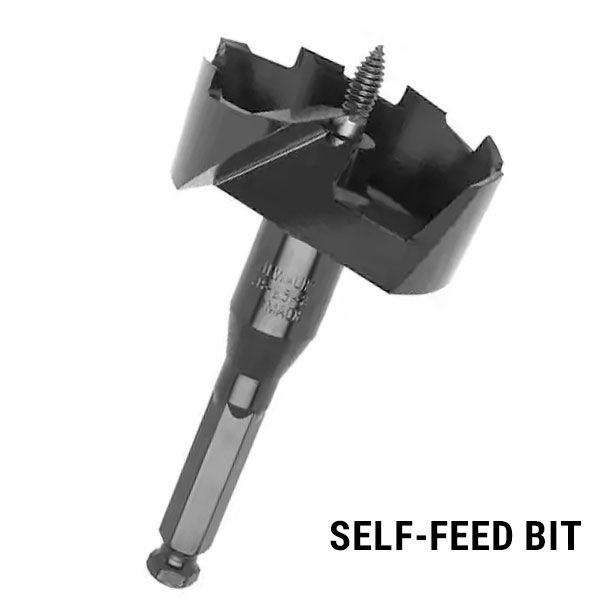
The self-feed bit is what you reach for when a spade bit isn’t big enough and a hole saw is overkill. A threaded lead screw (similar to auger) at the tip pulls the bit through thick timber fast and with minimal downward pressure. These bits are designed for making large-diameter holes easily. Sizes typically run from 1″ to 4″ (25 mm to 100 mm), making it the go-to for plumbers and framers boring large holes through multiple stacked joists in one pass. It is aggressive: it needs a powerful ½” drill and a firm grip.
Best Used For: Large-diameter holes through thick framing lumber, stacked joists, and beams for plumbing, HVAC ducting, and large cable runs.
Works With: Heavy-duty Cordless Drill (½” chuck), Corded Drill (½” chuck), Drill Press.
Pro Tip: Always clamp the workpiece securely and grip the drill firmly. With its large diameters tand the high torque reaction if the bit snags can wrench the drill violently out of your hands.
The next bit might look similar to a self-feed bit, but it is one of the most precise woodworking drill bits in this list. It is my choice when I want flat-bottomed blind holes for concealed cabinet hinges and wood joinery.
4. Forstner Bit
Also Known As: Hinge Boring Bit (35 mm variant)
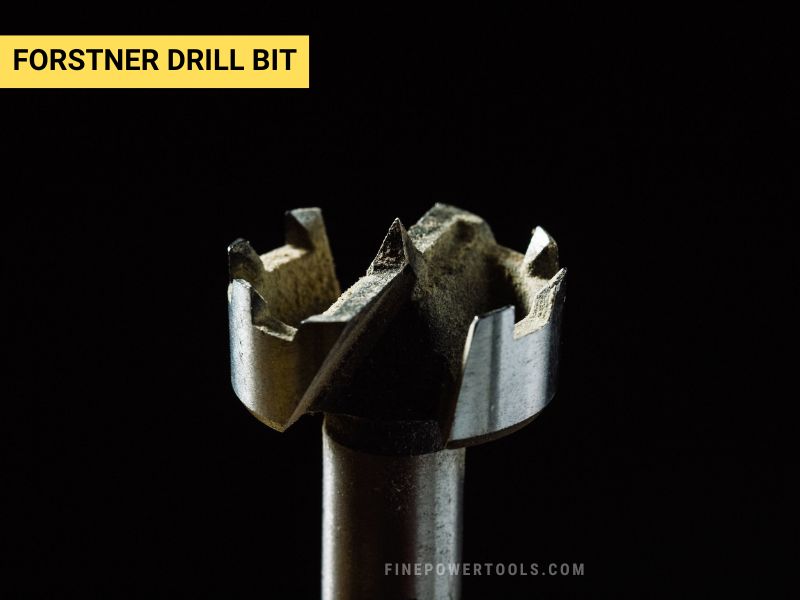
The Forstner bit cuts the cleanest, flattest-bottomed hole in woodworking. A centre spur locates it precisely, a continuous rim severs the wood fibres around the perimeter, and the result is a smooth, flat-bottomed recess with almost no tear-out. Unlike auger or spade bits, it has no self-feeding screw; it needs steady, controlled pressure (feed).
It can also drill overlapping holes and angled holes to create mortise without a wood router. Best used on a drill press; handheld use is possible but demands a steady hand.
Best Used For: Cabinet hinge recesses, shelf pin holes, flat-bottomed bolt recesses, inlay pockets, and any joinery where a clean flat-bottomed hole is required.
Works With: Drill Press (recommended), Cordless Drill, Corded Drill.
Pro Tip: Keep your RPM low. Forstner bits generate significant heat at high speeds, especially in hardwood. A slow, steady pace keeps the bit sharp and the hole clean.
5. OverDrive Bit
Also Known As: WoodOwl Bit, Cork Bit
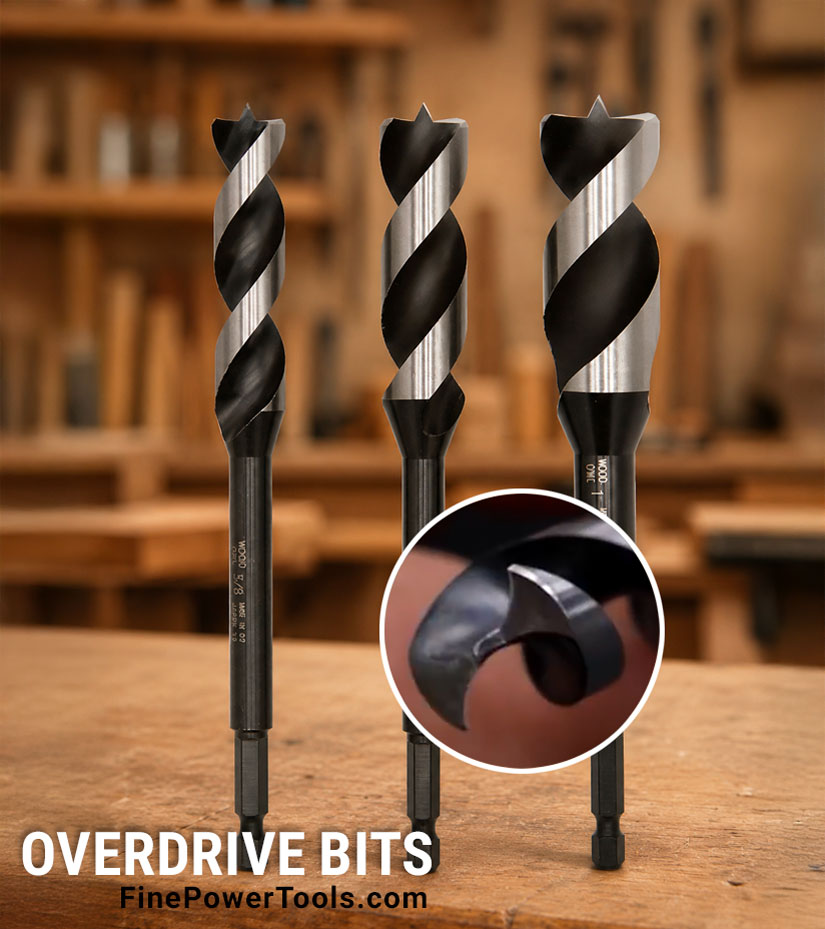
The OverDrive bit has a pointed cutting tip like the brad drill bit and deep flutes like auger bits. But unlike the brad bits, the OverDrive bit does not have a pronounced cutting lip, instead it has chamfered cutting edge. This unique cutting edge design allows the bit to drill the hole on-target and cut a clean hole with very little blowout.
The deep helical flutes allow the wood shavings to move out without clogging. This reduces friction and makes the cutting action smooth which according to the manufacturer increases the battery life of your cordless drill by up to 35%.
The OverDrive drill bit is manufactured by the Japanese firm Star-M and is available under the brand name WoodOwl in North America.
The WoodOwl OverDrive™ bits come with a 1/4″ hex shank and have a standard length of 6-1/2″.
Best Used For: Drilling clean holes without blowout for furniture, chairmaking, cabinetry.
Works With: Corded and cordless drills, Drill Press and Impact driver.
Pro Tip: Although the hex shank of the bit makes it a natural choice for impact drivers, I recommend you use it on a regular drill or drill press to get smooth holes.
6. Adjustable Wood Drill Bit (Expansive Bit)
Also Known As: Expansive Bit, Adjustable Spade Bit
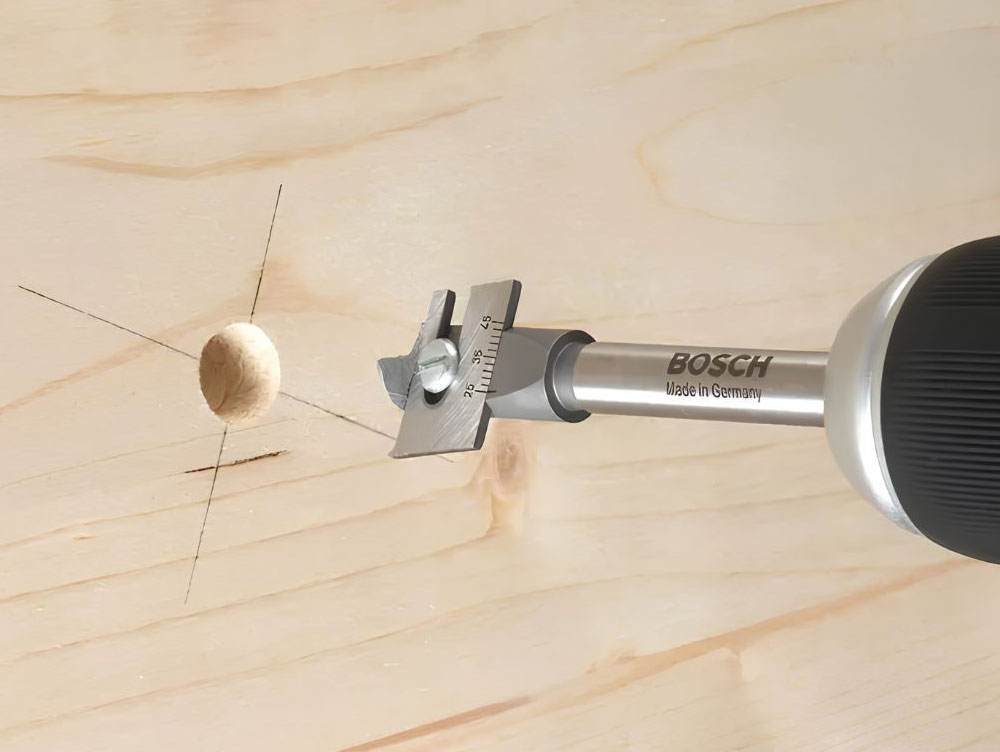
Image: A 15-45mm adjustable spade drill bit from Bosch
The expansive bit is an old-school solution to a real problem: you need one specific large hole size you don’t have a fixed bit for. An adjustable cutter blade slides outward on a calibrated scale and locks at your chosen diameter, covering a range of sizes with a single tool. Originally designed for use with a hand brace, it works with a slow-speed corded drill too.
To be honest I don’t use this tool. I would rather prefer a set of spade bits with different diameters than fiddling with the adjustable blade.
Best Used For: One-off large-diameter holes in wood where you need a specific size not covered by your fixed bit set.
Works With: Cordless Drill (low speed), Corded Drill (low speed), Hand Brace.
Pro Tip: Always do a test cut in scrap wood after adjusting the blade. The locking mechanism can slip slightly, and an off-size hole in your good stock is hard to fix.
7. Adjustable Circle Cutter (Fly Cutter)
Also Known As: Fly Cutter, Adjustable Hole Cutter, Circle Cutter, Beam Compass Cutter, Trammel Cutter
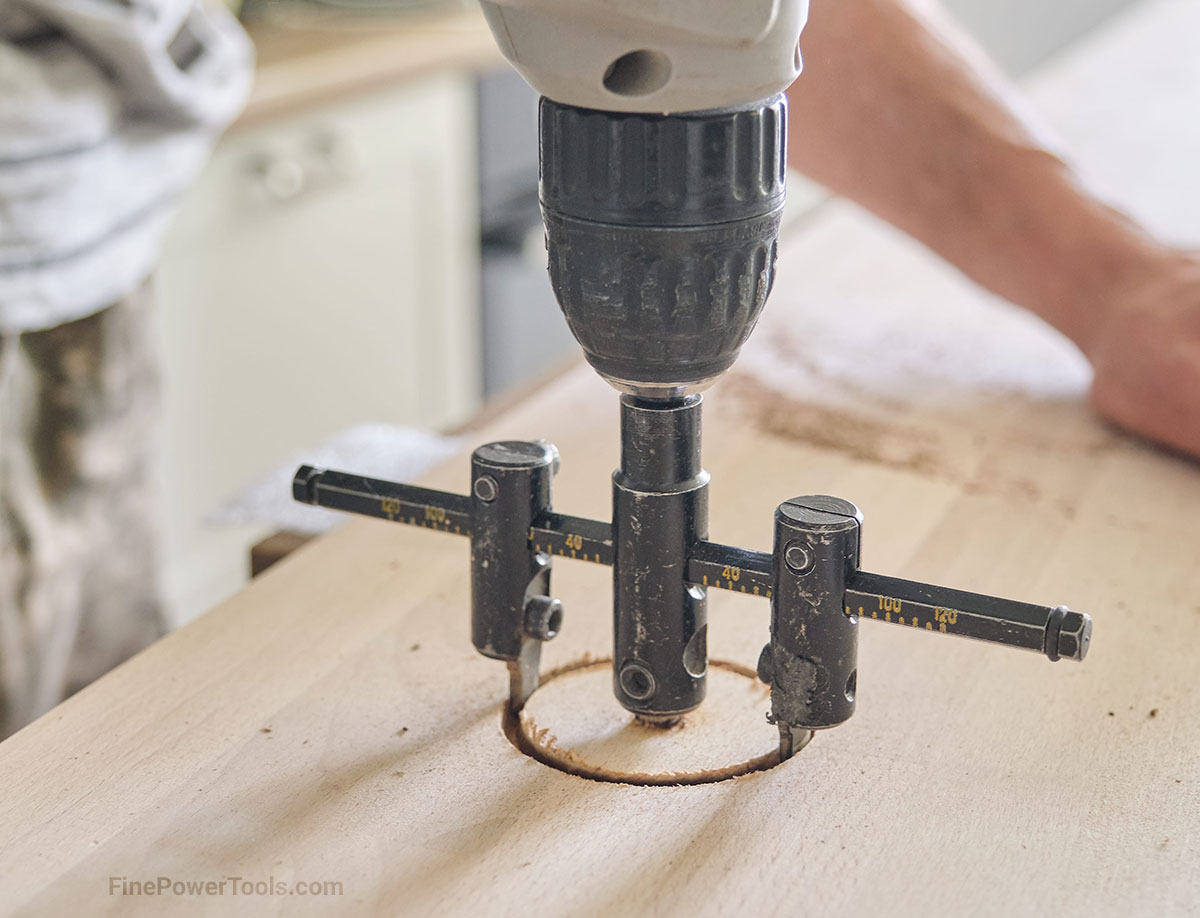
The adjustable circle cutter is the tool you reach for when you need a large, clean circular hole in wood and no fixed-size bit covers it. A central pilot drill bit locates and anchors the tool, while an adjustable arm extends outward holding a single angled cutting blade. Slide the arm to your desired radius, lock it, and the blade scribes a clean circle as the tool rotates. Cutting diameter typically ranges from 40 mm up to 300 mm or more. This is way beyond what any Forstner bit or hole saw set covers.
Unlike the adjustable expansive bit, which cuts by scraping inward from a fixed centre, the circle cutter traces the full perimeter of the hole with a single blade pass, leaving a smooth, accurate edge.
Here’s the critical safety point: the offset rotating arm generates serious torque and uneven rotational force, especially at larger diameters. Drill press use is not just recommended, it is effectively mandatory for anything above 75 mm. Handheld use at large diameters can cause the tool to catch and rotate the drill violently. Always clamp the workpiece securely to the drill press table and never hold it by hand.
Best Used For: Cutting non-standard large-diameter holes in wood, plywood, and MDF. Example: speaker mounting holes, decorative circular cutouts, pipe and duct openings, and any application where the required diameter falls outside your fixed-size bit set.
Works With: Drill Press (strongly recommended for all but the smallest diameters). Cordless or Corded Drill only for diameters under 75 mm, at low speed, with the workpiece firmly clamped.
Pro Tip: Always make a test cut in scrap material after setting the arm. When you tighten, the locking screw can shift slightly under first contact, and an oversized hole in your good stock is irreversible. Start at low RPM and let the blade find its path before increasing speed.
Once you cut large holes in wood with circle cutter, do not through away the cut-out portion. Use a plug cutter to cut plugs to hide screw heads with matching wood grain.
8. Plug Cutter
Also Known As: Wood Plug Cutter, Cork Bit
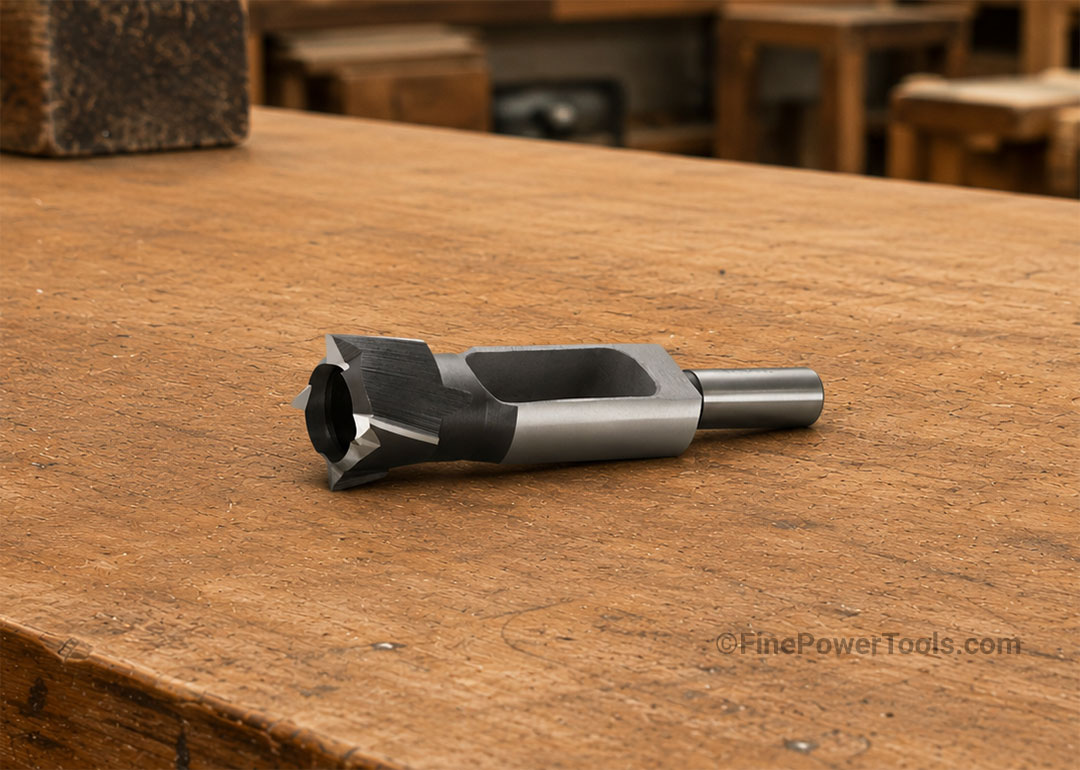
The plug cutter is not for drilling holes, but to cut the cylindrical wooden plugs. Mount it in a drill press, press it into a piece of matching timber, and it cores out a clean plug the same species and grain as your project. That plug then gets glued into a counterbored screw hole and trimmed flush, hiding the fastener completely. It’s the finishing touch that separates furniture-grade work from rough construction.
There are two types of plug cutter available.
- Straight-sided (for a tight friction fit) and
- Tapered (slightly easier to seat).
Best Used For: Concealing countersunk screws in furniture, cabinetry, and fine woodworking where a polished, fastener-free surface is required.
Works With: Drill Press (required for accuracy). It will be difficult to keep the handheld drill steady and true enough to cut a useable plug.
Pro Tip: Cut your plugs from the same board as your workpiece and align the grain. A well-matched plug is nearly invisible after sanding and finishing.
9. Countersink Bit (Wood)
Also Known As: Combination Countersink Bit, Pilot and Countersink Bit
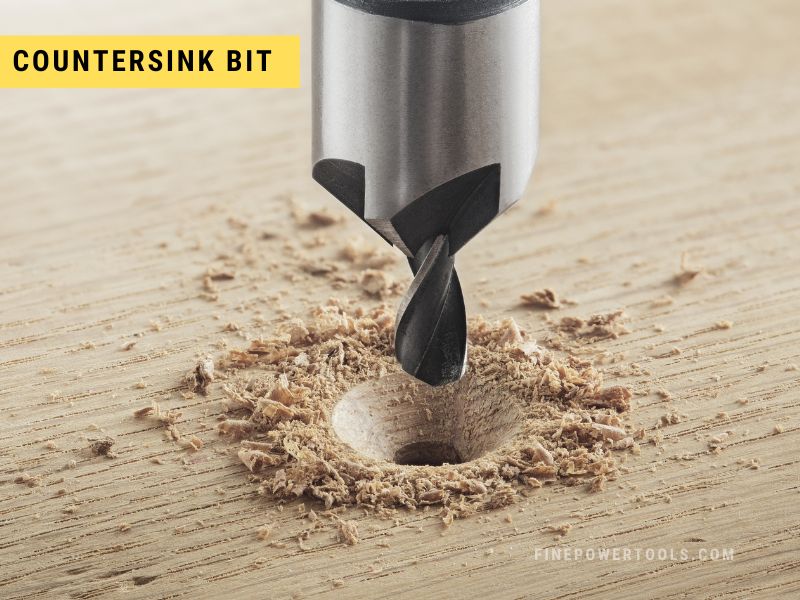
The wood countersink bit drills a pilot hole and a conical recess in one pass, so a screw head sits flush with (or just below ) the wood surface. Most versions for wood combine a small twist drill (for the pilot) with a fluted conical cutter (for the recess), and many include a stop collar to control depth. The cutting angle is more aggressive than its metal counterpart to slice wood fibres cleanly rather than scrape them.
Best Used For: Any screw fixing in wood where you want a clean, flush or recessed screw head. E.g., furniture assembly, carcass joinery, deck boards, and timber framing.
Works With: Cordless Drill, Corded Drill, Drill Press.
Pro Tip: Match the countersink angle to your screw head. Most wood screws use an 82° head, while the metric metal screws use 90°. Using the wrong angle leaves a gap ring around seating area which would affect the joint.
10. Pocket Hole Drill Bit
Also Known As: Kreg Bit, Stepped Pocket Bit
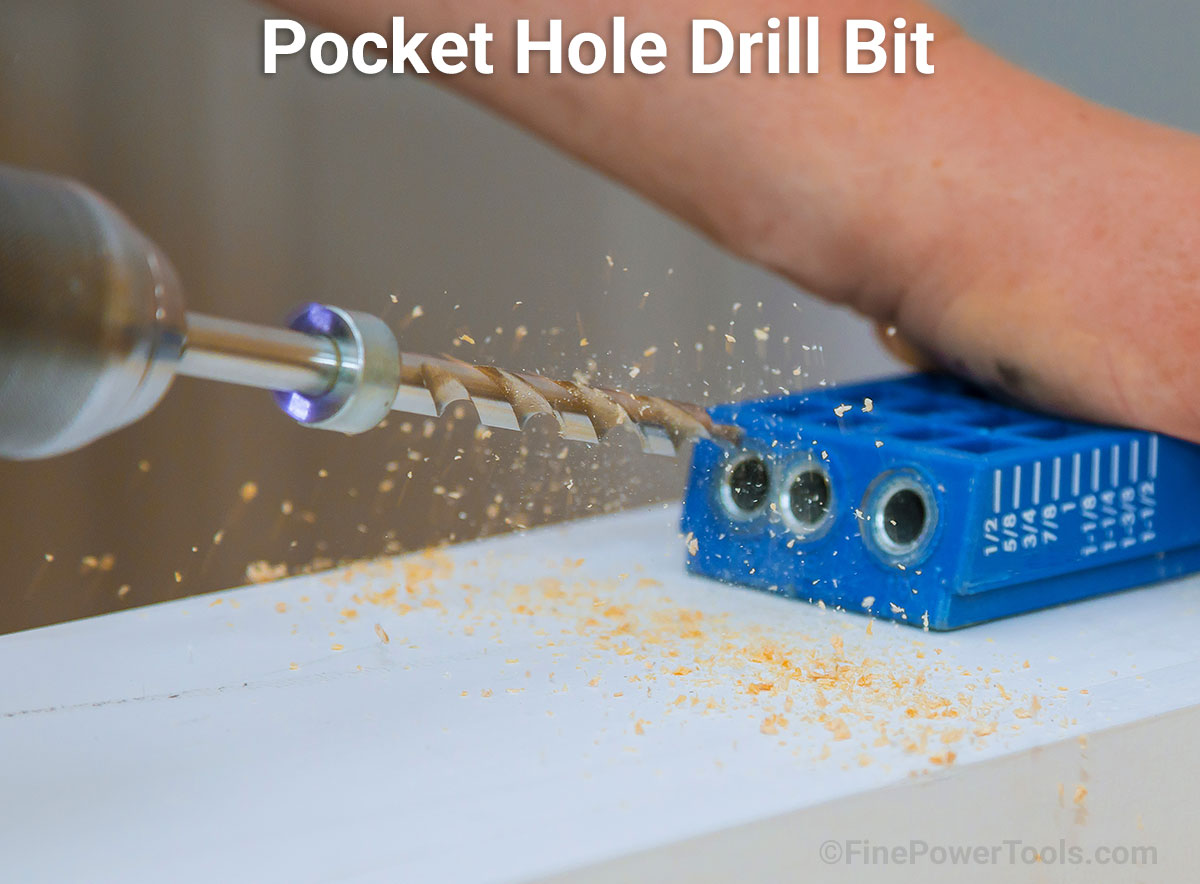
As the name suggests, pocket hole drill bits are used for creating pocket hole joinery. A regular twist drill bit cuts a hole with cone-shaped end. If you drive a pocket screw into that hole, the washer head of the screw acts like a splitter, cracking the the wood. This will ruin the structural integrity of your joint.
A pocket hole drill bit has a narrow pilot tip followed by a wider cutting shoulder that cuts at a flat, 90-degree angle. When guided by a pocket hole jig at a rigid 15 degrees, it cuts an elongated pocket with a clean flat bottom. This flat surface gives the underside of the self-tapping pocket screw head a square seat to press against, pulling the boards together to create a strong joint.
It is almost always used with a dedicated jig (Kreg being the most recognisable brand) that holds the angle and controls depth automatically. The technique is fast, strong, and requires no waiting period for the glue once the screw is driven.
Best Used For: Face frame joinery, cabinet carcass assembly, furniture building, and any butt joint where speed and strength matter more than traditional mortise-and-tenon craft.
Works With: Cordless Drill or Corded Drill used in conjunction with a pocket hole jig.
Pro Tip: Set your stop collar depth to match the timber thickness before drilling. Refer to the chart by pocket hole jig manufacturers publish. Drilling to the wrong depth produces weak joints or screw blow-out.
So far we have seen bits that drill round holes. What if you want to drill a square hole? For example to create a mortise and tenon joint?
11. Square Drill Bit (Mortise Bit)
Also Known As: Mortising Chisel Bit, Hollow Chisel Mortise Bit, Mortiser bit
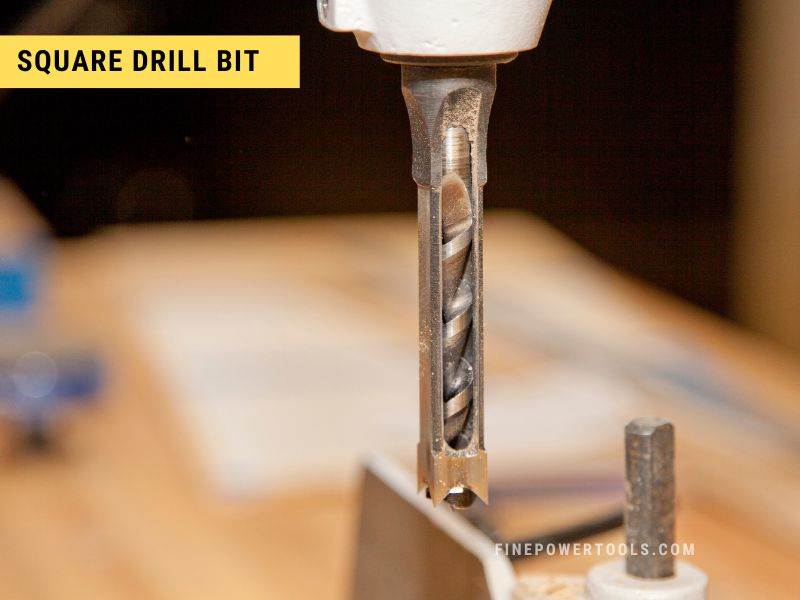
The mortise drill bit is actually two tools in one: an auger-style drill bit nested inside a hollow square chisel. The drill bores out the bulk of the waste, and the four-sided chisel stamps the edges square simultaneously. The result is a precise, square-cornered mortice (the female half of a mortise-and-tenon joint) that no round bit alone could produce. It mounts in a dedicated hollow chisel mortiser machine, or in a mortising attachment on a drill press.
Best Used For: Cutting square and rectangular mortises for traditional mortise-and-tenon joinery in furniture, doors, windows, and timber framing.
Works With: Hollow Chisel Mortiser Machine, Drill Press with Mortising Attachment.
Pro Tip: Keep the chisel sharp. A dull chisel requires excessive force and splits the wood rather than slicing it. Chisel sharpening stones sized for mortice chisels are inexpensive and worth having on the bench.
Next let’s move tougher materials like hard plastics, metals, etc.
Category 3: Metal Bits
Metal drilling punishes the wrong bit fast. Heat is the enemy as it dulls the cutting edge in minutes. Every bit in this category is engineered to handle the hardness, chip clearance, and thermal demands that wood bits would fail at immediately.
1. HSS Twist Drill Bit (Metal Cutting)
Also Known As: HSS Drill Bit, Jobber Drill (metal grade), Metal Drill Bit
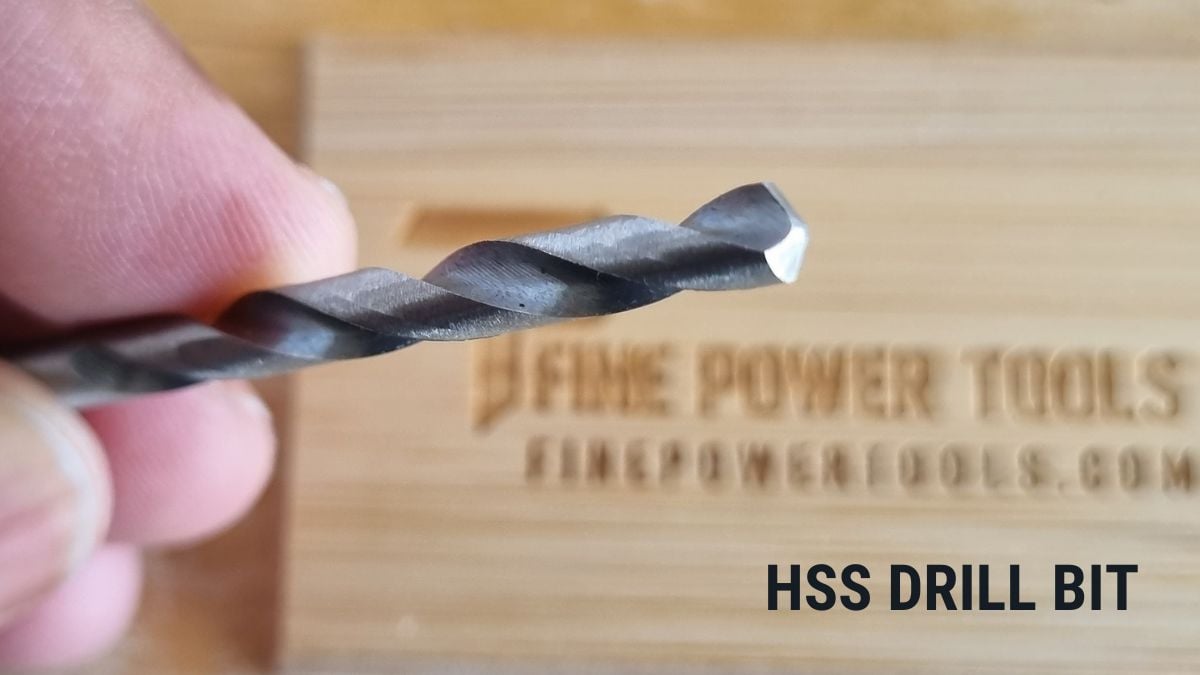
The same helical flute geometry as a general-purpose twist bit, but ground and manufactured specifically for metal. The key difference is material and tip geometry: metal-cutting twist bits are made from HSS, cobalt, or carbide, and are ground to a 118° or 135° split-point tip that self-centres on metal without walking. The split point eliminates the need for a centre punch on most materials, and the sharper geometry cuts metal cleanly rather than scraping it. For mild steel, aluminium, brass, and copper, standard HSS does the job. For stainless steel and hardened alloys, step up to cobalt grade.
Best Used For: Drilling clearance holes, pilot holes, and through-holes in mild steel, stainless steel, aluminium, brass, copper, and cast iron.
Works With: Cordless Drill, Corded Drill, Drill Press. For diameters above 13 mm (½”), a drill press is strongly recommended. (see also Taper Shank bits in Category 6.)
Dan’t Pro Tip: Always use cutting fluid or coolant on steel. Even a drop of multipurpose oil makes a measurable difference in heat, finish, and bit life. Run slow and let the bit cut; pressing harder just generates heat and dulls the tip faster.
While an HSS twist bit would be my choice for everyday metal drilling, a straight fluted bit is better suited for short-chipping materials like brass and cast iron. When drilling soft metals twist flutes can act like a screw and grab the material. Straight flutes eliminates this risk of self-feeding.
2. Straight Fluted Drill Bit
Also Known As: Straight Flute Drill, Zero-Flute Drill
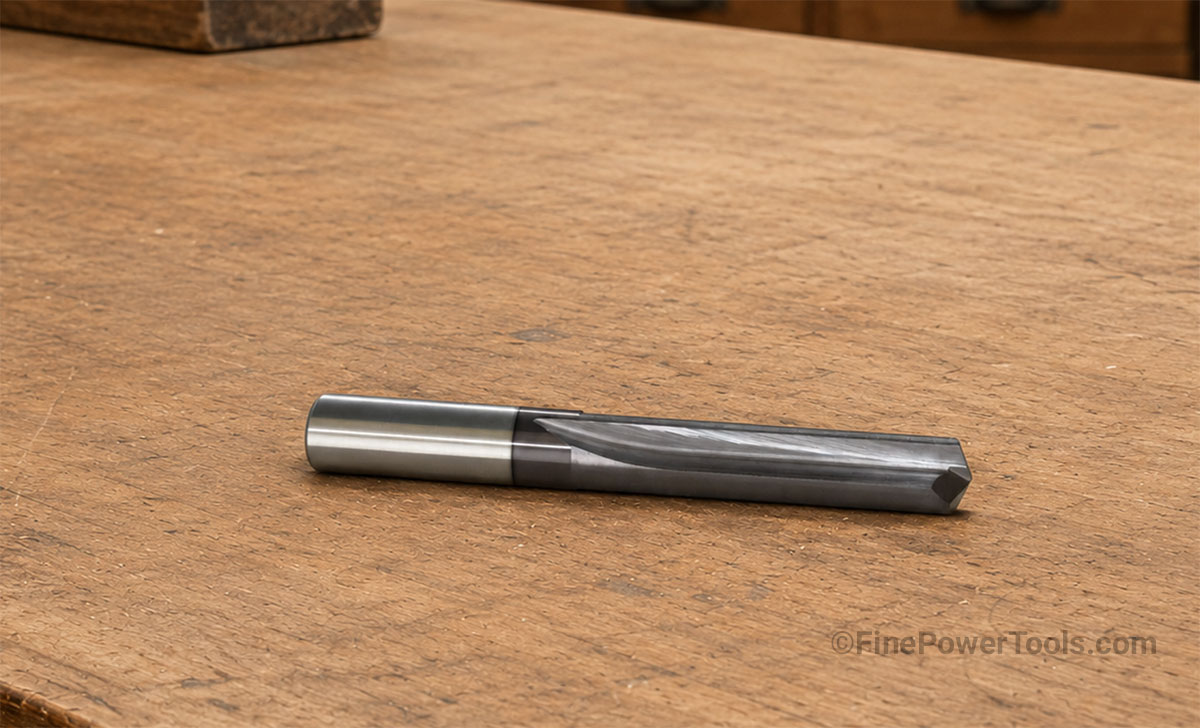
Where a twist bit uses spiral flutes to pull chips upward and out, a straight flute drill has channels that run perfectly parallel to the bit’s axis. That difference matters in specific materials: when drilling brass, thin-walled copper, or plastics, the spiral action of a twist bit tends to “grab” and self-feed aggressively which sometimes result in catching, cracking the material, or pulling through uncontrollably. Straight flutes eliminate that grabbing action, producing a smoother, more controlled cut with shorter chips that clear easily. They are not general-purpose bits; they exist to solve a specific problem.
Best Used For: Drilling brass, soft copper, thin-walled non-ferrous metals, and plastics where twist bits tend to grab or chatter.
Works With: Drill Press, Milling Machines, CNC Milling and Lathe
Pro Tip: When drilling on hard metals, use it only for shallow holes that require high finish. Chip clearing would be an issue for deeper holes.
3. Vortex-Point Bit
Also Known As: Step Step Point Drill Bit, Step-Tip Drill Bit
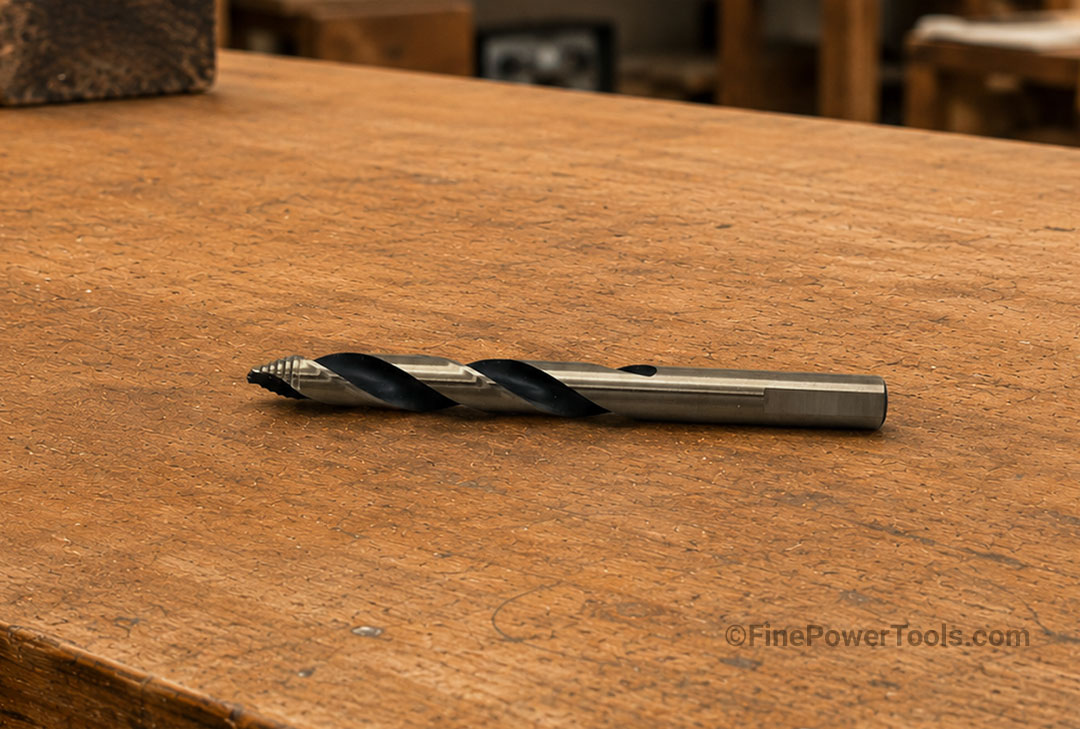
Imagine welding a step drill bit in front of a twist bit! That’s what a Vortex-Point geometry looks like. Instead of the 118° angle cutting tip of a twist bit, the Vortex-Point drill bit has a self-centering 135° split-point (diameter 1/8″ and larger) followed by a 45° angle cutting edge with steps much like a unibit before transitioning into standard twist flutes.
This unique cutting tip enables the Vortex-Point bit to start drilling the hole in metal without “walking” across the surface. The stepped cutting lip lowers the friction and heat and increase tool life up to 4 times according to the manufacturer.
Vortex-Point bits that are diameter 3/16 inch and larger have three flats machined at the end of the shank that would allow the self centering 3-jaw chucks on your drill to hold the bit without slippage. These bits come in mechanic’s length and are made in USA by Norseman™.
Best Used For: Recommended for drilling mild steel, brass, cast iron, copper, sheet metal, and even alloy steel. You could also use it to drill plastic and wood.
Works With: Drill Press, Cordless Drill, Corded Drill.
Dan’s Tip: While I love it for its efficiency, keep in mind that it’s not easy to resharpen the bit when it finally goes dull. For everyday metalworking jobs, I use the regular HSS bits because I can resharpen them easily on a bench grinder.
4. Countersink Bit (Metal)
Also Known As: Multi-Flute Countersink, Metal Countersink

A metal countersinking bit is used for the same job as its wood counterpart; creating a conical recess so a flat-head screw or bolt sits flush, but it’s built differently for metal. A metal countersink has three to six flutes rather than the wood version’s single or double flute, and those extra flutes are what prevent chattering. On hard, smooth metal surfaces, a single-flute cutter skips and vibrates across the surface; multiple flutes engage simultaneously, keeping the cut steady and the finish smooth. The most common countersink angle for metric screws is 90°; imperial flat-head screws typically use 82°.
Best Used For: Creating flush-head recesses for flat-head machine screws, rivets, and bolts in steel, aluminium, and other metal plate.
Works With: Cordless Drill, Corded Drill, Drill Press.
Pro Tip: Check your screw head angle before buying. The 82° and 90° countersinks are not interchangeable, and the wrong angle creates poor seating area for the screw head.
For fasteners like socket head cap screws (SHCS) with cylindrical heads, you need a cutting bit that can create a flat-bottomed recess.
5. Counterbore Bit
Also Known As: Plug Cutter Bit (when combined with pilot)
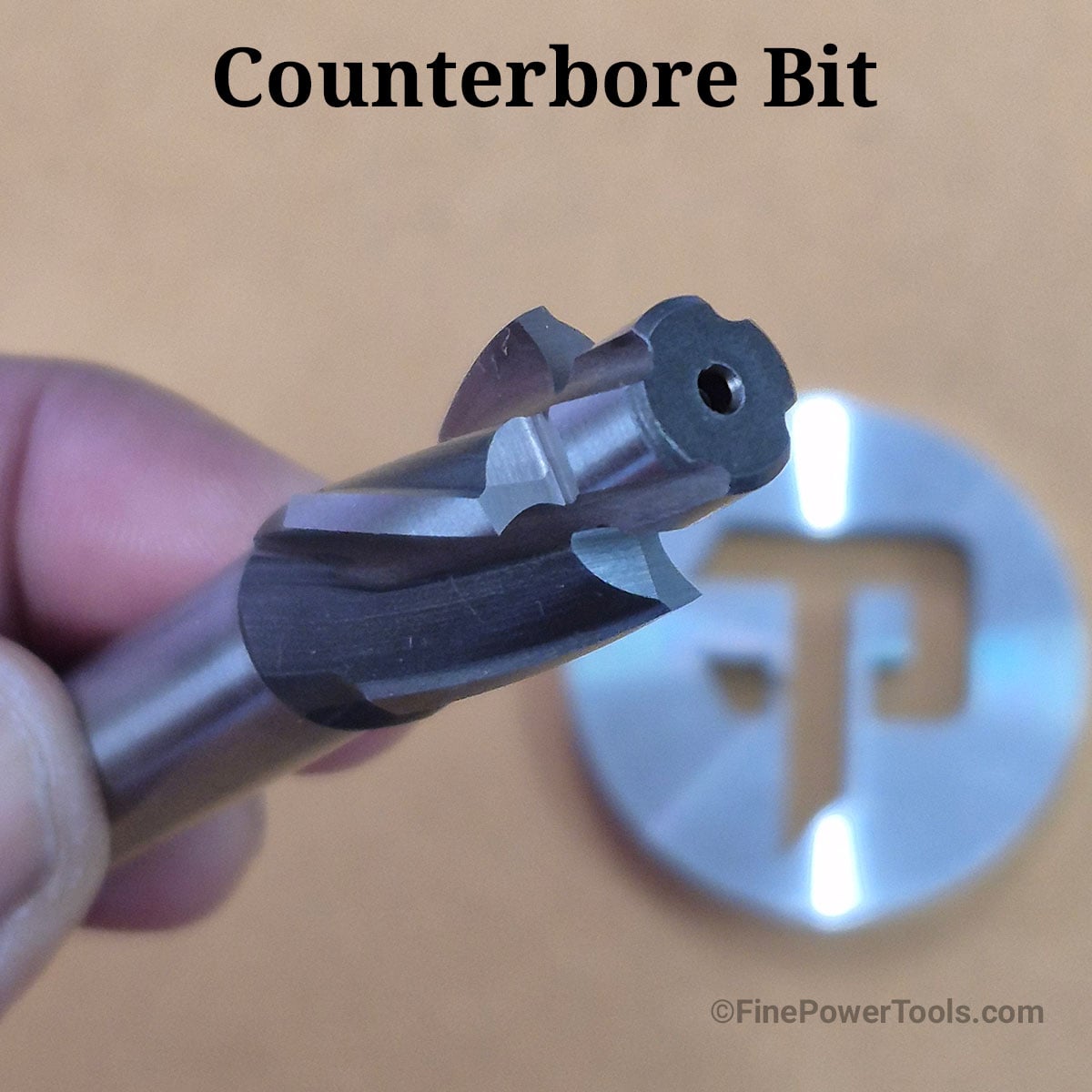
Where a countersink creates a conical recess for a flat-head screw, a counterbore creates a cylindrical, flat-bottomed recess for a bolt or cap-head screw to sit fully below the wood surface. The hole has two diameters: a narrow pilot hole at the bottom and a wider flat-bottomed recess at the top, sized exactly to accept the bolt head or a wooden plug. It’s the right tool when you need structural fasteners hidden under a plug in furniture, workbenches, and timber frames.
Best Used For: Recessing bolt heads, cap screws, and barrel nuts in furniture joinery and structural timber connections.
Works With: Cordless Drill, Corded Drill, Drill Press.
Pro Tip: Drill the counterbore first, then the through-hole it’s far easier to centre a smaller bit inside an existing flat-bottomed recess than to line up the counterbore over a pre-drilled hole.
6. Center Drill Bit
Also Known As: Slocombe Drill, Combined Drill and Countersink

The centre drill is a short, stubby bit used in lathe and machine tool work. Its job is not to drill the finished hole. Its primary use it to create a precise conical portion that a lathe’s tailstock centre seats into, holding the workpiece between centres for turning. The short body avoids deflection during drilling, ensuring the starting point is exactly where you need it. It also doubles as a countersink for machine screw heads in precision metalwork. It is not a general-purpose workshop bit ; it belongs on the lathe bench.
Best Used For: Starting holes precisely on a lathe, creating tailstock centre holes, and countersinking for machine screws in precision metal fabrication.
Works With: Lathe (primary use), Drill Press, Milling Machine.
Pro Tip: I sometimes use center drill for spotting. I know you do it too. But you shouldn’t use a centre drill as a substitute for a spot drill in CNC work. The two look similar but serve different purposes, which I will explain below..
7. Spot Drill Bit
Also Known As: Spotting Drill, NC Spot Drill
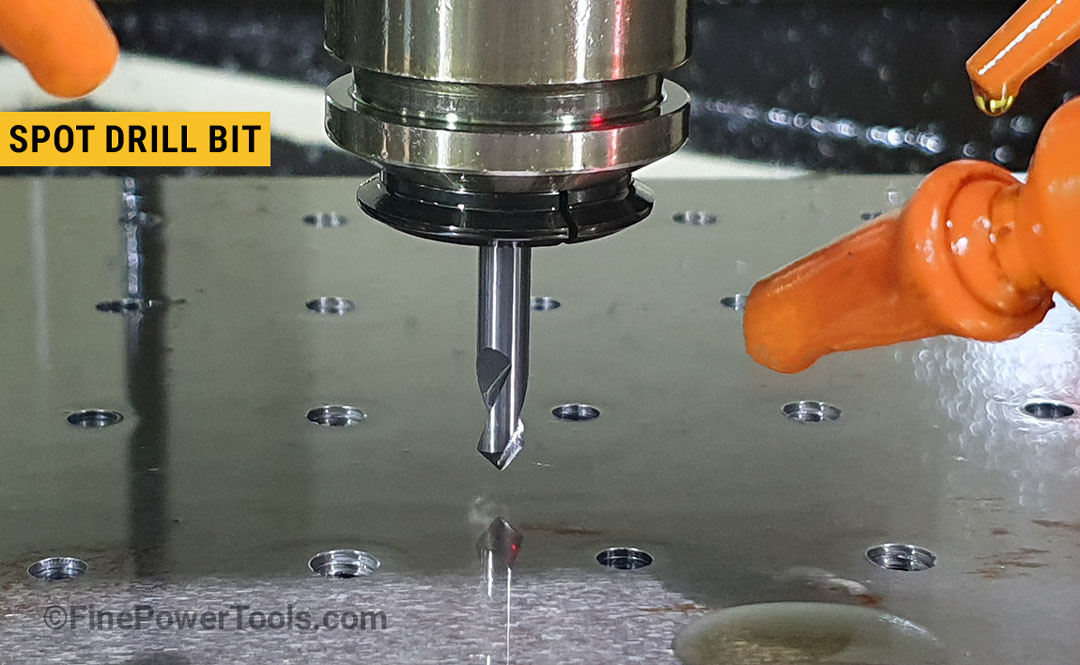
The spot drill’s sole purpose is to create a precise, shallow conical dimple on a metal surface that guides a twist drill exactly where you want it, preventing wander. It is shorter and stiffer than a centre drill, with a wider included angle (typically 90° or 120°), making it better suited to spotting than to true centre-drilling. On a drill press or CNC machine, you spot first, then drill every time. Okay, unless you use a split point bit.
On a handheld drill working with a centre punch, it’s less critical, but on any precision or repetitive metal work it is the difference between holes in the right place and holes that have drifted.
Best Used For: Accurately locating drill entry points on metal before drilling with a twist bit, especially on CNC machines, drill presses, and any precision metalwork.
Works With: Drill Press, Milling Machine, CNC Machining Centre. Can be used with a Cordless or Corded Drill on a guide.
Pro Tip: As you know by now, the spot drill is not a substitute for a centre drill on lathe work. Their tip angles differ, and using a spot drill to create a tailstock centre point will give you a poor fit and poor support.
When drilling large holes in thick structural steel, a standard twist bit can be slow and prone to overheating. An annular cutter is built to handle the job faster and more efficiently.
8. Annular Cutter
Also Known As: Mag Drill Bit, Core Cutter, Rota-Broach Cutter, Slugger Bit, Broach Cutter
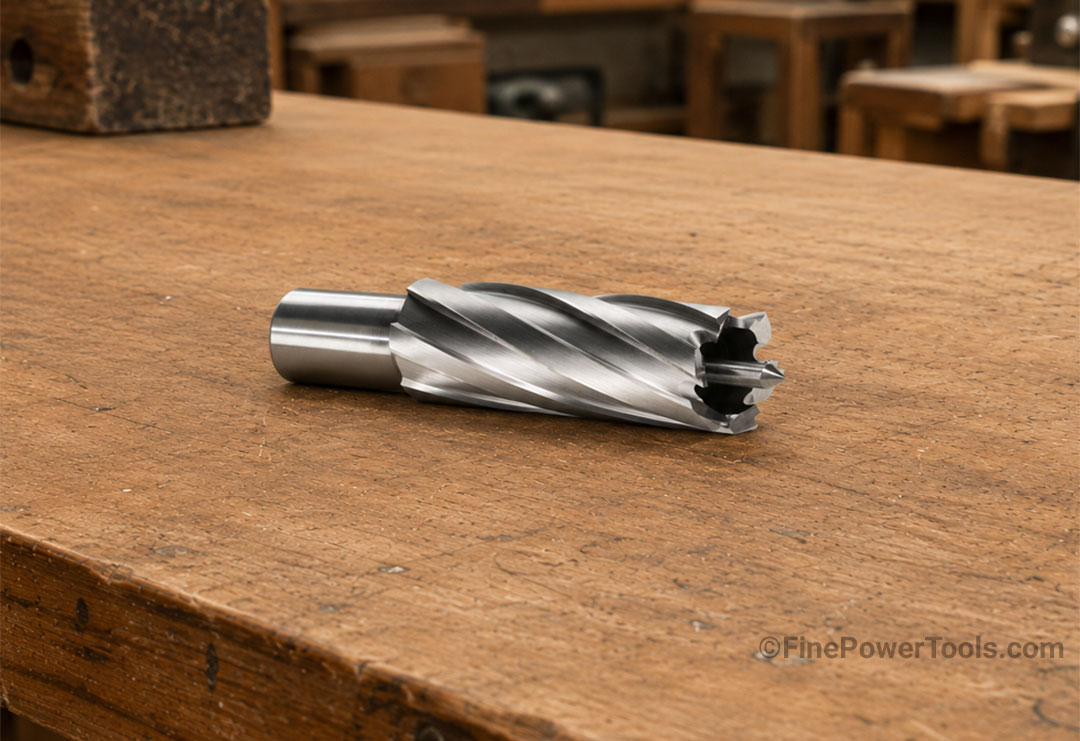
The annular cutter is a hollow, cylindrical cutting tool that cuts only the perimeter of a hole, leaving a solid slug at the centre. That hollow design is what sets it apart: because it removes only a thin ring of material rather than the entire disc, it requires dramatically less power, generates less heat, and cuts three to four times faster than a twist drill at equivalent diameters. The result is a clean, burr-free hole in one pass and no pilot hole required. It is used with a magnetic drill press (which clamps magnetically to the steel workpiece) or a milling machine, and the workpiece must be securely fixed. Standard in structural steel fabrication, it’s the right tool any time you need a clean, large-diameter hole in thick metal plate.
Best Used For: Clean, large-diameter holes in structural steel, mild steel, stainless steel, and cast iron in fabrication, construction, and industrial maintenance.
Works With: Magnetic Drill Press (primary), Milling Machine, Drill Press (with arbor adapter).
Pro Tip: Always use cutting paste or coolant. If not, the pilot pin at the centre can run dry and can get heated up due to friction and seize. A seized pilot pin in a mag drill mid-cut is a frustrating job to recover.
Have you ever worked on automotive or sheet metal restoration and spent half your time removing old fasteners? A rivet drill bit makes it easier to remove broken rivets without damaging or enlarging the original hole.
9. Rivet Drill Bit
Also Known As: Rivet Bit, Aircraft Drill Bit (in aerospace context)
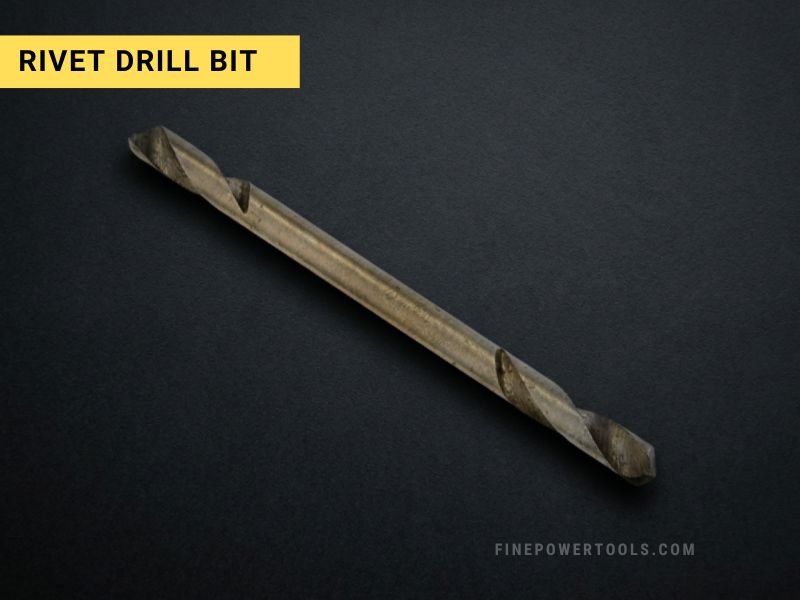
A rivet bit is a short, stiff twist drill precision-ground to produce clean, accurately sized holes for rivets in metal fabrication and sheet metal work. Rivet holes need to be exact. Too large and the rivet won’t clench properly; too small and it won’t seat. Most rivet bits are made from HSS or cobalt and are sized in numbered drill sizes (e.g. #30, #40) that correspond directly to standard rivet diameters. In aerospace and structural applications, they are often carbide-tipped for the tight tolerances and volume of holes involved.
Best Used For: Drilling rivet holes in sheet metal, aircraft structures, automotive bodywork, and metal fabrication where hole diameter precision is critical.
Works With: Cordless Drill, Corded Drill, Drill Press. Pneumatic Drill in professional sheet metal and aerospace applications.
Pro Tip: Use a centre punch or spot drill first. Rivet holes that wander even slightly misalign the joint and weaken the finished assembly.
📌 Related: Difference between metal vs. wood drill bits
As a DIY enthusiast, you may often need to drill through tile or brick walls. It’s easy to assume that bits that are hard enough for metal should handle masonry too. But that’s not the case. Masonry and tile need specialized drill bits to penetrate these tough materials.
Category 4: Masonry & Tile Bits
Masonry and tile are unforgiving. Drill into them with the wrong bit and you’ll either shatter the surface or burn out the tool. Every bit in this category is built for hard and abrasive materials and the tool you pair them with matters just as much as the bit itself.
1. Masonry Bit
Also Known As: Concrete Drill Bit, Brick Drill Bit, Carbide-Tipped Masonry Bit

The masonry bit is the standard tool for drilling into brick, block, concrete, and natural stone. Its defining feature is the brazed tungsten carbide tip hard enough to fracture the aggregate in concrete with each hammer blow. The bit doesn’t cut in the traditional sense; it pulverises the material through a combination of rotation and percussion. For soft brick and mortar, a standard hammer drill does the job. For reinforced concrete and dense stone, you need a rotary hammer with an SDS bit (see Category 6). Using a masonry bit in rotation-only mode without hammer action is slow, ineffective, and destroys the tip fast.
Best Used For: Drilling anchor holes, fixing plugs, and running pipes and cables through brick, block, concrete, and stone walls and floors.
Works With: Hammer Drill (for brick, block, and soft masonry), Rotary Hammer Drill with SDS shank (for reinforced concrete and hard stone). Light-duty use possible with a standard Cordless Drill in hammer mode.
Pro Tip: If you hit a pebble or aggregate that stops the bit dead, don’t force it. Instead, switch to hammer-only mode for a few seconds to break through it, then resume normal drilling.
2. Tile / Lance-Tip Bit
Also Known As: Arrow-Tip Bit, Spear-Point Tile Bit, Glass and Tile Bit, Carbide Tile Bit
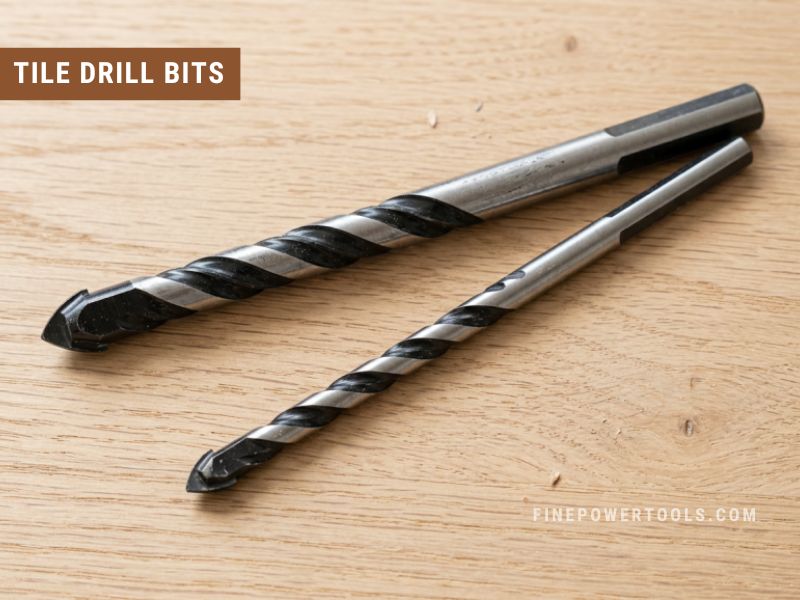
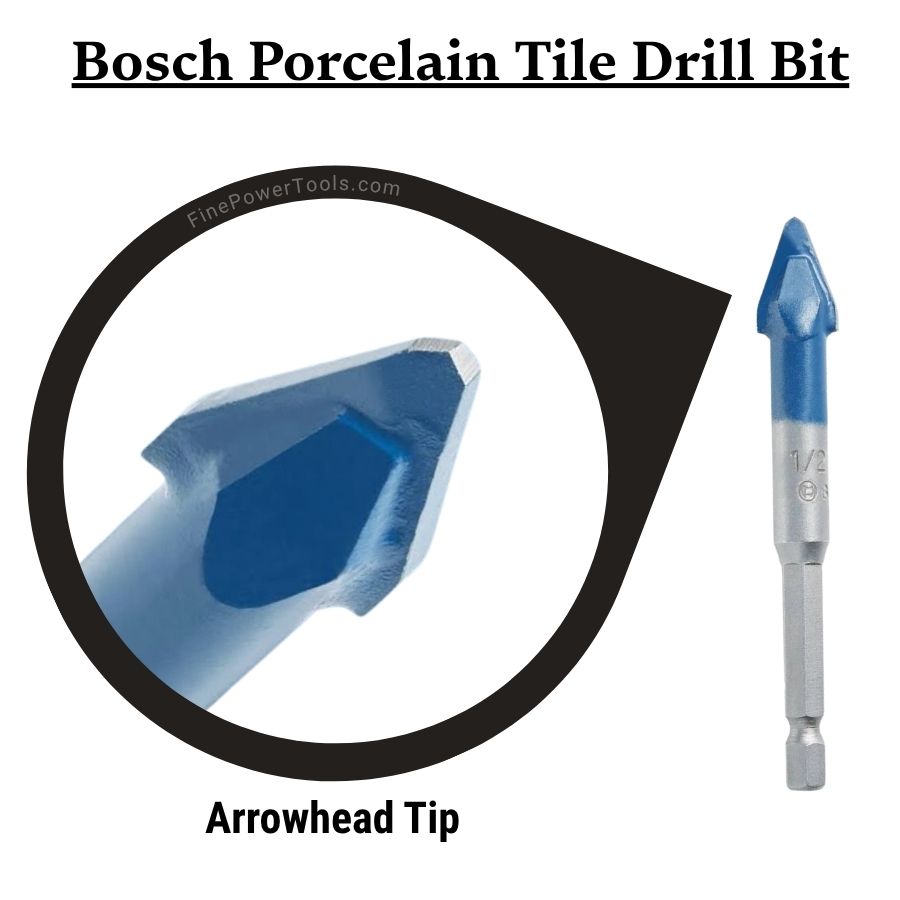
The lance-tip bit has a distinctive arrowhead-shaped tungsten carbide tip that scores and grinds through ceramic tile, glass, and soft stone without shattering them. It works by grinding rather than cutting. The arrow or spear geometry bites into the glaze, scores a clean circle, and works progressively inward. It handles ceramic wall tiles, unglazed terracotta, slate, marble, and glass well. For porcelain -which is significantly denser and harder- regular glass and tile bits fall short. Porcelain demands a diamond bit or dedicated ones like the Bosch Hex-9 bit which has a patented asymmetric cutting edge design.
The single most important rule with any tile bit: never use hammer mode. One hammer blow on ceramic or porcelain shatters the tile instantly.
Best Used For: Drilling through ceramic wall tiles, glass, terracotta, slate, and marble for fixings, pipe entries, and electrical outlets.
Works With: Cordless Drill or Corded Drill in rotation-only mode. No hammer function. Ever.
Pro Tip: Start at a 45° angle to score a small notch in the glaze first. This stops the bit skating across the smooth surface, then bring the drill upright to 90° and drill through.
Lance-tip bits and arrowhead carbide-tip bits are a good choice for small holes in tile. But when you need a larger opening for a plumbing pipe or shower drain, you’ll want to reach for a diamond core bit.
3. Diamond Core Bit
Also Known As: Diamond Drill Bit, Diamond Core Drill, Wet Core Bit, Diamond Hole Saw
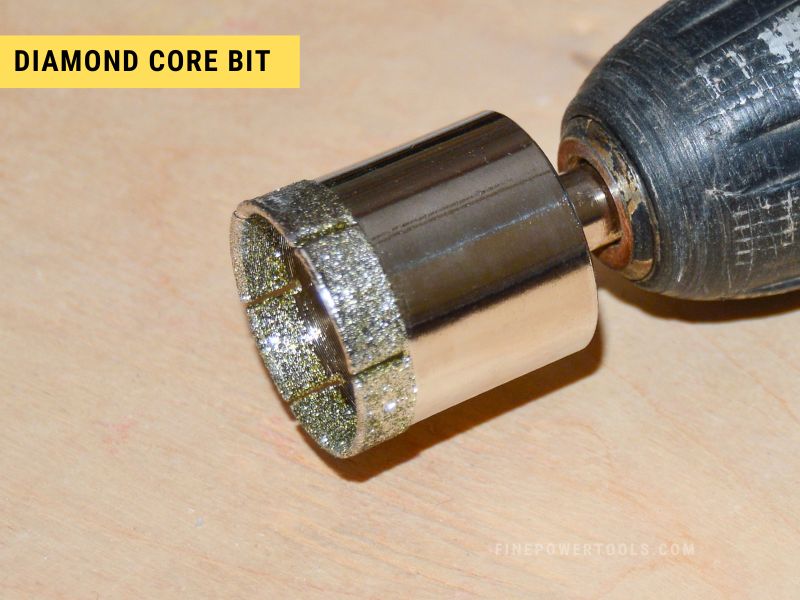
Where carbide grinds, diamond dominates. The diamond core bit is a hollow cylinder with industrial diamond grit bonded to its rim. Diamond, being the hardest material on earth, grinds through porcelain, granite, reinforced concrete, and natural stone with a clean, precise edge that no other bit can match.
Two types of core bits are, wet core bits that require a continuous water feed for cooling, and vacuum-brazed dry bits that use wax or air cooling for smaller diameter holes. Water cooling is essential on larger diameters. If you run a wet bit dry and you’ll burn through the diamond bond in minutes.
Best Used For: Holes in porcelain tile, granite countertops, natural stone, glass block, and dense concrete. Basically, anywhere carbide fails or chips the surface.
Works With: Cordless Drill or Corded Drill (smaller dry bits), Core Drill Machine (larger wet bits), Drill Press. Always rotation-only and bever use hammer mode.
Pro Tip: Never start a diamond core bit flat against a smooth tile surface, it will skate. Tilt it to 45° to score a starting notch first, then bring it to 90°, the same technique as the lance-tip bit.
4. Glass / Spear-Point Bit
Also Known As: Glass Drill Bit, Spear-Point Glass Bit, Arrow-Head Bit
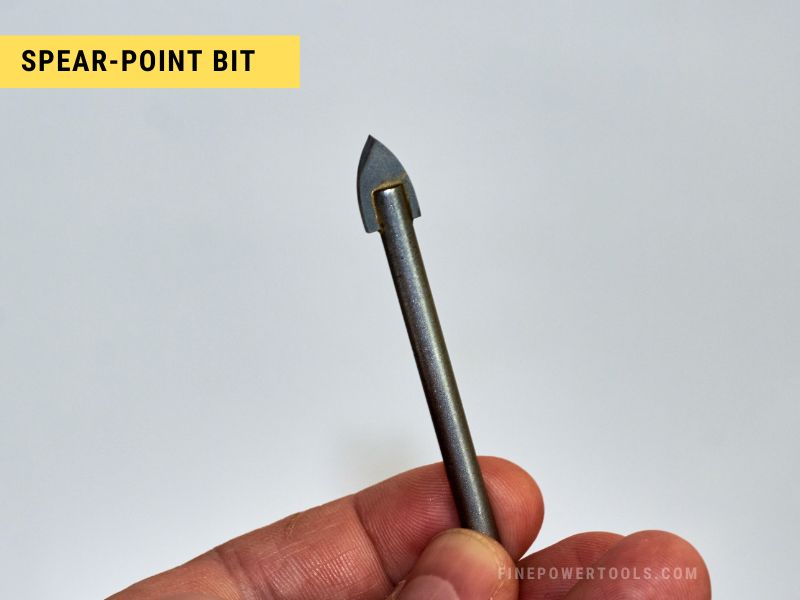
The glass bit is a close cousin of the tile lance-tip bit, but optimised specifically for glass, mirrors, and glazed surfaces. The tungsten carbide spear-tip grinds through glass by scoring and abrading rather than cutting. So, any sudden shock or excessive heat will crack or shatter the glass before the bit exits. That means slow speed, light pressure, and cutting fluid throughout. A small dam of plumber’s putty or modelling clay around the entry point holds a pool of water or cutting oil directly over the hole, providing constant cooling and flushing away glass dust that would otherwise score the surface.
Best Used For: Drilling holes in glass panes, mirrors, glass blocks, glazed ceramics, and glass bottles for fixings, cable entries, and decorative purposes.
Works With: Cordless Drill or Corded Drill at low speed, rotation-only. No hammer mode.
Pro Tip: Build a small putty dam around your drill mark and fill it with water before you start. That should keep the tip cool, and would reduce the risk of cracking the glass while drilling.
Next let’s see non-conventional bits.
Category 5: Specialty Drill Bits
These bits solve problems that general-purpose and material-specific bits can’t. Each one is purpose-built for a specific situation; when you need one, nothing else will do.
1. Installer Bit
Also Known As: Bell Hanger Bit, Cable Installation Bit, Flex Bit, Fish Bit
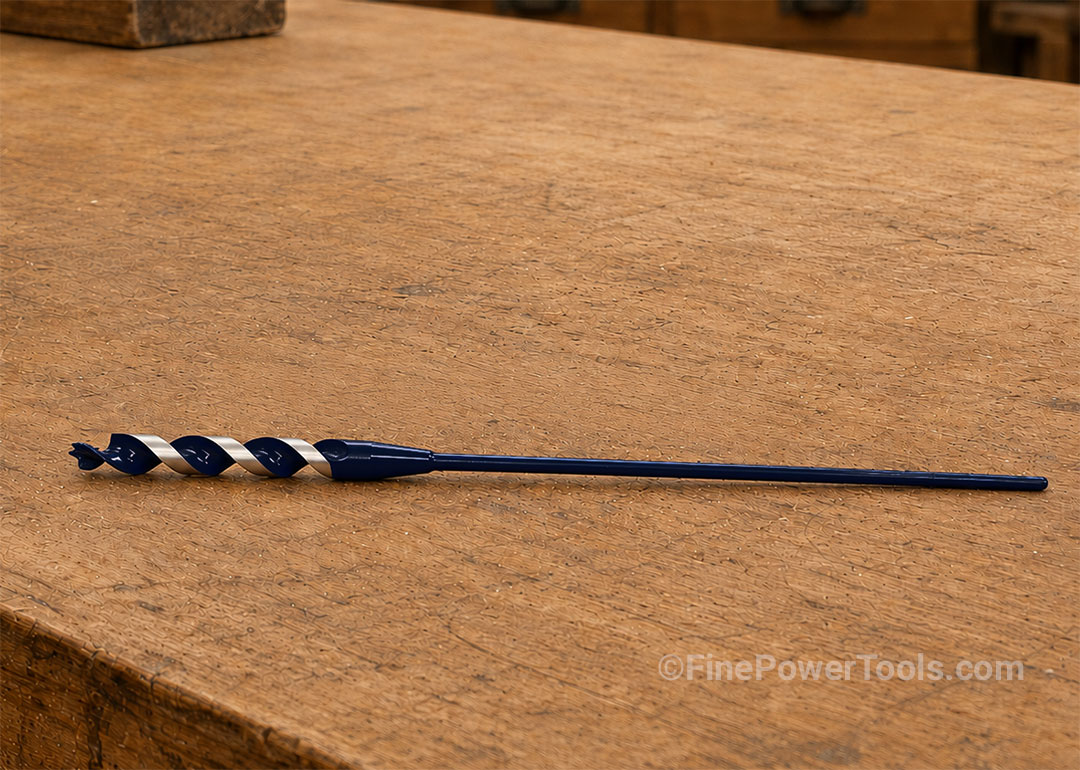
The installer bit is the electrician’s and plumber’s secret weapon for retrofit and renovation work. It comes in two forms: a long, rigid version for drilling through timber framing and joists in straight runs, and a flexible spring-steel shaft version that bends around obstacles inside wall and ceiling cavities without tearing open drywall or plaster. Most versions have a small hole near the tip; once the bit breaks through, you feed wire or cable into that hole and pull it back through the wall as you withdraw the bit. One operation: drill and fish the wire simultaneously.
Best Used For: Running electrical cable, data cable, and plumbing through finished walls, ceilings, and structural timbers without demolition.
Works With: Cordless Drill, Corded Drill. The flexible variant requires a slow, steady hand and never force it.
Pro Tip: With the flexible version, drill in short bursts and let the bit find its path. Forcing it straight causes the shaft to kink and snap at the bit-to-shank junction, which is the single most common failure point.
2. Self-Centering Bit (Vix Bit)
Also Known As: Vix Bit, Hinge Bit, Spring-Loaded Centering Bit

The Vix bit, named after its original Minnesota manufacturer, S.E. Vick Tool Co., solves one of woodworking’s most frustrating problems: getting pilot holes perfectly centred in hinge and hardware screw holes. A spring-loaded tapered nose seats precisely into the countersunk screw hole of any hinge or hardware plate, self-centring the bit automatically.
Press down, drill, and the pilot hole is dead centre every time. There is no need for marking, no punching, no guesswork. A built-in depth stop prevents drilling through. It seems like a small thing until you’ve ruined a cabinet door with an off-centre hinge hole.
Best Used For: Drilling perfectly centred pilot holes for hinges, strike plates, drawer slides, cabinet hardware, and any hardware with countersunk screw holes.
Works With: Cordless Drill, Corded Drill.
Pro Tip: The bit only self-centres when the nose cone is fully seated and the drill is held square. If you start the drill before the cone is seated and it will walk off-centre just like any other bit. Seat first, then squeeze the trigger.
3. Cone Drill Bit
Also Known As: Cone Cutter, Tapered Drill Bit
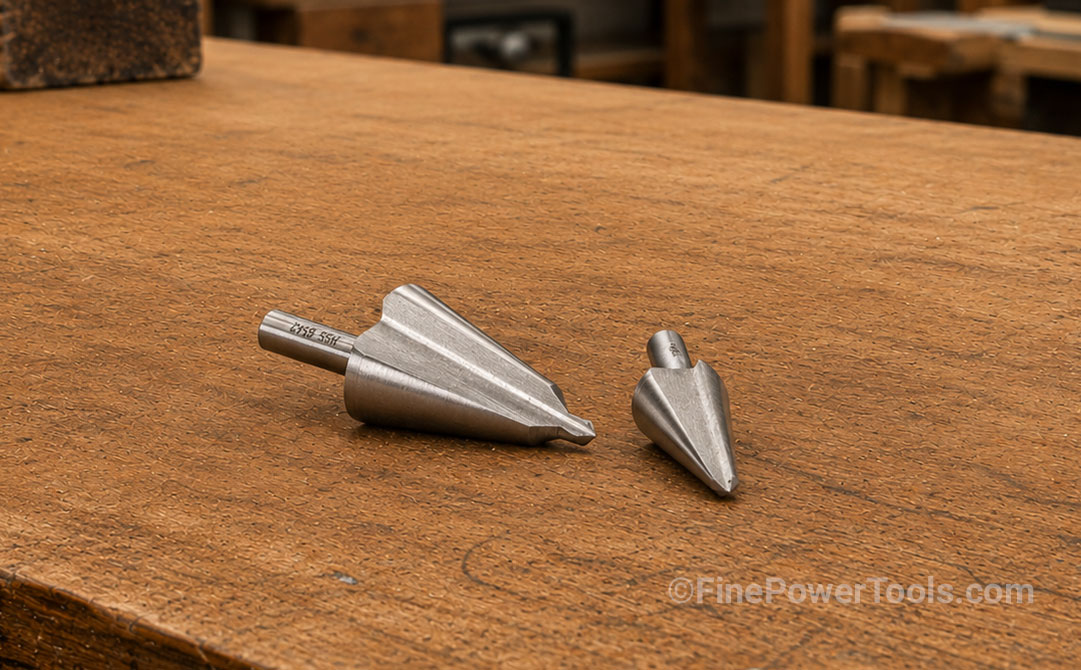
The cone drill bit looks like a smooth, unstepped version of a step bit. Instead of stepped diameters, it has a continuously sloped conical shape with no tiered steps. Where a step bit gives you discrete, fixed hole diameters (each step a specific size), the cone bit cuts a hole that widens gradually and infinitely as you drill deeper. That makes it the right choice when you need an exact hole size that falls between step increments, or when you’re reaming and enlarging an existing hole to a precise diameter. It’s also useful for deburring and chamfering the edges of pre-drilled holes in sheet metal.
The tradeoff: without stepped stops, it’s easy to overdrills. So lift the bit frequently to check hole size.
Best Used For: Cutting or enlarging holes to exact sizes not covered by step bit increments, deburring sheet metal holes, and chamfering the edges of drilled holes.
Works With: Cordless Drill, Corded Drill, Drill Press.
Pro Tip: Check the hole diameter frequently as you drill. The cone’s continuous taper offers no natural stopping point, and it’s very easy to go too deep without noticing.
4. Combination Drill Bit (Drill + Tap)
Also Known As: Drill and Tap Bit, Combi Tap Bit, Thread Drill Bit, 3-in-1 Tap Bit
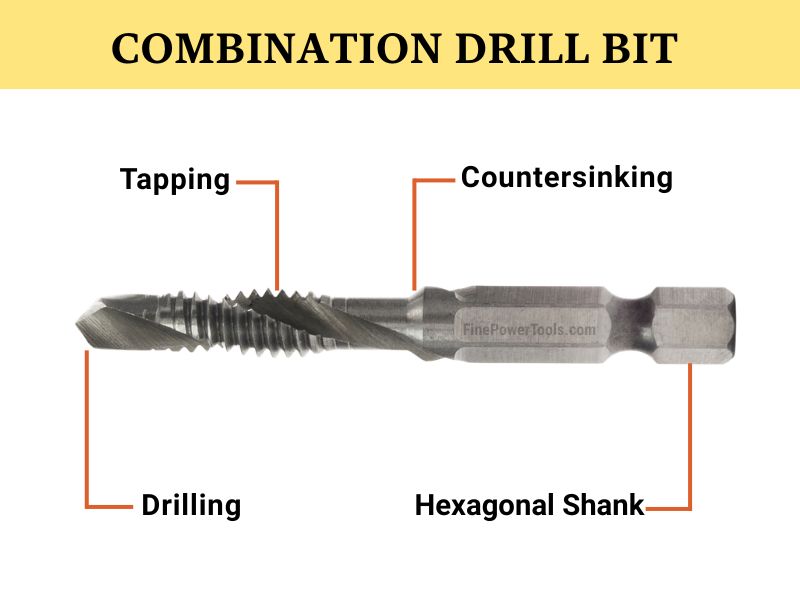
The combination drill and tap bit does three operations in a single pass: drills the core hole, cuts the internal thread, and countersinks or deburrs the entry edge; all without removing the bit or changing tools. The tip section drills the pilot hole, the mid-section cuts the thread as the bit advances, and the upper section chamfers the entry. It works in steel, aluminium, brass, copper, and plastic up to about 600 N/mm² tensile strength.
Combination bits are best suited to thin stock. Most manufacturers recommend material no thicker than 1× the thread diameter for reliable thread quality. Available in standard metric (M3 to M10) and imperial sizes. It is a genuine time-saver on repetitive tapping jobs, but not a replacement for dedicated taps in precision or deep-thread applications.
Best Used For: Tapping threaded holes in thin sheet metal, electrical enclosures, brackets, and general metalwork where speed matters more than precision thread depth.
Works With: Drill Press. You can also use a cordless drill with adjustable torque and reversing function. Not suitable for use with an impact driver.
Pro Tip: Ensure when drilling tough material like steel, the thickness is less than the drill section of the bit; otherwise, the tapping threads will engage before the hole is fully drilled, causing the bit to snap. Always reverse the bit out slowly after threading and let the thread track itself out.
So far, we’ve focused on choosing a bit based on the type job and type of material to be drilled. But there’s more to a drill bit than its cutting tip design and material.
The shank determines how it fits in the drill, while the coating can affect its durability and performance.
Let’s take a closer look at the drill bit shank types first.
Category 6: By Types of Shank
The shank is the back end of the drill bit, the part that goes into the chuck. It determines which tools the bit is compatible with, how much torque can be transferred without slipping, and how much hammer energy reaches the cutting tip. Getting the shank wrong means the bit either won’t fit, or it might not be held properly and then slip, or even cause breakage.
1. Straight Shank
Also Known As: Round Shank, Cylindrical Shank
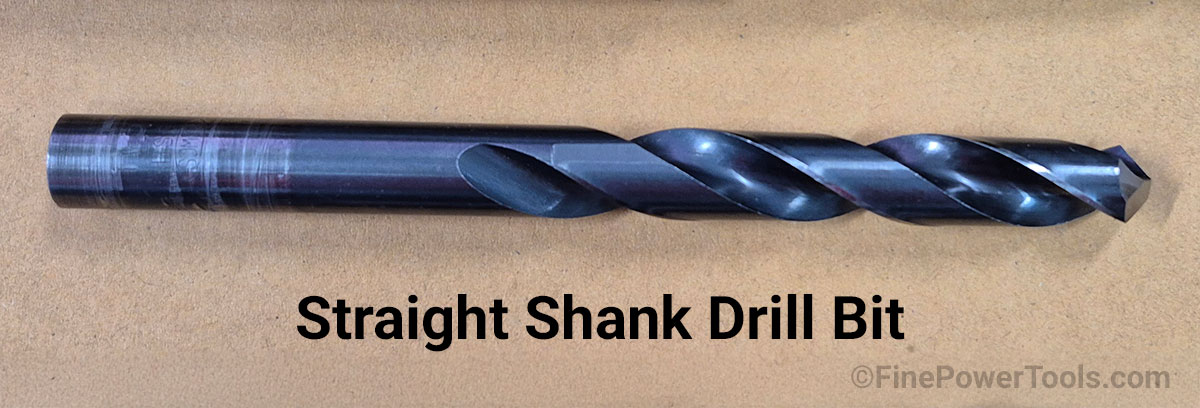
The straight shank is the standard and most commonly used one. It has a uniform cylindrical diameter from end to end, gripped by the three jaws of a standard keyless or keyed chuck. It fits virtually every drill on the market and covers the overwhelming majority of twist bits, wood bits, and smaller specialist bits. Its one limitation: under very high torque (large Forstner bits, big spade bits, step bits in thick steel), the jaws can lose grip and the bit spins in the chuck. When that happens, the answer is a hex shank.
Works With: Cordless Drill, Corded Drill, Drill Press or any tool with a standard 3-jaw drill chuck.
Pro Tip: If a straight shank bit keeps spinning under heavy load, wipe the shank with a clean rag before re-chucking. Oil or swarf on the shank is often the culprit.
2. Hex Shank
Also Known As: ¼” Hex Shank, Quick-Change Shank, Impact Shank
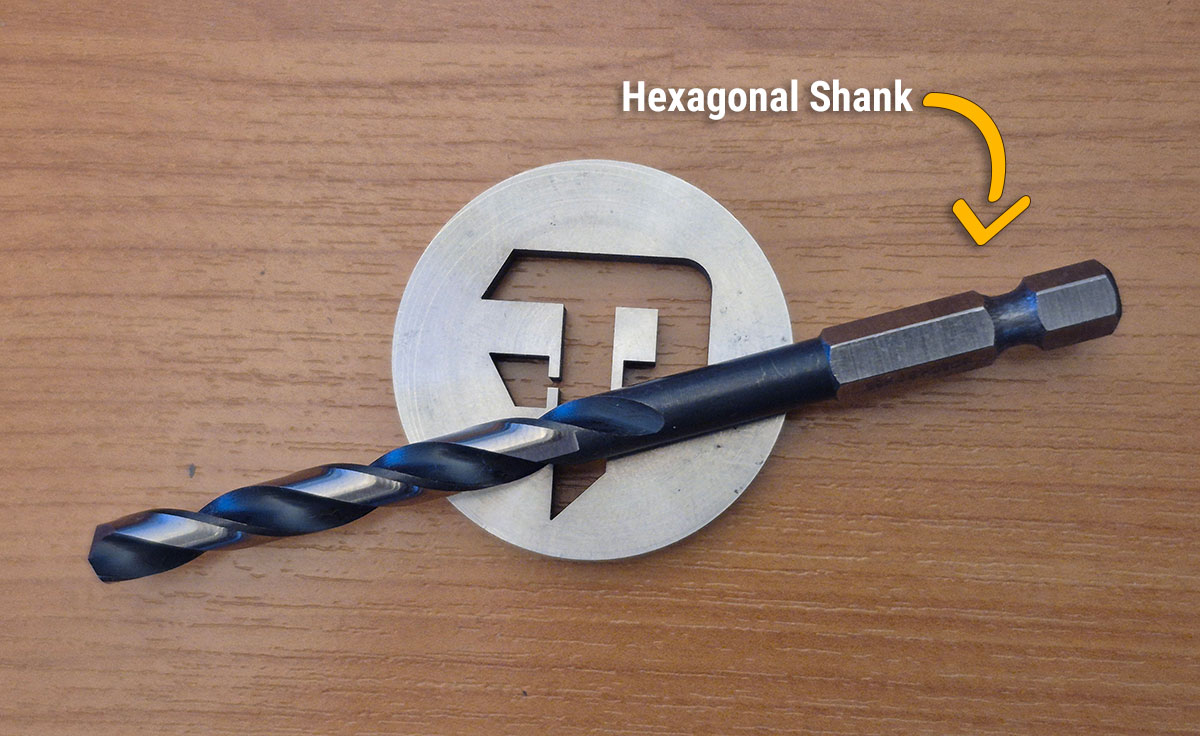
The hex shank has six flat sides ground along its length, typically to a ¼” across-flats dimension. That hexagonal profile locks into a quick-change chuck like the one found in impact drivers. Gripping on the 6 flats ensures that it cannot rotate inside it and no slipping under torque, no tightening required. It’s the standard shank on screwdriver bits, and increasingly common on drill bits, hole saws, countersinks, and step bits designed for use with cordless impact drivers and quick-change systems.
Note: Not all hex shank bits are impact-rated. Check the packaging if you intend to use them in an impact driver at high settings.
Works With: Impact Driver, Cordless Drill with quick-change chuck, Drill Press with hex collet. Fits any tool with a ¼” hex receiver.
Pro Tip: “Hex shank” and “impact-rated” are not the same thing. A non-impact rated hex bit in a heavy impact driver can snap under excessive torque. Look for bits specifically marked as impact-rated for impact driver use.
3. Taper Shank (Morse Taper)
Also Known As: Morse Taper Shank, MT Shank, Reduced Taper Shank
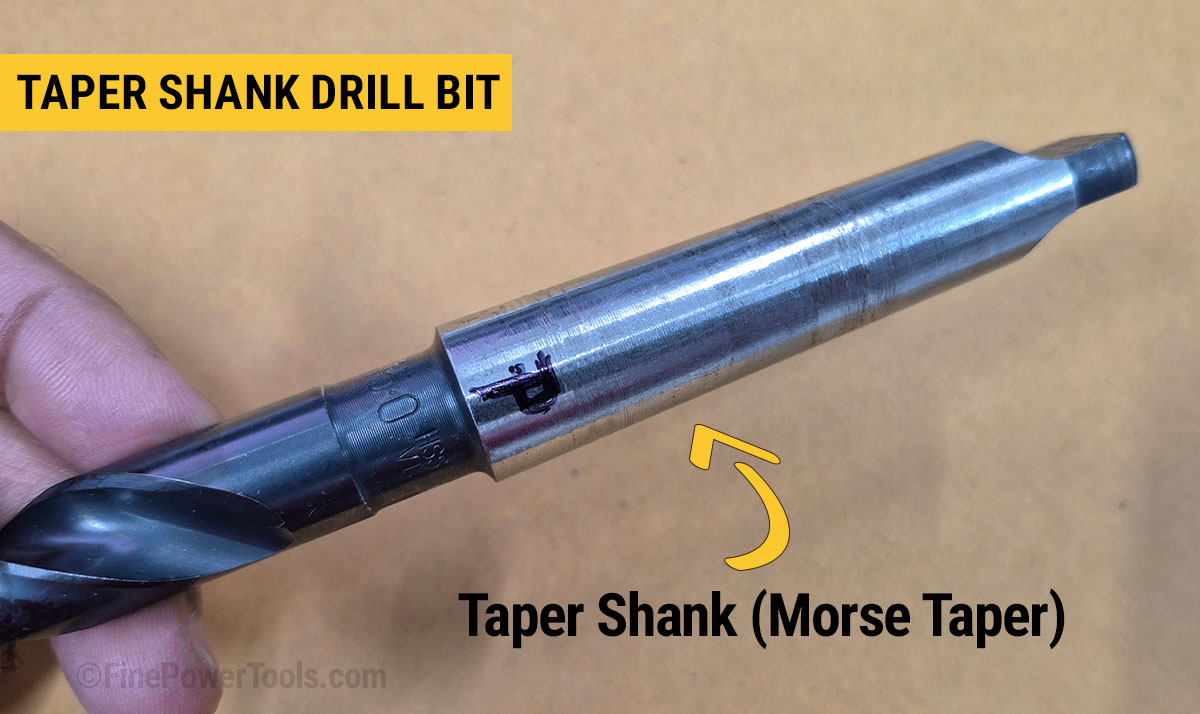
The Morse taper shank is a smooth, gently tapered cone -invented by the same Steven Morse who designed the twist drill bit- that seats directly into the matching tapered socket of a drill press spindle, lathe tailstock, or milling machine. The self-holding taper locks through friction alone: the harder you push, the tighter it holds. No chuck jaws needed. It’s the standard shank for large-diameter twist bits above 13 mm (½”), where the torque loads are too great for a standard 3-jaw chuck to hold reliably. Seven taper sizes exist (MT0 to MT7), with MT1, MT2, and MT3 covering most workshop drill bits.
Works With: Drill Press with Morse Taper spindle, Lathe (tailstock), Milling Machine. Requires a drawbar or drift key to eject the bit.
Pro Tip: Always clean both the taper shank and the spindle socket before inserting. Any dust or oil between them reduces the friction grip and the bit can spin or pull out under load.
4. SDS-Plus Shank
Also Known As: SDS+, Slotted Drive System Plus
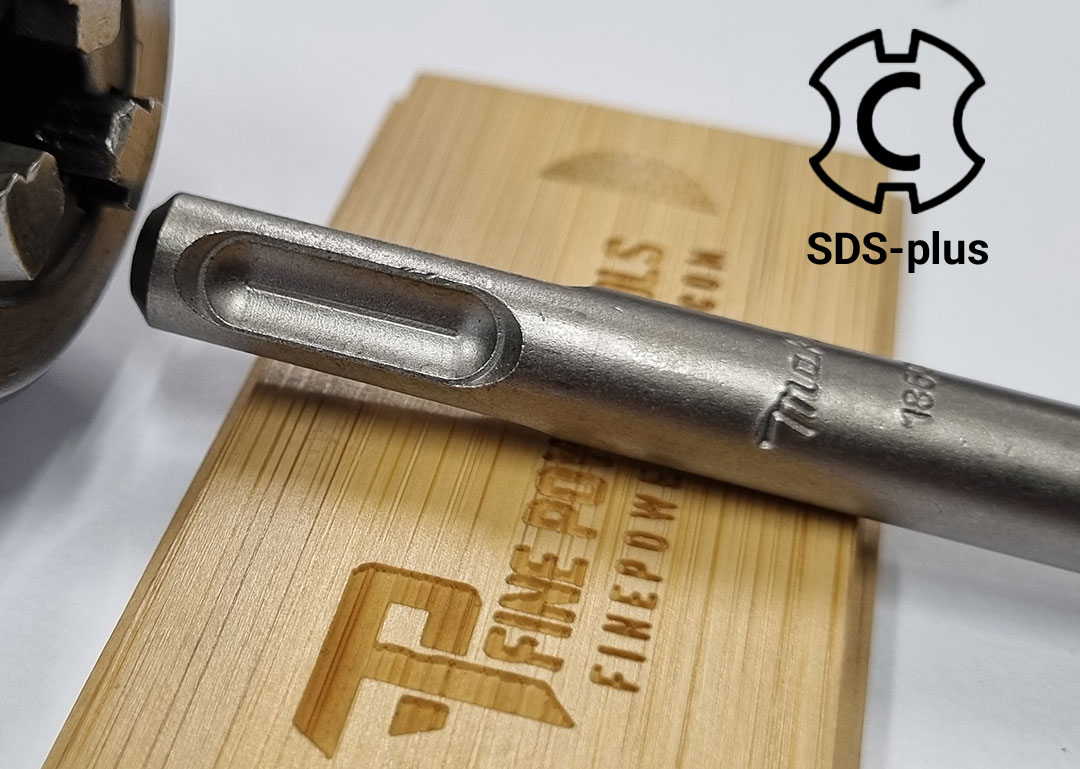
SDS-Plus is the trade standard for rotary hammer drill bits up to around 26 mm diameter (approximately 1-inch). The shank diameter is fixed at Ø10 mm which fits the rotary hammer chuck.
The SDS-plus shank has four slots; two open (for the locking balls to engage) and two closed (for the drive lugs to transfer rotation). Unlike a regular drill chuck the bit is not clamped rigid: it slides axially inside the chuck, absorbing and transmitting hammer blows directly to the cutting tip without the energy being wasted through the chuck jaws. That piston action is what makes rotary hammers so dramatically faster than standard hammer drills in concrete.
SDS-Plus is not compatible with SDS-Max.
Works With: SDS-Plus Rotary Hammer Drill only.
Pro Tip: A drop of grease on the SDS-Plus shank before insertion extends both bit and chuck life. The shank slides thousands of times per minute, and running it dry accelerates wear.
5. SDS-Max Shank
Also Known As: SDS-Max, SDS MAX
SDS-Max steps up from SDS-Plus for heavy-duty rotary hammers and demolition work. The larger 18 mm shank has five slots; three open, two closed. This allows greater piston travel, which means each hammer blow hits harder.
It’s designed for machines delivering 5 joules of impact energy or more, and for bits above 20 mm diameter where SDS-Plus runs out of power. The larger shank engagement also handles the extreme lateral forces generated in demolition work with chisels and breakers. SDS-Max and SDS-Plus are completely incompatible and they will not physically fit each other’s chucks.
Works With: SDS-Max Rotary Hammer Drill and Demolition Hammer only. Not interchangeable with SDS-Plus.
Pro Tip: SDS-Max is overkill for standard wall fixings. The extra weight and power become liabilities in confined spaces. Reserve it for reinforced concrete, deep core drilling, and demolition.
6. Spline Shank
Also Known As: Spline Drive, Spline Bit
The spline shank predates SDS-Max and uses 12 serrated teeth (splines) around the circumference of a 19 mm shank to engage with a matching spline chuck. It was developed by Bosch and Hilti for heavy-duty rotary hammer work and was the professional standard before SDS-Max arrived. SDS-Max was designed to largely supersede it, offering better piston travel and efficiency, but spline systems remain in use and are still manufactured for contractors with existing spline-chuck equipment. Spline and SDS-Max are not interchangeable, though aftermarket adapters exist.
Works With: Spline Drive Rotary Hammer Drill only. Not compatible with SDS-Plus or SDS-Max without an adapter.
Pro Tip: If you’re buying new, choose SDS-Max over spline. The tooling ecosystem is larger, more affordable, and better supported by every major manufacturer.
Category 7: By Material / Coating
The material a drill bit is made from or coated with also determines what it can cut, how long it lasts, and how much heat it can handle before the cutting edge softens and fails. This isn’t just a spec sheet detail. Pick the wrong material for the job and you’ll burn through bits in minutes. Pick the right one and the same bit lasts years.
1. Carbon Steel
High-Carbon steel is the most basic drill bit material which is affordable, easy to manufacture. They are adequate for soft materials at low speeds. It loses its hardness quickly when it heats up, which makes it unsuitable for metal or hard materials where friction generates significant heat.
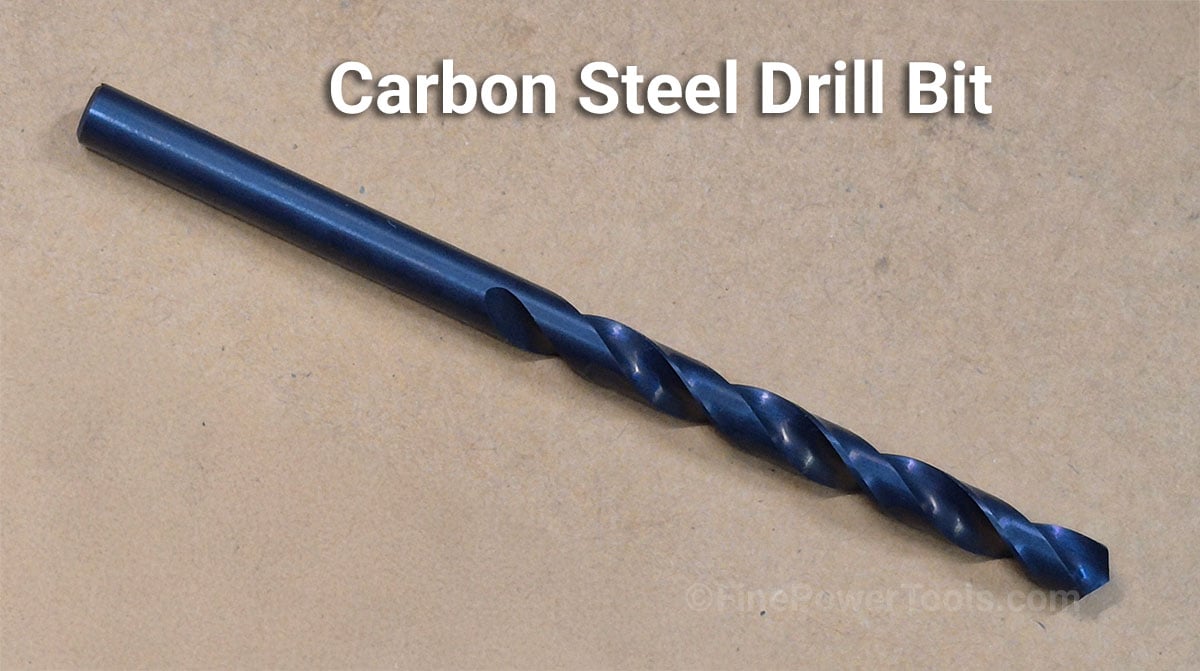
You’ll find carbon steel bits in budget sets and in specialised applications like plug cutters and hand-tool bits where speeds are low and materials are soft. For anything harder than pine or thin plastic, step up to HSS.
Best Used For: Softwood, thin plastic, and low-intensity hand-tool applications. Not Suitable For: Metal, hardwood at speed, masonry.
2. HSS (High-Speed Steel)
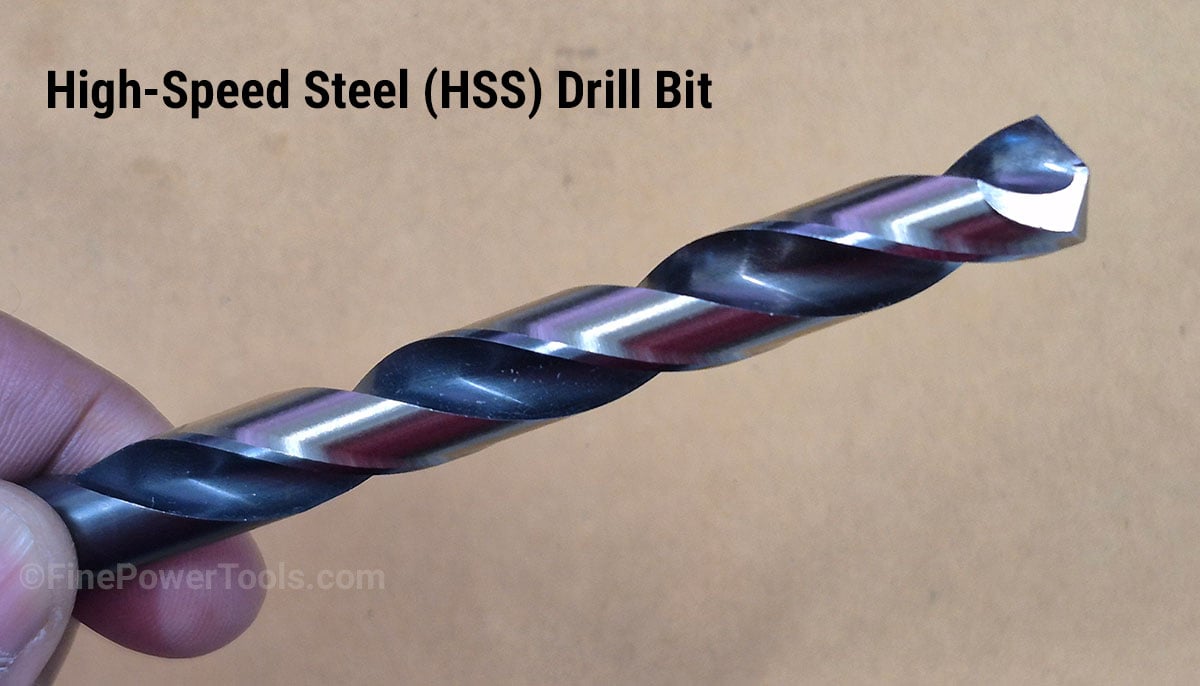
HSS is the baseline for serious drill bits. An alloy of iron with tungsten, chromium, vanadium, and sometimes molybdenum, it holds its hardness up to around 600°F (315°C) which is far beyond what plain carbon steel can handle. That heat resistance is what makes HSS the universal standard for twist bits, brad point bits, step bits, and most general-purpose drilling. Standard HSS handles wood, plastic, aluminium, brass, copper, and mild steel without issue. For stainless steel and harder alloys, move up to cobalt.
Best Used For: Wood, plastic, aluminium, brass, copper, and mild steel. Not Suitable For: Stainless steel, hardened alloys, masonry, or ceramic.
3. Titanium-Coated (TiN / TiAlN / TiCN)
Also Known As: Titanium Nitride (TiN), Gold Bit, Titanium Drill Bit
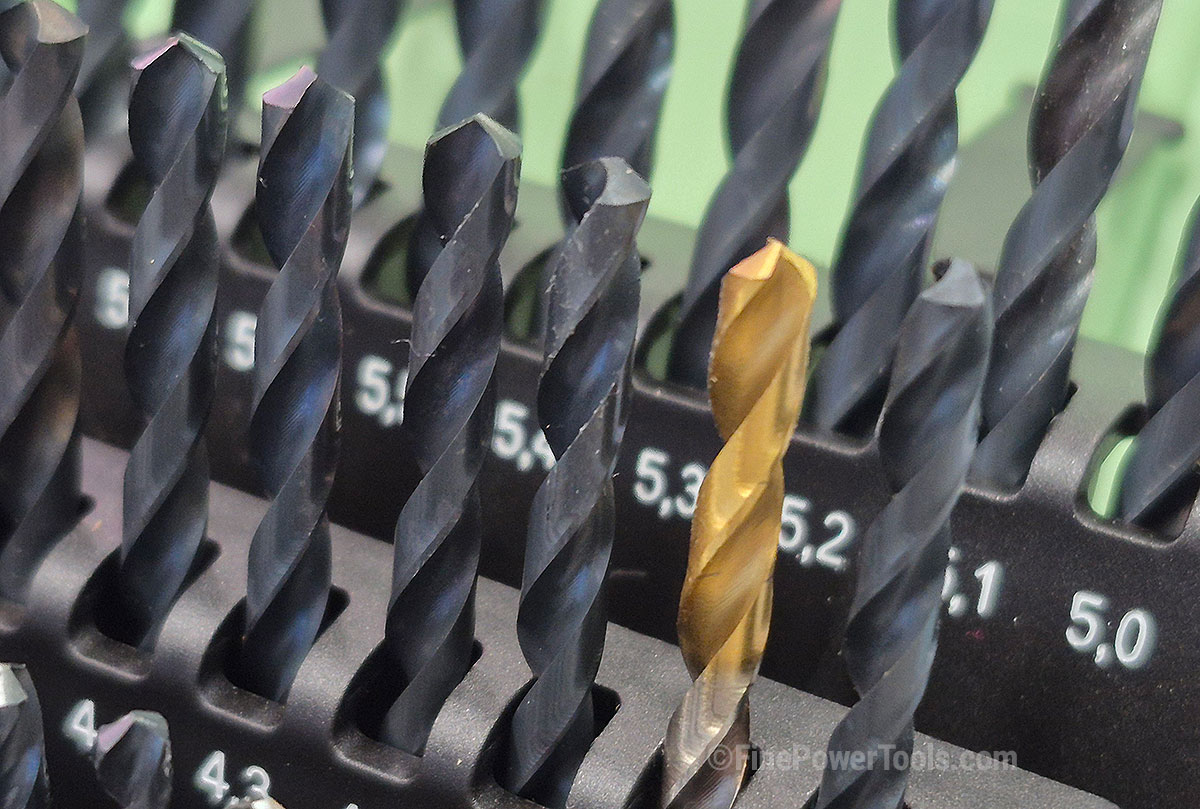
Titanium-coated bits are HSS bits with an extremely thin titanium nitride (TiN) surface coating applied by a PVD process. That gold-coloured coating increases surface hardness, reduces friction, and extends bit life. I have seen manufacturers often cited these bits as lasting up to six times longer than uncoated HSS in comparable applications.
Three popular coatings in the market are:
- TiN: Titanium Nitride (typically golden color)
- TiAlN (titanium aluminium nitride, typically dark grey/violet) and,
- TiCN (titanium carbon nitride, darker grey)
The critical limitation: once the coating wears through, the bit performs like a standard HSS bit.
Best Used For: General metal drilling, wood, and plastic where longer bit life than standard HSS is needed. Not Suitable For: Resharpening (removes the coating), impact drivers (unless specifically rated), masonry.
Pro Tip: The gold colour bit you see is the TiN coating, but not all gold-coloured bits are equal quality. The coating is only as good as the HSS underneath it.
4. Cobalt (HSS-Co)
Also Known As: HSS-Co, M35 (5% cobalt), M42 (8% cobalt), HSSE
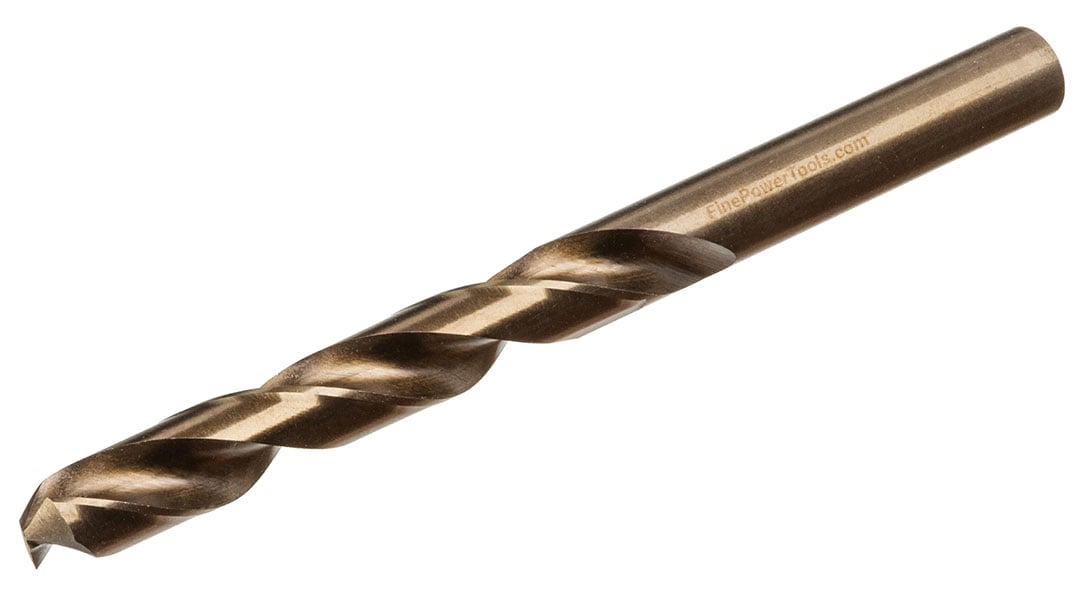
Cobalt bits are HSS alloys with 5% to 8% cobalt added into the steel itself. It’s not a coating, but a through-material upgrade. That cobalt raises hardness to 65–67 HRC (versus HSS at ~62 HRC) and pushes heat resistance well past 1,000°F (538°C). The result is a bit that stays sharp longer at the higher temperatures generated when cutting stainless steel, cast iron, titanium, and hardened alloys, materials that would dull a standard HSS bit within a few holes.
Because the cobalt is throughout the material, cobalt bits can be resharpened without losing their performance advantage. The tradeoff: they are more brittle than standard HSS and can chip if subjected to lateral force or impact.
Best Used For: Stainless steel, hardened steel, cast iron, titanium alloys, and Inconel. Not Suitable For: Impact drivers, masonry, ceramic.
5. Tungsten Carbide
Also Known As: Carbide Bit, TCT (Tungsten Carbide Tipped), Solid Carbide Drill Bit
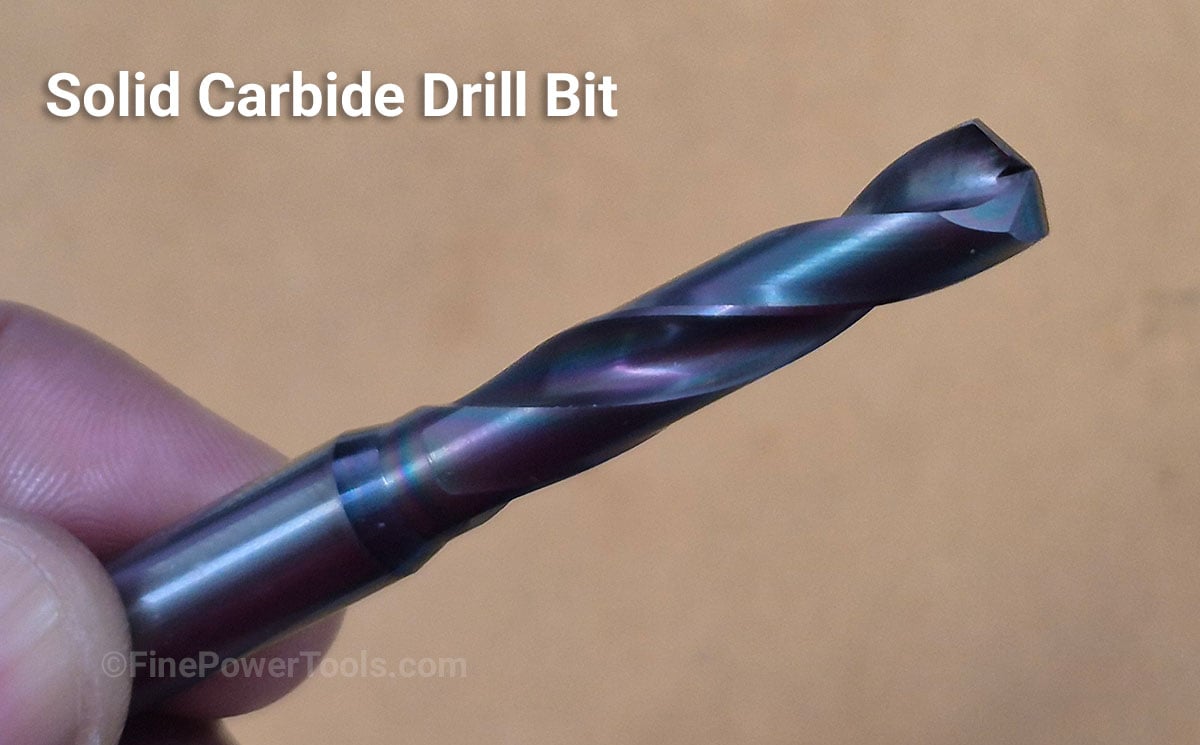
Tungsten carbide is one of the hardest cutting materials available. It is rated around 75 HRC on the Rockwell hardness scale, which is significantly harder than cobalt HSS at 65–67 HRC. It handles abrasive tough alloy steels, hardened steels, masonry, ceramics, and glass that would destroy HSS or carbon steel bits almost instantly.
The two types of carbide bits are,
- Solid carbide drill bit
- Carbide Tipped bit
Solid carbide bits are used for CNC and precision machine work where the bit is rigidly supported in collets. In masonry bits, carbide typically appears as a brazed tip bonded to an HSS or steel body (TCT) rather than as a solid carbide bit, because solid carbide is brittle and would fracture under the lateral stress of handheld drilling.
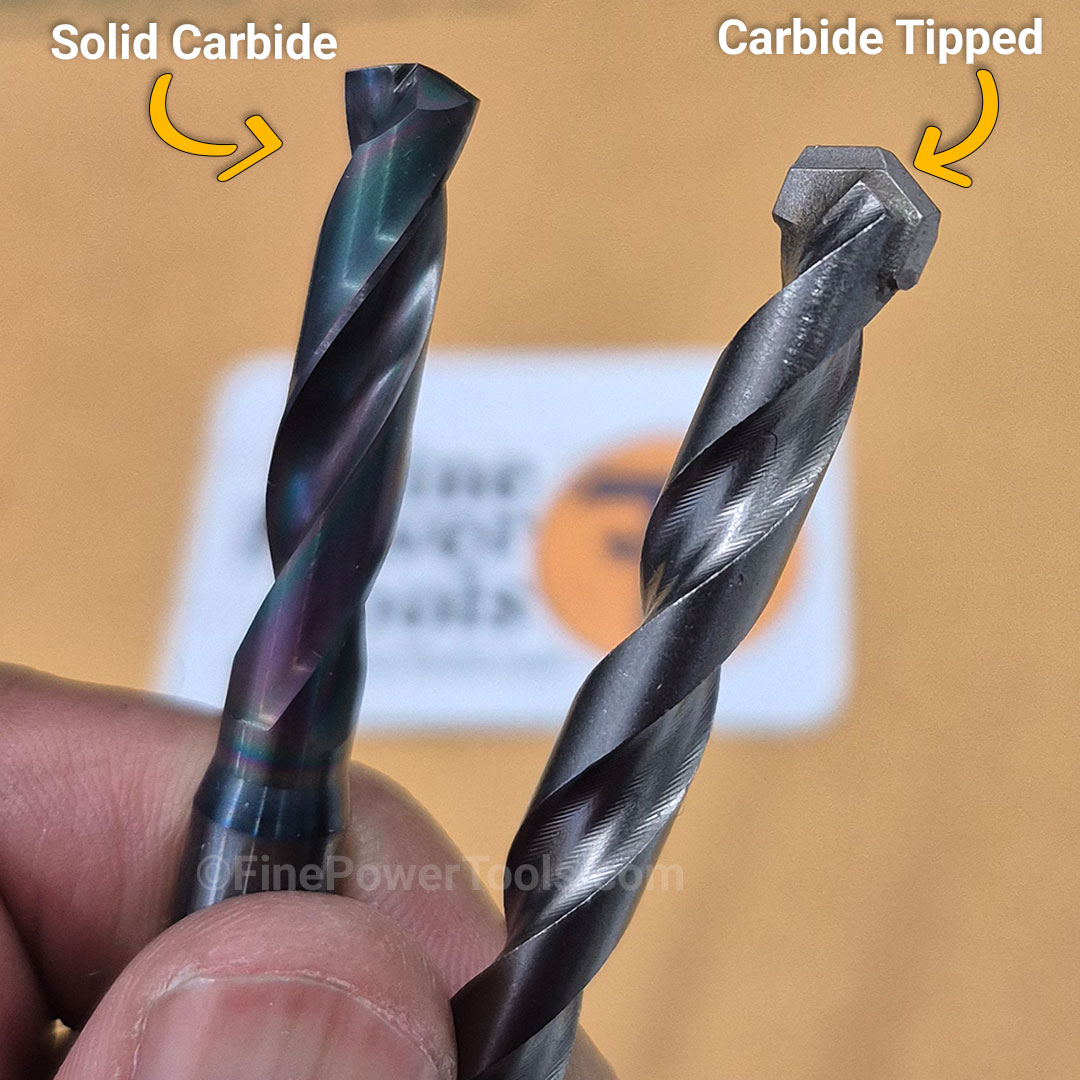
The tradeoff for all that hardness: carbide is notch-sensitive and chips under impact. So, never use carbide-tipped bits in hammer or impact mode unless specifically designed for it.
Best Used For: Concrete, brick, masonry, ceramic tile, porcelain, glass, Alloy Steel, hardened steel (in CNC/machine tool applications), and multi-material drilling.
Not Suitable For: Impact mode (unless designed for it), soft materials where the hardness is wasted and the brittleness becomes a liability.
There you have it. Over 40 types of drill bits that covers every drilling application you can think of.

Dan Miller is a professional toolmaker with extensive experience in the metalworking and tooling industry.
An avid DIY enthusiast and passionate hobbyist woodworker, Dan shares his expert knowledge here.