
When looking for a new air compressor, it’s crucial to know how much airflow and pressure your tools need and other considerations to get the most out of it.
In this article, you will find all the information you need to make an informed decision to choose a compressor that suits your needs.

Compressor Size Calculator
As a general rule of thumb, you should sum the CFM (Cubic Feet per Minute) of all the tools you plan to run simultaneously, and add a safety margin of 30 to 50%.
Use the tool below to quickly find the ideal compressor size based on your specific needs.
Interactive Air Compressor Finder
Select your tool and usage type to see your recommended compressor size instantly.
How to Determine Air Compressor Size
Here’s how you can find out the right size compressor for your pneumatic tools.
- List All Your Tools: First, list down all the pneumatic tools you intend to use and for each tool, note down the air consumption (CFM)
- Find the Highest PSI Requirement: Among all your tools look for the one that require the highest operating pressure (PSI). This will give you the minimum PSI your compressor needs to provide.
- Calculate the total CFM:
Multi-tool Usage: If you’re going to use multiple tools simultaneously, sum the CFM values of all those tools.
Individual Usage: For single tool use, identify the tool with the highest CFM requirement. - Tank Size: Tools that require consistent air flow (like grinders and paint sprayers), a larger tank is needed whereas intermittent tasks such as nailing can operate with smaller tanks.
- Duty cycle: For tasks that require continuous supply of air, go for a compressor with duty cycle of 70% or above.
- Finally, add a Safety Margin: To ensure efficient operation and account for any potential underestimation, add a 20-30% safety margin to your calculated CFM value. This margin will also accommodate for potential future additions to your tool collection.
CFM (Air Consumption)
When choosing a compressor, one of the main considerations is airflow, which usually appears on pneumatic tools and compressors expressed in CFM (cubic feet per minute). In other words, it indicates how much air the compressor can deliver in one minute.
However, CFM is just a part of the equation because it expresses volume but not pressure. To do any job, from inflating a tire to powering a pneumatic hammer, you need a compressor capable of delivering a specific air volume at a sustained pressure.
A compressor’s CFM is determined by factors like its motor’s capacity and volumetric efficiency. Small tools usually work with just one or two CFM, while large industrial tools require 90 CFM or more.
CFM Requirement
When you purchase a compressor, you usually want to use it for several tasks, such as spray paint, inflating tires, and operating pneumatic tools. To determine how much CFM you need, I suggest you check the specs of the tools you will be using and choose a compressor with a slightly higher airflow. You don’t want your compressor to run at its full capacity for extended periods, as it may result in a reduced lifespan of the unit. That’s why you should choose a compressor with a CFM at least 40 percent larger than your most air-demanding tool.
A simple way to calculate this is to multiply that tool’s CFM by 1.4; for example, if the tool’s spec sheet says it needs 6 CFM at 70 PSI, then you should get at least a compressor capable of delivering 8.4 PSI at 70 PSI.
Concurrent Usage
Another factor to consider is whether you will be using multiple tools simultaneously. For example, if you own a small shop or you would like to work with friends on your projects, you will have to buy a compressor that can handle the air demands of both tools.
For example, if you will be using a pneumatic wrench and an orbital sander at the same time, you will have to add both tools’ CFM and look for a compressor that can deliver that airflow.
However, remember that you may need a compressor considerably bigger tank size to work with two tools at a time.
Output Pressure – PSI Rating
Another important consideration when choosing an air compressor is the PSI (Pounds per Square Inch) rating, which represents the maximum air pressure per square inch it can deliver.
In the context of power tools run on compressed air, this figure can be associated with the power of electric power tools because it’s directly related to their capacity to make pneumatic tools work.
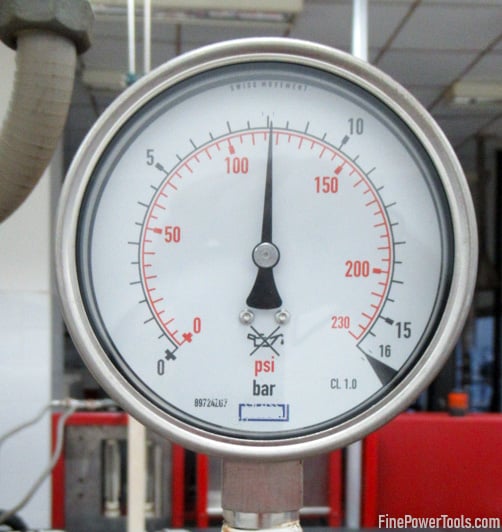
Generally, most pneumatic tools operate at a standard 90 PSI (approximately 6 bar). Certain tasks and specialized tools like sandblasters may demand either a higher (100 -150PSI) optimally, while tools like tire inflators require lower PSI (30 – 40 PSI) to function. Usually, the more powerful the power tool, the more pressure is needed to make it work, and the higher the tool’s power, the higher the air supply demand.
⌛ Air Pressure Converter
Similar to CFM, it’s always advisable to buy an air compressor with higher air pressure than what your most demanding tool requires, of at least 10 to 20% more. This compensates for any pressure losses that may result in air gaps, which can be frustrating and affect your work.
Tank Size
The compressors’ tanks store pressurized air so that the motor doesn’t have to stay constantly running while you work. Tanks provide constant pressure, which is needed by pneumatic tools to operate properly.
If you plan to use the compressor for tire inflation and use tools that work with just small air tools (example: air nailers and impact wrenches), a small tank is sufficient.
However, when using tools like sandblasters and paint sprayers, you can’t afford to interrupt your job to wait for the motor to reload the tank, you will need a larger tank.
Small and medium compressors are fitted with tanks from 2 to 100 gallons, so it’s essential to consider the jobs you will be doing and the storage space available for storing them.
Another thing to consider is the tool’s CFM and PSI rating, which determine the compressed air consumption. Larger tools need more air; hence, they will empty the tank faster. That being said, it’s important to choose the tank’s size wisely.
A quick way to calculate the approximate tank size you would need is by multiplying your tool with the biggest CFM by 4. For example, to run a tool of 12 CFM, then:
12 CFM * 4 = 48 gallons.
If you will be using two tools simultaneously, then you should multiply the total CFM (Tool A CFM + Tool B CFM) by four.
Keep in mind, however, that this is a general guideline, and actual requirements might vary based on specific applications and usage patterns.
Tank Size Calculator
For pneumatic tools that require continuous supply of air (e.g., paint sprayer, sandblaster) use the following formula to calculate the air compressor tank size.
Tank Size (in Gallons) = (Total CFM × Run Time in minutes) / 1.5
Air Compressor Tank Size Calculator
Air Compressor Size Chart
Below is a handy chart detailing typical CFM and PSI requirements for common tools, along with their recommended tank capacities, to assist you in choosing the right compressor size.
| Tool | SCFM | PSI | Typical Tank Size |
| Pin Nailer | 0.3 to 1 | 60 to 100 | 1 to 2 gallons |
| Brad Nail Gun | 0.3 to 1 | 70 to 120 | 1 to 4 gallons |
| Finish Nailer | 2 to 3 | 70 to 120 | 2 to 6 gallons |
| Framing Nailer | 2 to 4 | 90 to 120 | 4 to 8 gallons |
| Pneumatic Riveter | 3 to 5 | 90 | 15 to 20 gallons |
| Screw Driver | 4 to 8 | 70 to 90 | 20 to 30 gallons |
| Sanding, Grinding & Painting | |||
| Mini Die Grinder | 4 to 8 | 90 | 20 to 30 gallons |
| Orbital Sander | 6 to 12 | 90 | 30 to 60 gallons |
| 7” Angle Grinder | 8 to 12 | 90 | 30 to 60 gallons |
| Paint Spray Gun (HVLP) | 9 to 15 | 20 to 45 (at gun) |
30 to 60 gallons |
| Dual-Action Sander | 10 to 15 | 90 | 60 to 80 gallons |
| Automotive & Mechanics | |||
| ¼” Air Ratchet | 2.5 to 4 | 90 | 10 to 14 gallons |
| ⅜” Air Ratchet | 3 to 5 | 90 | 18 to 20 gallons |
| ⅜” Impact Wrench | 2.5 to 3.5 | 90 | 10 to 14 gallons |
| Pneumatic Greaser | 3 to 5 | 90 | 16 gallons |
| ½” Impact Wrench | 4 to 5 | 90 | 16 to 26 gallons |
| 1” Impact Wrench | 10 to 15 | 90 | 40 to 80 gallons |
| Bead Breaker | 12 | 125 to 150 | 60 to 80 gallons |
| Cutting & Shaping | |||
| Pneumatic Nibbler | 4 to 6 | 90 | 15 to 20 gallons |
| Pneumatic Saw | 4 to 6 | 90 | 20 to 30 gallons |
| Air Chisel | 4 to 8 | 90 | 20 to 40 gallons |
| Cut-off Tool | 4 to 10 | 90 | 20 to 40 gallons |
| Pneumatic Shear | 8 to 16 | 90 | 30 to 60 gallons |
| Utility & General Shop | |||
| Inflator | 1 | 100 | 1 to 6 gallons |
| Blow Gun | 2.5 | 100 | 1 to 6 gallons |
| Pneumatic Drill | 3 to 6 | 90 | 20 to 30 gallons |
| Sand Blaster | 10 to 25 | 90 to 100 | 60 to 80 gallons |
* The tank size also depends on the CFM.
** These are approximate values, and actual requirements can vary by brand and specific model of the tool.
*** For best performance, choose a compressor that delivers at least 1.5× the SCFM required by your highest-demand air tool. But, you can use slightly smaller tanks for home or small business applications.
Consider Duty Cycle
The duty cycle is the percentage of time a compressor can run without overheating. For instance, if a compressor has a duty cycle of 50%, it can run for half the time and then needs to rest for the other half.
If you plan to use your tools continuously, aim for a compressor with a higher duty cycle (70-100%).
Choosing Wisely: Points to Ponder
When selecting the right air compressor, you might want to consider other influencing factors, such as:
- Portability: If you’ll be moving the compressor around, consider its weight, size, and whether it has wheels .
- Power Source: Ensure the compressor can be powered easily in your workspace (110V or 220V). Some heavy-duty industrial grade compressors might require a three-phase power supply.
- Maintenance (Oil-free vs. Oil-lubricated): Oil-free compressors typically require less maintenance and don’t release oil into the air supply. However, they may have a shorter lifespan compared to oil-lubricated models.
- Noise Level: When working in residential areas or indoors, the noise level can be a concern. You might want to utilize some of the techniques to quiet an air compressor.
- Environmental Factors: Extreme cold can affect some compressors, leading to starting issues or reduced efficiency. In humid climates, consider getting a compressor with a good moisture trap or a separate air dryer.
Final Words
When choosing a compressor’s size, you should do some homework and read the specs of the pneumatic tools you will use. That will help you determine the PSI, CFM, and tank size to use your tools smoothly and operate them for longer intervals between air pressurization cycles.
Remember to consider the higher CFM and PSI values and choose a slightly larger compressor to ensure smooth and correct operation.

David Castillo is an automotive industry expert specializing in vehicle electronics and stand-alone fuel management systems. He has over 20 years of experience and owns a car repair garage and tuning shop.
David still runs his shop but is now more focused on pre-purchase car inspections and writing for FinePowerTools.