
As much as I enjoy modern minimalist designs, I have always been drawn to beauty of antique woodwork.
Walk into any antique shop and you’ll find stylish dining tables, cabinets, chairs and heirloom clocks that have survived for generations. They are a testament not only to craftsmanship, but also to the wood chosen by the people who made them.
One of the things that drew me to the woodworking is the beauty of the finished wood; the grain patterns, texture, color, and little imperfections that give every piece its own character. But as I gained experience, I’ve also learned that choosing wood based on appearance alone can be a costly mistake.
Ask me how I know: my first real furniture project was a bookshelf made from cheap construction pine. Three years later, it sagged like a hammock.
Rookie mistake! 😳
Choosing wood by color or texture alone is a quick way to end up with sagging cabinet shelves, cracked fastener holes, blotchy finishes, or an outdoor project that rots in short time.
There is no single best wood, but only wood that is right for your particular project.
Wood Classification
Wood can be classified botanically, by species, by physical properties, or by how it was manufactured.
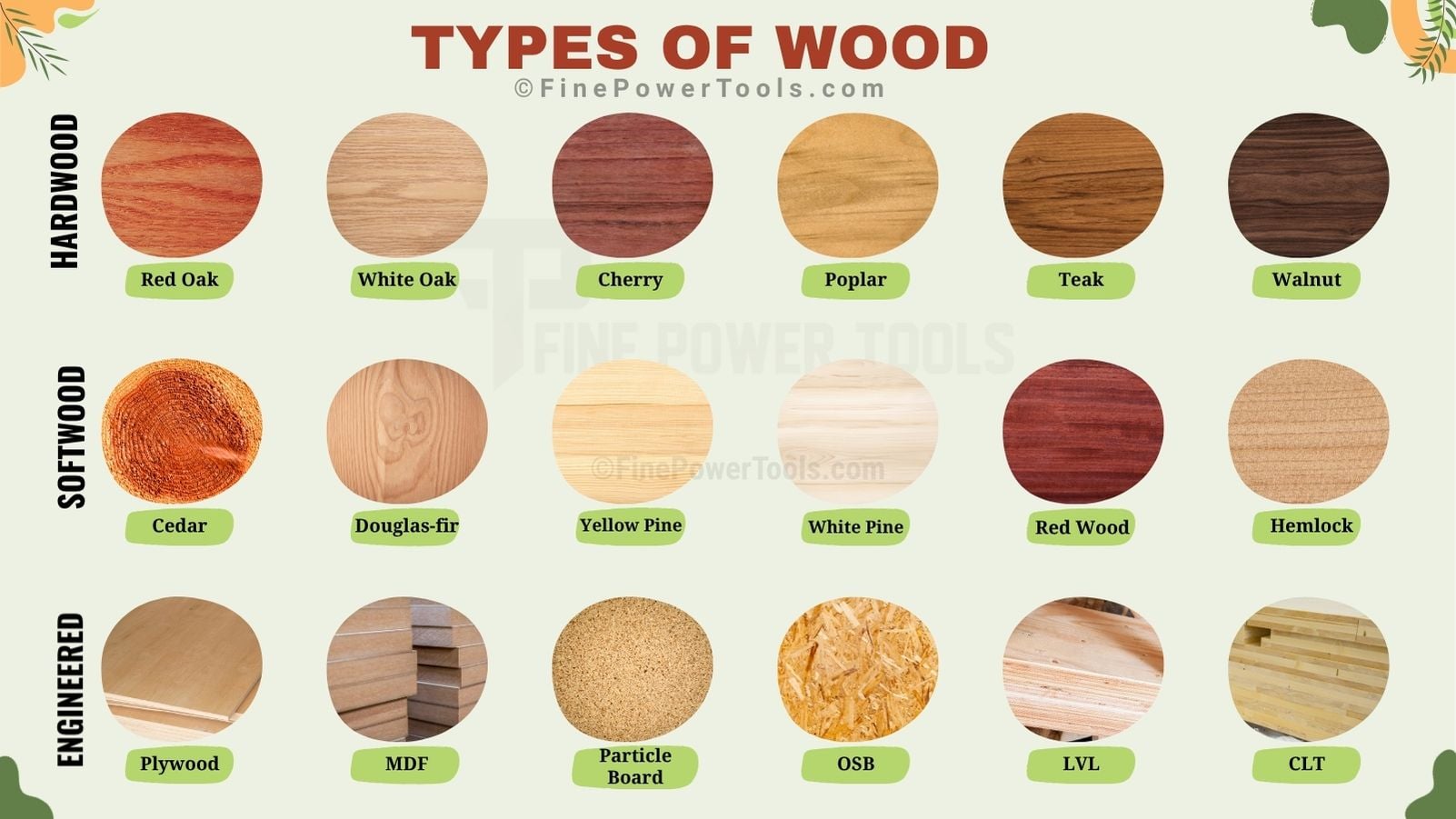
As woodworkers, we usually begin with three broad groups:
- hardwood
- softwood, and
- engineered wood.
These categories are useful, but they do not tell you everything. Grade, moisture content, grain direction, defects, and manufacturing quality can matter as much as the species name stamped on the rack. USDA testing also shows considerable variation within a species because trees grow under different soil, climate, moisture, and spacing conditions.
Hardwood
Hardwood comes from flowering trees, botanically known as angiosperms. Most temperate hardwoods are broadleaf deciduous trees such as cherry, maple, walnut, and oak, although some hardwood trees are evergreen.
📌Note: When I first started woodworking, I assumed “hardwood” simply meant wood that was hard. Another rookie mistake!
In reality, these terms are botanical classifications based on how trees reproduce, not how hard they are. Balsa wood is botanically a hardwood despite being soft enough to dent with your fingernail, while some softwoods (like yew or longleaf pine) are much harder than light hardwoods.
For more details see softwood vs. hardwood comparison guide.
The USDA Wood Handbook explicitly groups hardwoods and softwoods independently of their actual hardness.
🌳 Hardwood Characteristics at a Glance:
- Botanical Source: Angiosperms (Flowering trees, mostly broadleaf deciduous).
- Examples of Hardwood: Maple, ash, oak, walnut, cherry, hickory, mahogany, etc.
- Key Advantages: Beautiful grain patterns, high wear resistance, strong fastener-holding power, excellent finishing and rot resistance.
- Drawbacks: Cost, weight, slow machining, risk of tear-out and burn during machining.
- Common Uses: Flooring, furniture and cabinetry, wood turning, decorative joinery etc..
Hardwoods commonly offer attractive grain, good wear resistance, strong fastener holding, and the ability to accept refined clear finishes. They are widely used for furniture, flooring, cabinets, millwork, turning, and decorative joinery. Their disadvantages are usually cost, weight, slower machining, and a greater chance of burning or tear-out when cutters are dull.
Softwood
Softwood comes from gymnosperms, primarily cone-bearing trees such as pine, cedar, spruce, fir, redwood, cypress, and hemlock. Softwoods often grow quickly and produce long, relatively straight logs, which helps explain their widespread use in construction lumber, framing, sheathing, trim, and outdoor work.
Most softwoods are lighter and easier to cut than dense hardwoods. They are also widely available in construction dimensions and usually cost less. The trade-off is that many dent easily, contain pitch or knots, and do not wear as well as oak, maple, or hickory. Softwoods with uneven earlywood and latewood bands can also absorb stain irregularly.
🌳 Softwood Characteristics at a Glance:
- Botanical Source: Gymnosperms (Cone-bearing trees, mostly evergreens).
- Common Examples: Cedar, pine, redwood, spruce, Douglas fir, and hemlock.
- Key Advantages: Fast growing trees, light weight, easier to cut and drill, and widely available in standard construction sizes.
- Common Uses: Construction lumber, Structural framing, outdoor building, trim, and general carpentry.
- Drawbacks: softwoods generally have lower wear resistance, can contain knots or pitch pockets, and often absorb stain unevenly due to dense summerwood bands.
📌Note: While most softwoods have a lower Janka hardness and dent easily, certain softwood species like Southern Yellow Pine or Douglas Fir are surprisingly hard.
Engineered Wood
These are made by breaking wood into veneers, strands, particles, or fibers and bonding those elements into a controlled product.
- Plywood uses cross-laminated veneer.
- OSB uses oriented strands.
- Particleboard uses small particles.
- MDF uses refined wood fibers.
- LVL aligns veneer primarily in one direction to create structural members.
Engineered products make efficient use of smaller trees, residues, and pieces that might not produce high-grade solid lumber. Manufacturing also reduces the localized effect of knots and other defects, allowing properties to be controlled more consistently than in natural boards.
Their strengths include predictable sheet sizes, broad panels, dimensional consistency, and, in some products, high structural capacity.
Their limitations include vulnerable edges, difficult repairs, variable moisture resistance, heavy dust production, and reliance on the correct product grade. For example, there are several types of plywood. An “Exterior” plywood panel is not interchangeable with interior decorative plywood simply because both are called plywood.
📋 Engineered wood Facts:
- Source: Mixed wood components (veneers, strands, particles, or fibers) bonded together under high pressure and heat.
- Common Engineered Woods: Plywood, OSB, particleboard, MDF, LVL, and melamine.
- Key Advantages: Available in standard sheet sizes, dimensional stability (minimal warping), high structural strength in panels or beams, relatively cheaper.
- Drawbacks: Lacks the rich colors and grain pattern of solid wood, edges prone to damage, difficult to repair, dust during machining, and varying moisture resistance depending on the specific grade (e.g., exterior vs. interior).
- Common Uses: Subflooring, roofing, cabinet carcasses, large flat panels, shelving, and structural beams.
Quick Comparison of Popular Wood Types
The following comparison table should help you identify the wear-resistance, cost, workability and uses of different types of wood.
Janka Hardness denotes the wood’s resistance to denting and wear.
Cost is relative and varies by region, grade, thickness, and board width.
Hardwood Comparison Chart
| Wood | Janka Hardness | Workability | Outdoor Use | Relative Cost | Common Uses |
| Red Oak | 1,290 lbf | Good | Poor (without protection | Moderate | Furniture, flooring |
| White Oak | 1,350 lbf | Good (dense) | Good (heartwood) | Mod. to High | Flooring, exterior joinery |
| Hard Maple | 1,450 lbf | Fair to good | Poor | Mod. to High | Worktops, flooring |
| Black Walnut | 1,010 lbf | Very good | Moderate | High | Fine furniture, panels |
| Black Cherry | 950 lbf | Very good | Poor to moderate | High | Furniture, millwork |
| White Ash | 1,320 lbf | Good | Poor | Moderate | Tool handles, bent parts |
| Hickory | 1,880 lbf | Difficult | Poor | Mod. to High | High-wear parts, flooring |
| Yellow-Poplar | 540 lbf | Very good | Poor | Low to Mod. | Painted trim, prototypes |
Softwood Comparison Chart
| Wood | Janka Hardness | Workability | Outdoor Use | Relative Cost | Common Uses |
| Eastern White Pine | 380 lbf | Excellent | Poor | Low | Shelves, trim, painted furniture |
| Western Red Cedar | ~350 lbf | Excellent | Good (heartwood) | Mod. to High | Fencing, siding, outdoor furniture |
| Douglas-Fir | 620–710 lbf | Good | Limited (untreated) | Moderate | Framing, beams, doors |
| Redwood | 420–480 lbf | Good | Good heartwood | High | Decking, siding, outdoor structures |
Engineered Wood Products
| Product | Workability | Outdoor Use | Relative Cost | Common Uses |
| Plywood | Good | Grade-dependent | Low to High | Cabinets, furniture, sheathing |
| MDF | Excellent for profiles | Interior only | Low to Mod. | Painted cabinets, trim, templates |
| OSB | Construction-focused | Exposure-dependent | Low | Wall, roof, and floor sheathing |
About Janka Hardness
Janka hardness measures resistance to indentation. The test records the force needed to embed a diameter 0.444-inch (or 11.28 mm) steel ball halfway into the wood. A higher number generally means better dent resistance, but it does not automatically mean greater strength, stability, rot resistance, or workability.
Rating Guide
- Softwoods: Under 1,000 lbf (e.g., Pine is around 420 lbf).
- Hardwoods: 1,000 to 1,500 lbf (e.g., Hard Maple is 1,450 lbf).
- Very Hard Woods: Over 3,000 lbf (e.g., Brazilian Walnut/Ipe is around 3,680 lbf).
* Published ratings are averages from controlled wood specimens, so an individual board may behave differently.
USDA clear-wood tests place hard maple, red and white oak, hickory, ash, beech, birch, walnut, cherry, yellow-poplar, and the listed softwoods in broadly the same hardness ranges shown above. The figures should be treated as comparison tools rather than guarantees for every board.
Common Hardwood Species
Following are some of the popular hardwood species that we use in North America.
Major U.S. Hardwoods by Region
| Southern | Northern and Appalachia | Western |
|---|---|---|
| Black willow | Aspen | Aspen |
| Ash | Ash | Oregon white oak |
| Basswood | Basswood | California black oak |
| Black walnut | Black walnut | Black cottonwood |
| Butternut | Butternut | Bigleaf maple |
| Red oaks | Red oaks | Red alder |
| White oaks | White oaks | Paper birch |
| Magnolia | Hard maple | Oregon ash |
| Soft maple | Soft maple | Tanoak |
| Cottonwood | Cottonwood | |
| Elm | Elm | |
| Hackberry | Hackberry | |
| True hickory | True hickory | |
| Pecan hickory | Birch | |
| American beech | American beech | |
| Tupelo | Black cherry | |
| American sycamore | American sycamore | |
| Yellow-poplar | Yellow-poplar | |
| Black locust | Black locust | |
| Honeylocust | Honeylocust | |
| Sassafras | Buckeye | |
| Sweetgum |
You can see that every hardwood has its own characteristics and balance of appearance, hardness, stability, decay resistance, and working behavior.
Even two woods with similar Janka hardness ratings may machine very differently. For instance, oak wood usually has large pores and prominent rays, while maple lumber is close-grained and more likely to show burns from a slow feed rate.
1. Oak: Red and White
About Oak: Oak is one of the standard hardwoods used in North American woodworking. There are over 500 distinct species of oak trees out of about 10 to 20 species are harvested for making commercial lumber. Here we will discuss about the two most widely available varieties.
- White Oak (Quercus alba)
- Red Oak (Quercus rubra)
Red oak is widely used for interior furniture, flooring, cabinets, and stair parts. White oak offers similar strengths with better natural decay resistance and a different pore structure.
Appearance and grain: Both are open-grained and usually straight-grained. Red oak commonly ranges from light brown to pinkish or reddish brown. White oak tends toward tan, olive brown, or medium brown. If you go for quarter-sawn boards, you can clearly see the medullary rays as flakes or ribbons, especially in white oak.
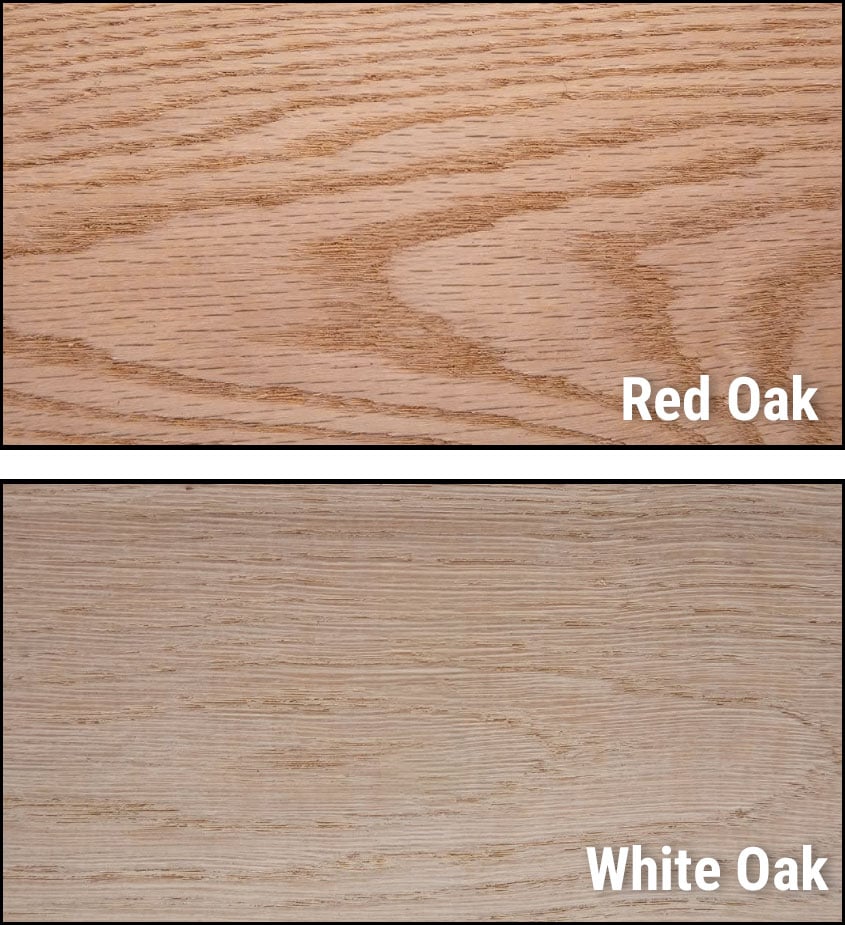
Hardness: Northern red oak averages about 1,290 lbf (Janka Hardness) and the white oak averages about 1,350 lbf.
Both oak wood species can resist household wear & tear and dents well.
Workability: Oak cuts, drills, routs, glues, and stains well. But white oak can feel noticeably tougher under hand tools. The coarse grain of oak may tear around reversing figure, and the large pores remain visible unless you use grain filler.
Durability and moisture resistance: Red oak is not a good choice for exterior use. Its open pores easily absorb moisture along the grain. White oak heartwood is much more suitable for outdoor use, exterior joinery, boat components, and cooperage, although sapwood and detailed joints still need protection.
White Oak Uses: Boatbuilding, barrels (for wine and whiskey), outdoor furniture, exterior joinery, flooring, and cabinetry.
Red Oak Uses: Interior furniture, tables, indoor flooring, cabinetry, stairs, molding, and architectural millwork.
Advantages: Strong, affordable, widely available, familiar-looking, and receptive to stain.
Cons: Heavy, coarse-textured, prone to splintering, and likely to react with iron (nails and screws) when wet, producing dark staining.
⚒ Tools and tips: Use sharp carbide cutters and make a light final routing pass. Pre-drill screws near board ends.
Vacuum the open pores before finishing. For a smooth film finish, decide early whether you want the grain texture visible or filled.
2. Maple
About Maple Wood: Hard maple, usually sugar maple or black maple, is the dense, pale material associated with butcher blocks, gym floors, worktops, and durable cabinetry.
There are also softer maple species. Keep this in mind when you look for maple wood at your local lumberyard.
Appearance and grain: Creamy white sapwood is common, with heartwood ranging from light to reddish brown. Hard maple has fine and even texture. You may find curly, bird’s-eye, and quilted figures in different maple boards but are not separate species.
Hardness: Hard maple wood averages about 1,450 lbf. It withstands abrasion and wear well, which is why it appears in sports flooring, worktops, and other high-use surfaces.
Workability: Straight-grained maple boards cuts and machines cleanly. But if the cutting tool becomes dull, maple burns quickly when a saw blade or router bit rubs instead of cuts. Use sharp blades while planning since figured stock can tear out during planing.
Durability and moisture resistance: Hard maple is durable against wear and dents but has little natural resistance to decay. (Those are two different properties.) Meaning, maple is primarily an indoor wood.
Common uses: Flooring, cabinetry, drawers, butcher blocks, cutting boards, turned items, musical instruments like guitar and violin, workbenches, painted or clear-finished furniture, etc.
Advantages: high wear resistance, pale color (creamy white to light tan color), fine texture, and excellent polished surfaces.
Limitations: Can burn, can blotch under penetrating stain, and requires more effort to nail or screw (use an impact driver) than softer species.
⚒ Tools and tips: Keep blades edges sharp and maintain a steady feed rate. Take shallow router passes. Pre-drill when you want to drive long fasteners.
If you feel the color is too pale and want a dark color, make sure that you test dye, toner, or gel stain on an offcut before flooding the surface with ordinary penetrating stain.
Black Walnut
About Walnut Wood: Walnut combines rich natural color with unusually pleasant workability. It is expensive, but it often requires less color staining than pale woods like maple because a clear finish already produces a refined appearance.
Appearance and grain: Sapwood is pale. Heartwood ranges from gray-brown to chocolate brown and sometimes shows purple or darker streaks. Grain is usually straight but can be wavy, curly, or irregular.
Hardness: Black walnut averages about 1,010 lbf on the Janka hardness scale. It is hard enough for furniture yet softer and easier to cut and shape than maple, hickory, or oak.
Workability: Walnut wood has good machinability. It cuts, planes, turns, carves, routs, glues, and finishes well. Irregular grain can still be a problem as it can tear under a planer, but normal straight-grained lumber is forgiving.
Durability and moisture resistance: Walnut heartwood has useful natural decay resistance, although it is not usually chosen over cedar, redwood, white oak, cypress, or teak for fully exposed outdoor projects. Sapwood is less resistant.
Common uses: Fine furniture, cabinet doors, tables, gunstocks, turning, carving, veneer, paneling, and decorative accents.
Advantages: Attractive without stain, strong and stable in use, and it is relatively easy to machine.
Limitations: Expensive. Getting a uniform color could be a problem because of the pale sapwood contrast, and color variation between boards.
⚒ Tools and tips: Buy for color as carefully as for grade. Arrange boards under the lighting where the project will be used.
Walnut dust can stain hands and nearby pale materials, so use a good shop vacuum and clean the workbench before switching species.
Cherry
About Cherry Wood: Black cherry is the classic furniture and cabinet wood. It is relatively easy to shape, can be finished to a smooth surface, and changes color substantially as it ages.
Appearance and grain: Fresh heartwood may appear light pinkish brown. Exposure to light and oxygen deepens it toward a warm reddish brown. The grain is fine and usually straight, sometimes with curly figure or small dark gum pockets.
Hardness: Black cherry wood averages about 950 lbf. It is softer than oak or maple but sufficiently durable for most furniture and cabinetry.
Workability: Cherry saws, planes, carves, turns, and routs well. Like maple, it can burn when cutting edges of the blades are dull or feed speed is too slow.
Durability and moisture resistance: Heartwood offers some decay resistance, but cherry remains primarily an interior furniture wood.
Common uses: Furniture, cabinets, interior doors, turned bowls, carvings, moldings, and architectural millwork.
Advantages: Fine grain, excellent workability, and attractive natural aging.
Limitations: Relatively expensive, prone to uneven staining, and easy to scorch during machining.
⚒ Tools and tips: Make sure that you scrape or sand out burn marks completely because finish will make them more obvious. Let the natural wood provide the color when possible. If color matching matters, place newly finished pieces in similar light conditions rather than trying to stain every board identically.
Ash
Overview: White ash is strong, springy, shock-resistant, and visually similar to oak at a glance. Its combination of toughness and elasticity has long suited tool handles, sports equipment, bent parts, and furniture.
Appearance and grain: Sapwood is pale cream to light brown. Heartwood is darker brown. The grain is bold, open, and generally straight.
Hardness: White ash averages about 1,320 lbf, close to red oak.
Workability: It machines well, steam-bends well, and accepts glue and finishes. Coarse fibers can splinter, especially on routed edges and cross-grain cuts.
Durability and moisture resistance: Ash has poor natural decay resistance and should not be assumed suitable outdoors simply because it is strong.
Common uses: Furniture frames, chairs, handles, baseball bats, flooring, bent components, cabinets, and turning blanks.
Advantages: Excellent strength-to-weight balance, good bending behavior, and lively grain. Limitations: Low rot resistance and open grain that may need filling for a glass-smooth finish.
⚒ Tools and tips: Back up crosscuts to reduce splintering. Round over handle edges rather than leaving sharp corners. Watch grain direction closely when routing around a curved template.
Birch
Overview: Yellow birch is the primary furniture-grade birch in North America. Birch plywood and solid birch are common in cabinetry, drawers, interior furniture, and turned work.
Appearance and grain: Sapwood is pale yellow to nearly white. Heartwood may be light reddish brown. The grain is fine and generally straight, sometimes wavy or figured.
Hardness: Yellow birch averages about 1,260 lbf, while paper birch is softer.
Workability: Birch machines to crisp edges and sands smoothly. It can tear around irregular figure and often absorbs penetrating stain unevenly.
Durability and moisture resistance: It has low natural decay resistance and is better reserved for dry interiors.
Common uses: Cabinets, drawer boxes, furniture, plywood faces, doors, turned items, toys, and interior trim.
Advantages: Fine texture, clean machining, pale appearance, and good availability in plywood. Limitations: Blotchy staining, limited outdoor durability, and less dramatic grain than oak or ash.
⚒ Tools and tips: Use a sharp crosscut blade because pale birch shows torn fibers easily. For dark finishes, use dye, toner, or a controlled spray schedule. Solid birch and birch-faced plywood may not match perfectly after finishing, so test both.
Hickory
Overview: Hickory is among the hardest and toughest commercially available North American hardwoods. It handles impact exceptionally well but demands sharp tools and careful fastener preparation.
Appearance and grain: Sapwood is nearly white. Heartwood is reddish or medium brown. Boards often contain strong color contrast, and grain may be straight, wavy, or irregular.
Hardness: Shagbark hickory averages about 1,880 lbf; pignut and mockernut can be even harder.
Workability: Hickory cuts slowly, can tear out, and resists hand tools. It also burns if a dull blade lingers. Sanding takes longer than it does on walnut or cherry.
Durability and moisture resistance: Hickory excels at shock and wear resistance, not decay resistance. Untreated hickory is a poor choice for prolonged outdoor exposure.
Common uses: Tool handles, flooring, ladder rungs, striking-tool components, chairs, sporting goods, and high-wear furniture parts.
Advantages: Outstanding hardness, impact resistance, and strength. Limitations: Difficult machining, high movement, color variation, and a tendency to split around fasteners.
⚒ Tools and tips: Pre-drill holes when you drive screws and nails. Avoid positioning fasteners too close to the end grain.
Use carbide cutting tools and pass light cuts.
Beech
Overview: American beech is a hard, fine-textured wood used for furniture, workbench parts, bent components, flooring, and utility items.
Appearance and grain: It is pale cream to light reddish brown with a fine, even texture and visible rays. Quarter-sawn surfaces may show small flecks.
Hardness: American beech averages about 1,300 lbf.
Workability: Beech machines, turns, and steam-bends well. It can move noticeably with humidity if stock is not properly dried or if wide parts are restrained incorrectly.
Durability and moisture resistance: Its natural decay resistance is low. It should not be used outdoors without an appropriate treatment system and careful detailing.
Common uses: Chairs, workbenches, tool handles, drawer runners, toys, flooring, turning, and food-related utensils.
Advantages: Hard, uniform, bendable, and usually less visually dominant than oak. Limitations: Poor rot resistance, significant moisture movement, and a tendency to stain unevenly.
⚒ Tools and tips: Check moisture content before building tight-fitting doors or drawers. Allow the stock acclimate to the shop.
Seal all faces of broad panels consistently, but remember that finish slows moisture exchange rather than stopping it.
Yellow-poplar
Overview: Often sold simply as “poplar,” yellow-poplar is botanically unrelated to true poplars. It is a lightweight hardwood prized for paint-grade furniture, interior trim, patterns, and inexpensive practice projects.
Appearance and grain: Sapwood is creamy white. Heartwood may be tan, green, brown, gray, or occasionally purple. Grain is usually straight with a fine to medium texture.
Hardness: Yellow-poplar averages about 540 lbf, making it much softer than oak, maple, or walnut.
Workability: It saws, routs, glues, drills, and shapes easily. Some boards develop fuzzy fibers, particularly when cutters are dull or sanding pressure is excessive.
Durability and moisture resistance: It dents easily and has low natural decay resistance.
Common uses: Painted furniture, face frames, interior trim, drawer parts, prototypes, carvings, and jigs.
Advantages: Affordable, widely available, easy to machine, and excellent under paint. Limitations: Soft surface, variable greenish color, and poor exterior durability.
⚒ Tools and tips: Poplar is one of the most practical woods for learning joinery. Use a sharp plane or scraper on fuzzy grain. Fill dents and end grain before applying high-sheen paint.
Mahogany
Overview: “Mahogany” is used loosely in the lumber trade. Genuine or Honduran mahogany, Swietenia macrophylla, is different from African mahogany, Philippine mahogany, and several substitute species. Confirm the botanical or trade name before comparing price or performance.
Appearance and grain: Genuine mahogany ranges from pinkish or orange-brown to deeper reddish brown. It typically has medium texture and straight to interlocked grain, sometimes producing ribbon stripe on quarter-sawn surfaces.
Hardness: Genuine mahogany is commonly placed around 800 lbf, though imported-species data are more variable than the extensive USDA data for domestic woods.
Workability: Good genuine mahogany is pleasant to saw, carve, turn, and finish. Interlocked grain may tear when planed in one direction.
Durability and moisture resistance: Heartwood generally offers useful decay resistance and stability, but suitability varies among woods marketed under the mahogany name.
Common uses: Fine furniture, doors, architectural joinery, boat interiors, musical instruments, carving, and veneer.
Advantages: Stable, attractive, relatively light for its performance, and easy to shape. Limitations: Expensive, variable naming, sustainability concerns, and possible interlocked-grain tear-out.
⚒ Tools and tips: Buy from a supplier that states the species. Use a high-angle plane, scraper, or light climb-cutting pass where reversing grain tears. Use dust extraction because tropical wood dust can irritate or sensitize some workers.
Teak
Overview: Teak is an oily, durable tropical hardwood commonly associated with boats, exterior furniture, and high-end architectural work.
Appearance and grain: Heartwood varies from golden or medium brown to darker brown and often contains darker streaks. Grain is generally straight but may be wavy or interlocked. Texture is coarse and can feel slightly oily.
Hardness: Teak averages about 1,000 lbf in USDA’s imported-wood data.
Workability: Teak machines reasonably well, but natural silica can dull cutting edges. Its extractives may complicate gluing and finishing.
Durability and moisture resistance: Teak heartwood is highly valued for outdoor durability, dimensional stability, and resistance in wet service. Sapwood should not be treated as equivalent.
Common uses: Outdoor furniture, boat decks and trim, exterior doors, countertops, laboratory fittings, and architectural joinery.
Advantages: Excellent outdoor service, stable behavior, and low maintenance expectations. Limitations: High price, tool wear, oily surfaces, and sourcing concerns.
⚒ Tools and tips: Confirm legal and certified sourcing rather than relying on the word “plantation” alone.
Use carbide cutters and expect more frequent sharpening. Prepare glue surfaces shortly before assembly and follow the adhesive manufacturer’s guidance for oily tropical woods.
Common Softwoods
Major U.S. Softwoods by Region
| Western | Northern | Southern |
|---|---|---|
| Incense-cedar | Northern white-cedar | Atlantic white-cedar |
| Port-Orford-cedar | Balsam fir | Fraser fir |
| Douglas-fir | Eastern spruces | Baldcypress |
| White firs | Eastern hemlock | Southern Pine |
| Western hemlock | Eastern redcedar | Eastern redcedar |
| Western larch | Tamarack | |
| Lodgepole pine | Jack pine | |
| Ponderosa pine | Red pine | |
| Sugar pine | Eastern white pine | |
| Western white pine | ||
| Western redcedar | ||
| Yellow-cedar | ||
| Redwood | ||
| Engelmann spruce | ||
| Sitka spruce |
Softwood Trees
Below is the list of 10 most popular softwoods in the U.S.
1. Pine
Pine is a group, not one uniform material. Eastern white pine is soft and easy to carve. Ponderosa pine is common in millwork. Southern yellow pines are heavier, harder, and stronger.
Pine Wood Properties & Characteristics
- Appearance and grain: Most pines have pale sapwood, yellow to reddish-brown heartwood, visible growth-ring contrast, knots, and resin canals.
- Hardness: Eastern white pine averages about 380 lbf, ponderosa pine about 460 lbf, and several southern pines are considerably harder.
- Workability: Pine cuts easily, but knots can chip cutters and deflect hand tools. Resin can build up on blades. Soft earlywood sands faster than dense latewood, creating ripples if you press too hard.
- Durability and moisture resistance: Untreated pine generally has poor outdoor durability. Pressure-treated pine is a different product whose performance depends on treatment and intended use category.
Common Uses of Pine
Framing, shelving, painted furniture, trim, paneling, cabinets, carvings, and outdoor construction when properly treated.
Pros & Cons
- Advantages: Affordable, available, lightweight, and beginner-friendly.
- Limitations: Dents, knots, pitch, uneven stain, and variable quality.
⚒ Tools and tips: Select boards one at a time. Avoid loose knots in structural or narrow parts.
Clean resin from blades according to the blade manufacturer’s instructions. Use a washcoat, gel stain, or toner if an even dark color matters.
2. Cedar
Overview: Cedar may refer to western red cedar, northern white cedar, eastern redcedar, or other commercially named woods. Western red cedar is one of the most familiar choices for siding, fences, outdoor furniture, and lightweight exterior work.
Cedar Wood Properties & Characteristics
- Appearance and grain: Western red cedar ranges from pale tan to reddish or chocolate brown, often within the same board. Grain is usually straight and texture is coarse.
- Hardness: Western red cedar is roughly 350 lbf, so it dents easily.
- Workability: It cuts and shapes with little power, but its soft fibers crush under clamps and splinter along edges. Fasteners near ends can split thin stock.
- Durability and moisture resistance: The heartwood has good natural decay resistance. Sapwood and pale second-growth material may be less durable, and no cedar board benefits from trapped water.
Common Uses:
Siding, shingles, fences, planters, outdoor seating, pergolas, closet lining, and lightweight trim.
Pros & Cons
- Advantages: Lightweight, easy to machine, stable, and naturally decay resistant.
- Limitations: Soft surface, brittle edges, variable color, and irritating dust.
⚒ Tools and tips: Use broad clamp pads and stainless or corrosion-resistant exterior fasteners.
Pre-drill near ends.
Wear effective respiratory protection because western red cedar dust is a recognized sensitizer associated with occupational asthma.
3. Douglas-fir
About: Douglas-fir is a strong structural softwood used for beams, framing, doors, workbenches, and utility furniture. It is not a true fir.
Properties & Characteristics of Douglas-fir
- Appearance and grain: Sapwood is pale. Heartwood ranges from yellowish tan to reddish brown. Growth rings are prominent, producing a strong straight-grain pattern in vertical-grain stock.
- Hardness: Coast Douglas-fir can test around 710 lbf, while values differ among growing regions.
- Workability: Clear, straight-grained boards machine well. Coarse grain and abrupt density changes can splinter, and knotty construction grades require more careful handling.
- Durability and moisture resistance: Untreated Douglas-fir has limited decay resistance compared with cedar, redwood, white oak, or teak. Its structural strength should not be confused with outdoor durability.
Common Uses
Framing, beams, roof structures, doors, benches, ladders, worktables, flooring, and architectural timber.
Pros & Cons of Douglas-fir
- Advantages: Strong for its weight, available in long dimensions, and relatively stiff.
- Limitations: Splintering, hard knots, uneven finishing, and limited untreated exterior life.
⚒ Tools and tips: Support the exit side of crosscuts. Use a sharp combination or crosscut blade for finish parts.
For workbench stock, choose dry, straight boards and remove loose splinters before assembly.
4. Spruce
About Spruce Wood: Spruce is light, stiff, and widely used in framing, ladders, crates, musical instruments, and engineered components. Sitka, Engelmann, black, red, and white spruce differ in density and strength.
Spruce Wood Properties & Characteristics
- Appearance and grain: Spruce is usually pale cream to light yellow with straight grain and a fine to medium texture.
- Hardness: Sitka spruce averages about 510 lbf, while Engelmann spruce is closer to 390 lbf.
- Workability: It cuts easily but can splinter and crush. Small knots may be much harder than surrounding wood.
- Durability and moisture resistance: Spruce generally has low natural decay resistance and is not a preferred untreated exterior material.
Common Uses:
Framing, roof trusses, ladders, aircraft and boat components, soundboards, boxes, and general construction.
Pros & Cons of Spruce Wood
- Advantages: Light weight, useful stiffness, and good strength-to-weight performance.
- Limitations: Poor decay resistance, denting, and splinter-prone edges.
⚒ Tools and tips: Use sharp blades with adequate tooth support for thin parts. Avoid driving fasteners close to ends without pre-drilling. Seal end grain carefully in painted exterior assemblies.
In home improvement centers like Home Depot, you will find these structural woods grouped and sold under the SPF (Spruce-Pine-Fir) label.
5. Redwood
Redwood is valued for stable, lightweight heartwood that performs well in exterior exposure.
Properties & Characteristics
- Appearance and grain: Heartwood ranges from pinkish brown to deep reddish brown. Sapwood is pale. Grain is generally straight, with a coarse texture.
- Hardness: Old-growth material averages about 480 lbf and young-growth material about 420 lbf in USDA data.
- Workability: Redwood saws, planes, and routs easily. Soft fibers can dent, and brittle edges may chip.
- Durability and moisture resistance: Heartwood has good natural decay resistance, especially in higher-heartwood grades. Sapwood and low-heartwood boards do not provide the same performance.
Common Uses:
Decking, siding, fences, pergolas, planters, trim, and outdoor furniture.
Pros & Cons
- Advantages: Good exterior stability, light weight, and easy machining.
- Limitations: Soft surface, high cost in many regions, and major performance differences among grades.
⚒ Tools and tips: Specify heartwood content when durability matters. Use corrosion-resistant fasteners. Do not bury end grain or create joints that collect water.
6. Cypress Wood
About Cypress Wood: Baldcypress is a moderately light softwood used for exterior trim, siding, outdoor furniture, millwork, and boat-related applications.
Properties & Characteristics
- Appearance and grain: Sapwood is pale. Heartwood ranges from yellowish brown to reddish or dark brown, usually with straight grain and medium texture.
- Hardness: Baldcypress averages about 510 lbf.
- Workability: It cuts and machines well, although grain can splinter and some stock contains oily or resinous areas.
- Durability and moisture resistance: Old-growth heartwood developed a strong reputation for decay resistance. Modern stock varies, so grade and heartwood content matter.
Common Uses:
Siding, exterior trim, shutters, outdoor furniture, porch components, boat parts, and interior paneling.
Pros & Cons
- Advantages: Stable, workable, and potentially durable heartwood.
- Limitations: Variable modern stock, soft surface, and limited availability in some markets.
⚒ Tools and tips: Inspect growth rings and sapwood content instead of buying by species name alone. Use exterior-rated fasteners and keep horizontal surfaces sloped or drained.
7. Hemlock
About Hemlock Wood: Western hemlock is a general-purpose structural and millwork softwood. It is stronger and harder than its pale, even appearance may suggest.
Hemlock Properties & Characteristics
- Appearance and grain: The wood is pale yellowish to light brown with relatively uniform texture and straight grain.
- Hardness: Western hemlock averages around 540 lbf.
- Workability: It machines reasonably well but can splinter and develop torn fibers. It does not have the heavy resin content associated with some pines.
- Durability and moisture resistance: Natural decay resistance is low. Untreated hemlock is not a preferred outdoor material.
Common Uses:
Framing, doors, moldings, paneling, ladders, boxes, and utility furniture.
Pros & Cons of Hemlock
- Advantages: Even appearance, useful strength, and good availability in western markets.
- Limitations: Low rot resistance, splinters, and limited decorative figure.
⚒ Tools and tips: Use a sharp finishing blade for exposed crosscuts. Pre-drill small or edge-positioned fasteners. Sand splinter-prone edges before handling large assemblies.
8. Larch (Tamarack)
Larch tree (also known as Tamarack in eastern regions) is a unique deciduous conifer that drops its needles in the autumn. Western larch is highly valued in the lumber industry as one of the strongest, heaviest, and stiffest commercial softwoods available, often grouped with Douglas-fir for high-load applications.
Larch Properties & Characteristics
- Appearance and grain: The wood features a striking reddish-brown heartwood paired with a narrow, yellowish-white sapwood. The grain is typically straight or slightly spiraled with a sharp, high-contrast growth ring pattern.
- Hardness: Western larch sits around 830 lbf, making it substantially harder and more scratch-resistant than standard pines or cedars.
- Workability: It works reasonably well with power tools but its high density demands sharp blades. It has a high resin content that can gum up cutting edges, and it tends to split easily when nailed or screwed near edges.
- Durability and moisture resistance: The heartwood possesses moderate to good natural decay resistance, though it is not quite as resilient as cedar or redwood when in direct contact with the ground.
Common Uses:
Heavy structural framing, timbers and beams, exterior siding, subflooring, decking, utility poles, mine timbers, and railway ties.
Pros & Cons
- Advantages: Exceptionally strong and stiff, excellent nail-holding capabilities, highly durable under heavy structural loads, and distinctive visual grain.
- Limitations: Prone to warping and twisting during drying, high resin content, heavy to handle, and easily splits without care.
⚒ Tools and tips: Always pre-drill holes for fasteners near board ends to prevent splitting. Keep a pitch cleaner handy to regularly remove resin buildup from your saw blades, and ensure timbers are properly seasoned or acclimated to minimize warping after installation.
9. Yew
About Yew Wood: Pacific yew (and its European counterpart) is a slow-growing, shadow-tolerant evergreen tree. It is famous in woodworking as the ultimate botanical anomaly: a softwood that behaves exactly like a dense, premium hardwood. Historically prized for archery bows, it remains a highly sought-after specialty wood today.
Yew Properties & Characteristics
- Appearance and grain: The heartwood is a vivid orange to dark reddish-brown that deepens beautifully with age, contrasted by a bright yellow sapwood. The grain is straight but frequently interrupted by tight knots and swirls.
- Hardness: Pacific yew ranks at an incredible 1,600 lbf, outclassing major hardwoods like Red Oak and Hard Maple.
- Workability: Yew is notoriously difficult to machine. It is heavy, dense, and tough on hand tools. It quickly dulls cutting edges, and its frequent grain reversals mean it tears out easily if planed or routed too aggressively.
- Durability and moisture resistance: The heartwood is exceptionally durable and highly resistant to decay and insect attack, making it one of the longest-lasting natural woods available.
Common Uses:
Archery longbows, woodturning (bowls and vessels), fine furniture accents, musical instruments, carving, and small specialty gift items.
Pros & Cons
- Advantages: Extremely dense and durable, highly flexible and elastic (excellent for bending), finishes to a brilliant natural luster, and features stunning coloration.
- Limitations: Very expensive and difficult to source in large dimensions, notoriously tough on tool edges, highly prone to grain tear-out, and toxic to work with.
⚒ Tools and tips: Use ultra-sharp carbide-tipped blades and take very shallow passes when routing or planing to prevent severe grain tear-out.
Wear a high-quality respirator and maintain excellent dust collection, as yew wood dust contains taxane alkaloids that are highly toxic and can cause cardiac issues or severe respiratory irritation.
10. Fir (True Firs)
Overview: True Firs encompass a massive group of commercial softwoods native to North America, including White Fir, Balsam Fir, and Grand Fir. In the lumber industry, they are rarely sold by their individual names; instead, they are heavily harvested for structural framing and typically sold in mixed regional batches stamped as Hem-Fir or SPF.
Properties & Characteristics
- Appearance and grain: The wood is incredibly light in color, ranging from a creamy white to a soft straw-yellow with a faint reddish tint. The grain is typically straight with a uniform, fine texture.
- Hardness: True firs are relatively soft, hovering between 320 lbf and 480 lbf depending on the specific species, making them easy to dent.
- Workability: Because it is lightweight and soft, it cuts, rips, and planes with very little effort. However, its low shock resistance means it can split easily if large fasteners are driven too close to the edge without care.
- Durability and moisture resistance: True firs have very little natural resistance to decay or insect attacks. They should never be used in exterior applications without proper chemical pressure-treatment or moisture protection.
Common Uses:
Light structural home framing (wall studs, plates, rafters), subflooring, heavy utility plywood, paper pulp, and prefabricated trusses.
Pros & Cons
- Advantages: Extremely affordable, widely available nationwide, lightweight to handle, and exceptionally easy to drive nails or screws into.
Limitations: Very low natural rot resistance, low shock resistance, and prone to bruising or crushing if handled roughly on a job site.
⚒ Tools and tips: When using true fir for framing, standard construction screws or framing nails work beautifully without pre-drilling.
Always store true fir lumber in a dry, covered area on the job site; because it absorbs moisture easily, unprotected boards will warp, twist, or develop surface mold rapidly if left out in the rain

Dan Miller is a professional toolmaker with extensive experience in the metalworking and tooling industry.
An avid DIY enthusiast and passionate hobbyist woodworker, Dan shares his expert knowledge here.