
One of the first power tools I worked on was a bench drill press from Flott. At that time, I was only aware of one other type of drill which was the cordless drill.
Over the years, I have used several different kinds of drills from handheld corded drill to heavy-duty CNC drilling machines. I’ve experienced cordless drills stall repeatedly when drilling large holes in steel, and seen people doing the mistake of using oversized hole saw that twist a drill violently enough to wrench a user’s wrist.
Now that I know what type of drill is right for a specific job, I want to share it with you.
Drill Types at a Glance
| Drill Type | Primary Use | Key Characteristic | Typical Users |
|---|---|---|---|
| Cordless Drill/Driver | General drilling & screwdriving | Portable, versatile, adjustable clutch | Homeowners, DIYers, tradespeople |
| Corded Drill | Continuous drilling & driving | Consistent power without battery limits | Construction, maintenance, workshops |
| Hammer Drill | Brick, block & masonry drilling | primarily a drill with percussion mode. Some models may include clutch. | DIYers, tradespeople |
| Combi Drill | Drilling, screwdriving & light masonry | Drill, driver & hammer modes with adjustable clutch | DIYers, tradespeople |
| Impact Driver | Fastening screws, bolts & fasteners | High torque with impact action | Contractors, woodworkers |
| Rotary Hammer | Concrete & heavy masonry | Powerful piston-driven impact; often hammer-only mode | Construction professionals |
| Right-Angle Drill | Drilling in tight spaces | Compact 90° head | Plumbers, electricians, carpenters |
| Magnetic Drill | Drilling structural steel | Magnetic base secures tool to steel | Metalworkers, fabricators |
| Core Drill | Large-diameter holes in concrete/masonry | Annular core bit removes a cylindrical core | Construction professionals |
| Drill Press | Precision stationary drilling | High accuracy and stability | Woodworkers, metalworkers |
| Rotary Tool/Dremel | Detail work, carving, grinding & cutting | High RPM with small accessories | Hobbyists, crafters |
| Pneumatic Drill | Production & continuous drilling | Air-powered, compact design | Manufacturing, automotive, industry |
Picking the right drill for the task isn’t just about efficiency, it’s about creating the right sized hole while working safely.
In this guide I’ll cover the most commonly used drill types and their applications.
Common Types of Drills
Let’s start with the obvious one: the one that would most likely to come in your mind when you hear the word “drill.”
1. Drill Driver
The handheld cordless drill is the most common power tool. This portable drill has a battery-powered motor that spins a self-centering 3-jaw chuck (usually keyless) that holds the drill bit (round shank and hex-shank).
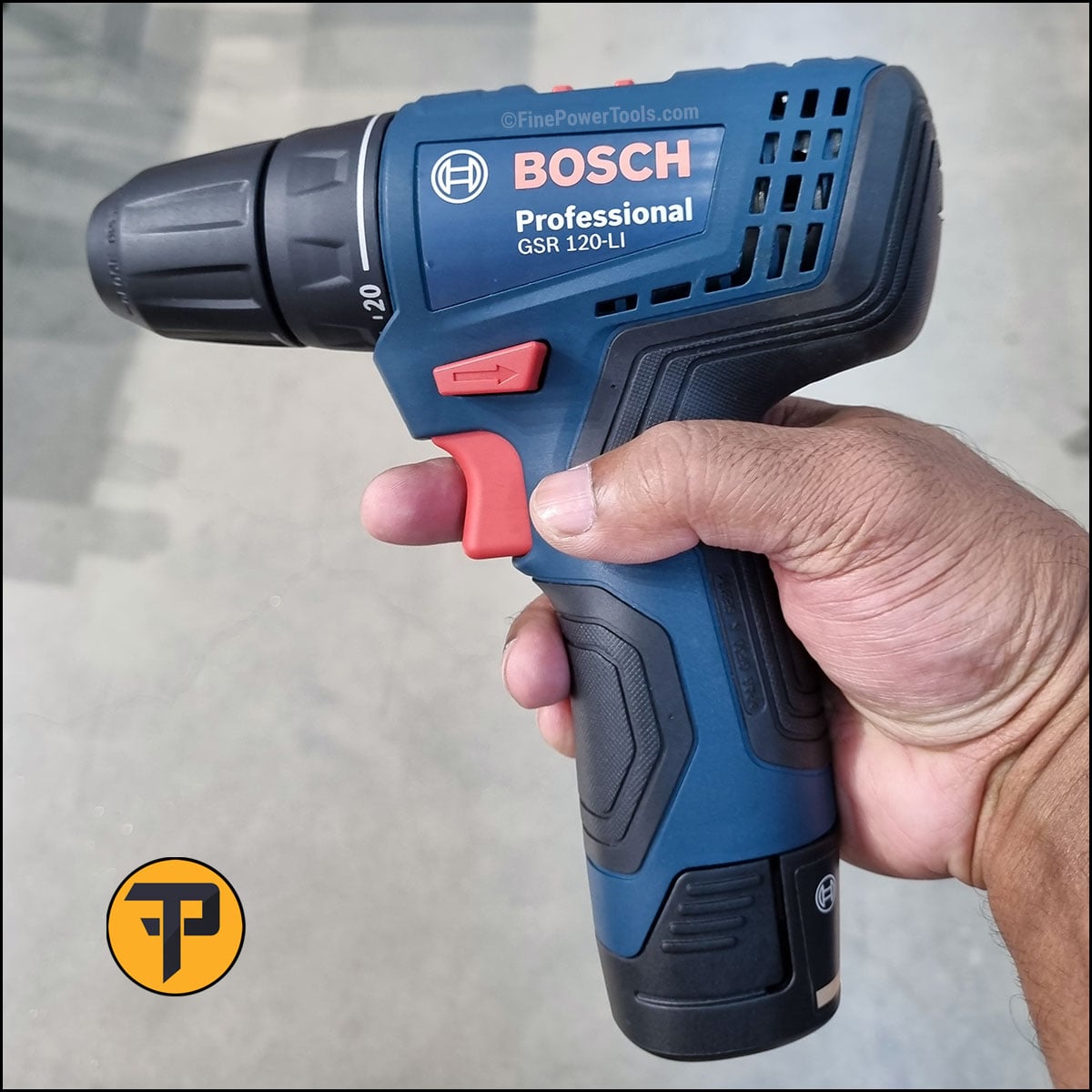
Modes: A cordless drill driver has least two modes; a drill mode for boring holes and a driver mode for driving screws. When you set the mode to the drive function, a clutch mechanism engages which allows you to control the torque.
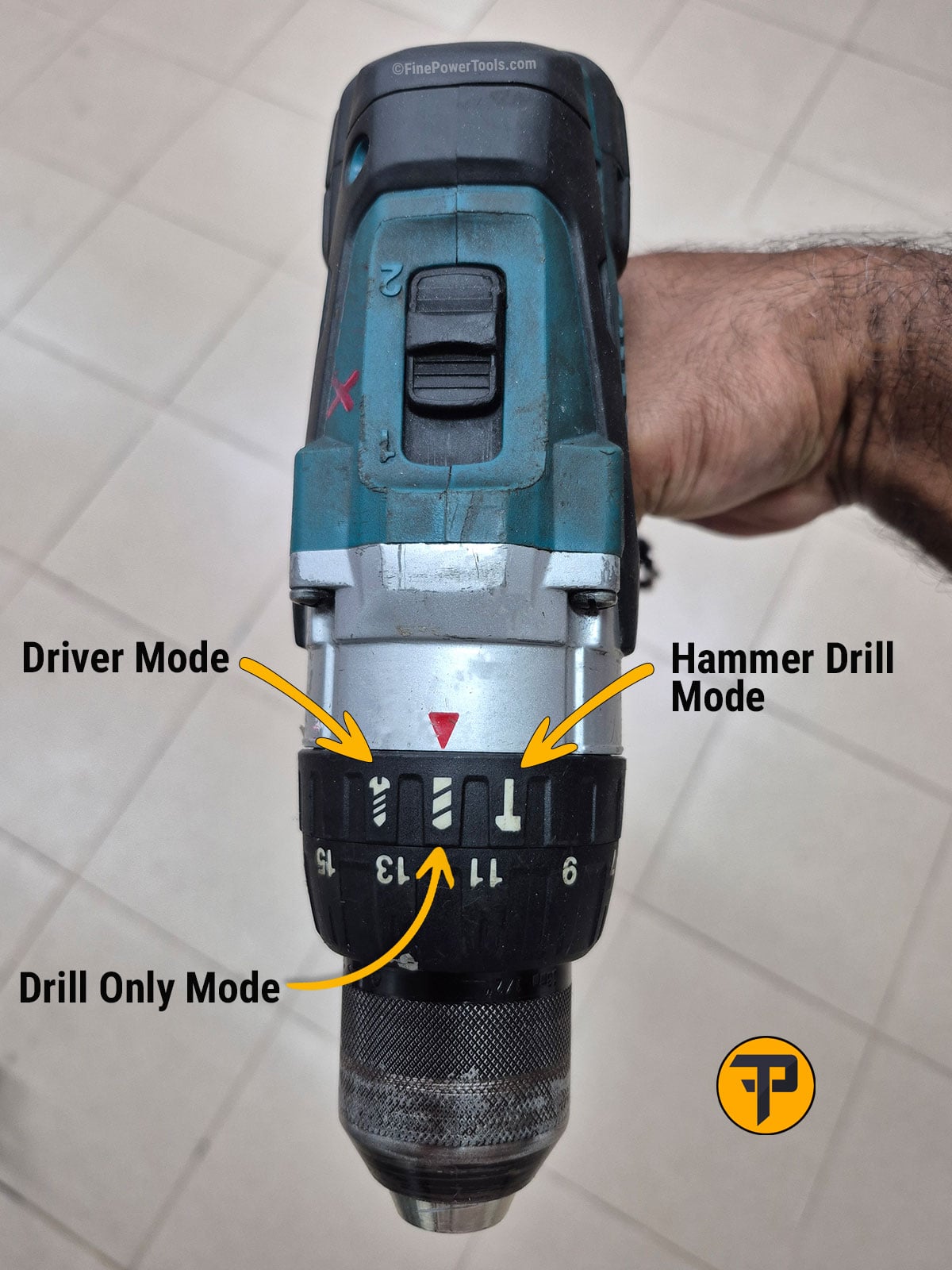
Like the drill in the above image, most models feature a numbered collar behind the chuck. Selecting a lower number on the clutch prevents the drill from driving a screw too deep into soft materials, while a higher number provides the muscle needed for dense hardwoods.
Speed Setting: These tools usually have a mechanical two-speed switch on top. Setting it to “1” gives you low speed but maximum torque for heavy driving, while setting it to “2” delivers high speed perfect for quickly cutting clean holes.
Primary Uses
Cordless drills are commonly used for:
- Drilling holes in wood, plywood, MDF, drywall, plastic, and metal.
- Driving fasteners (screws, bolts) for woodworking and home repair.
- Installing cabinets, shelving, fixtures, assembling furniture and DIY projects.
- General maintenance and home improvement work.
Their portability makes them especially useful when working on ladders, rooftops, construction sites, and other locations without easy access to electrical outlets.
A cordless drill is a rechargeable battery-powered tool used for drilling holes and driving screws and threaded fasteners into material. It is one of the most commonly used power tools that essential for DIY enthusiasts to professionals alike.
A drill driver has an electric motor that rotates the chuck (the part which holds the drill bit) delivering a continuous rotational torque.
Its notable mechanical feature is an adjustable slip clutch, the numbered collar you can see directly behind the chuck. This clutch disconnects the internal drivetrain at the set resistance (torque) level. This stops the chuck from spinning to prevent over-driving fasteners, snapping/damaging screw head.
- Tool Holding: Most models are equipped with keyless, self-centering three-jaw chuck that can hold up to Ø1/2 inch (13mm) round shank drill bits and hex-shank bits. Some compact 12V models have 3/8-inch chuck.
- Modes: A cordless drill driver has least two modes; a drill mode for boring holes and a driver mode for driving screws. When you set the mode to the drive function, a clutch mechanism engages which allows you to control the torque.
- Optimal Work Materials: You can easily drill softwood, hardwood, MDF, plywood, plastics, drywall, aluminum, and light-gauge sheet metal.
- Speed: Newer models have a dual-speed gearbox with a low-RPM/high-torque setting (Gear 1) for heavy-duty fastening, and a high-RPM setting (Gear 2)for high-speed drilling.
- Limitation: Likely hood of stalling when large-diameter hole saws through thick material, and inability to penetrate masonry.
Dan’s Field Notes 📌
- Applying excessive pressure to force the drill bit into the workpiece which would result in burning or breaking the bit.
- Using it to drill in concrete and masonry and not using the right drill bit type.
2. Corded Electric Drill
ource like the wall outlet which gives you continuous run time and higher motor speeds and torque. Unlike cordless models, there is no performance drops that happens as the battery drains.
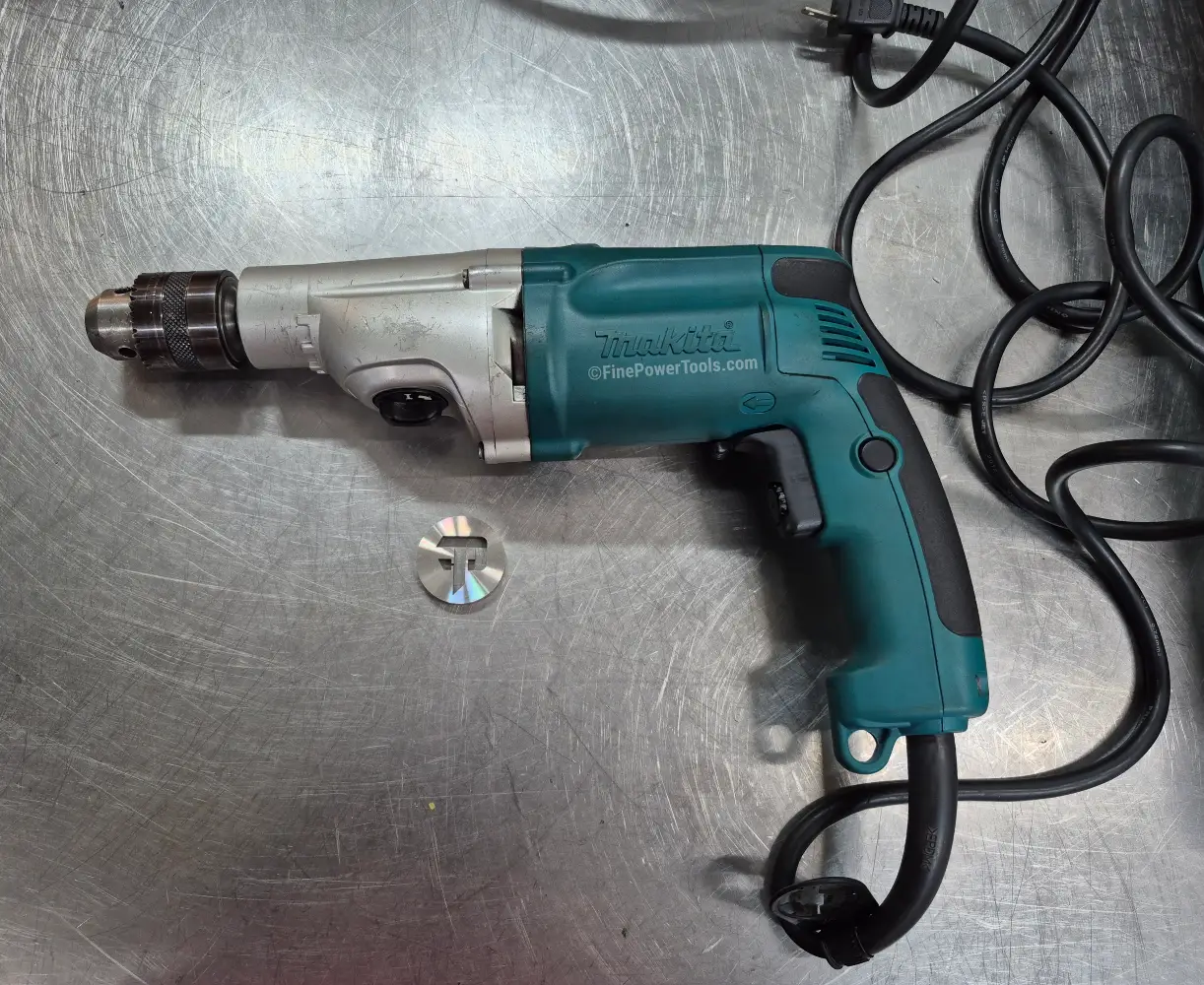
This type of drill usually has direct drive where the motor is directly connected to the drill chuck which makes it suitable for heavy-duty drilling.
A few light-duty models come with keyless chucks, while most of the heavy-duty corded drills come with higher power motor and keyed self-centering 3-jaw chucks.
Uses
- A corded drill primarily used for drilling holes
- You can easily make holes in wood, plastic, MDF, plywood.
- Drill holes in dense materials like hardwood, metal, masonry etc.
- Drilling anchor holes in concrete.
- You can use it for boring large holes using diamond core bits through brick or masonry walls.
- Mixing thick liquids like industrial paint, sealants, epoxy resins, joint compound, thin-set mortar, grout, or stucco.
- Sanding, rust removal, buffing and metal polishing.
Corded versions are generally not suitable for driving fasteners since they have no clutch for limiting the torque and you will end-up damaging the fastener head.
Key Features
Speed (RPM): Most model comes with variable speed trigger that allows you to change the RPM.
Torque Control: Not suitable for driving screws since there is no mechanical slip-clutch for torque control. While you can manually feather the trigger to drive fasteners, it is easy to overdrive the fastener resulting in stripped screw heads or broken fastener.
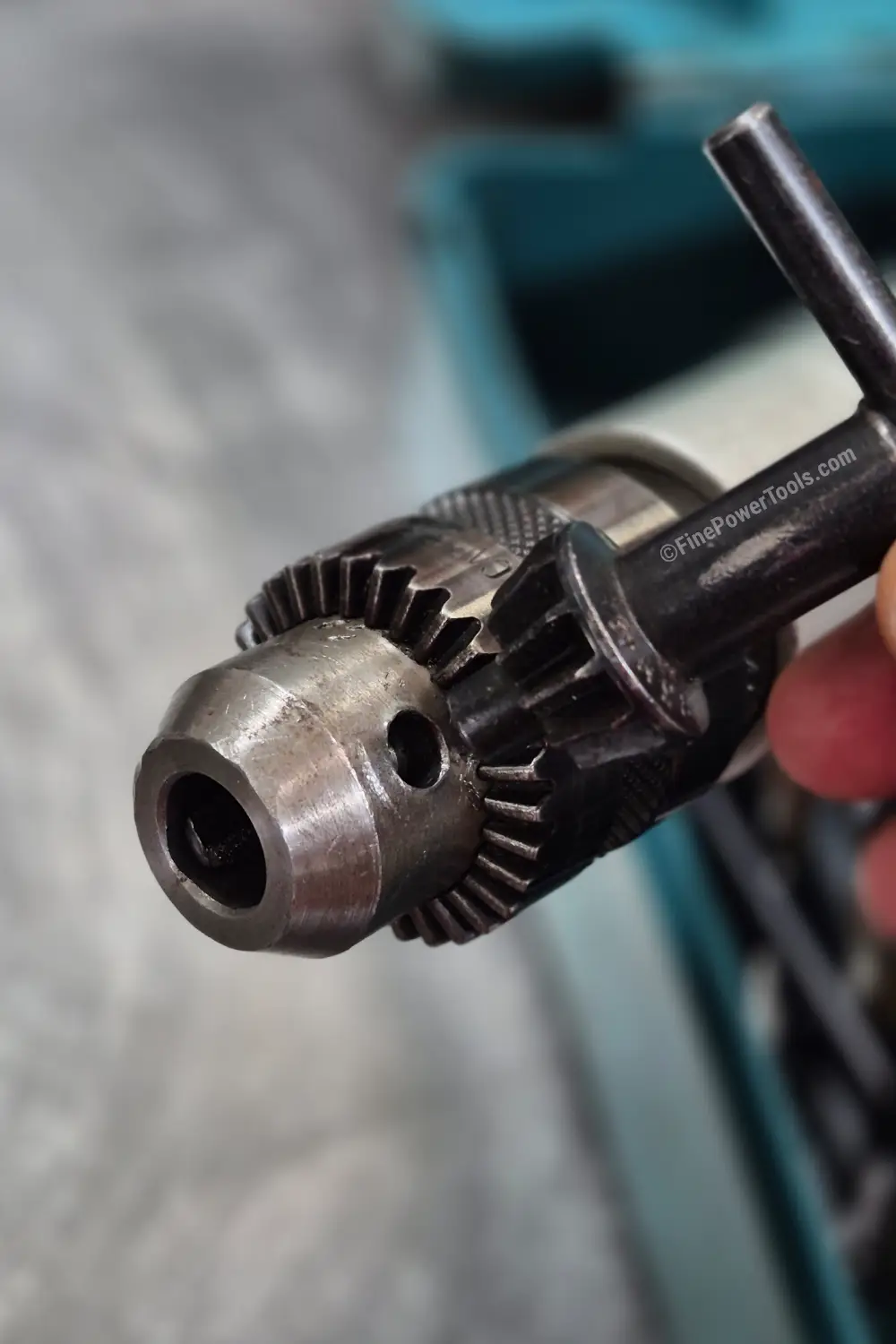
Chuck Type: Often comes with keyed chuck with a toothed metal chuck key to tighten and loosen bits, providing a very secure grip for high-torque applications, though some modern corded models do offer keyless chucks.
Additional Features:
Many corded drills have a depth stop rod and side auxiliary handle for better control during heavy-duty drilling.
Trigger Lock Button: A unique feature of corded drills is a lock-on button located on the side of the handle. If you press it while holding the trigger, it keeps the drill running continuously at the set speed without pulling the trigger.
Dan’s Notes 🔖
Even if you are confident about your trigger control, I would recommend against using it. Why?
Because unlike the cordless version where the rotation stops instantly upon releasing the trigger, the corded drill tends to spin for a second or two, which can easily strip or damage your screw.
3. Hammer Drill
ammer drill is a power tool designed to combine rapid forward-and-backward concussive blows with standard bit rotation. This pounding motion rapidly fractures hard, brittle materials, allowing the specialized carbide-tipped masonry bit to pulverize the material while the rotation clears out the dust.
Some cordless hammer drills are also designed as drill/drivers with adjustable clutches, while others are primarily drilling tools.
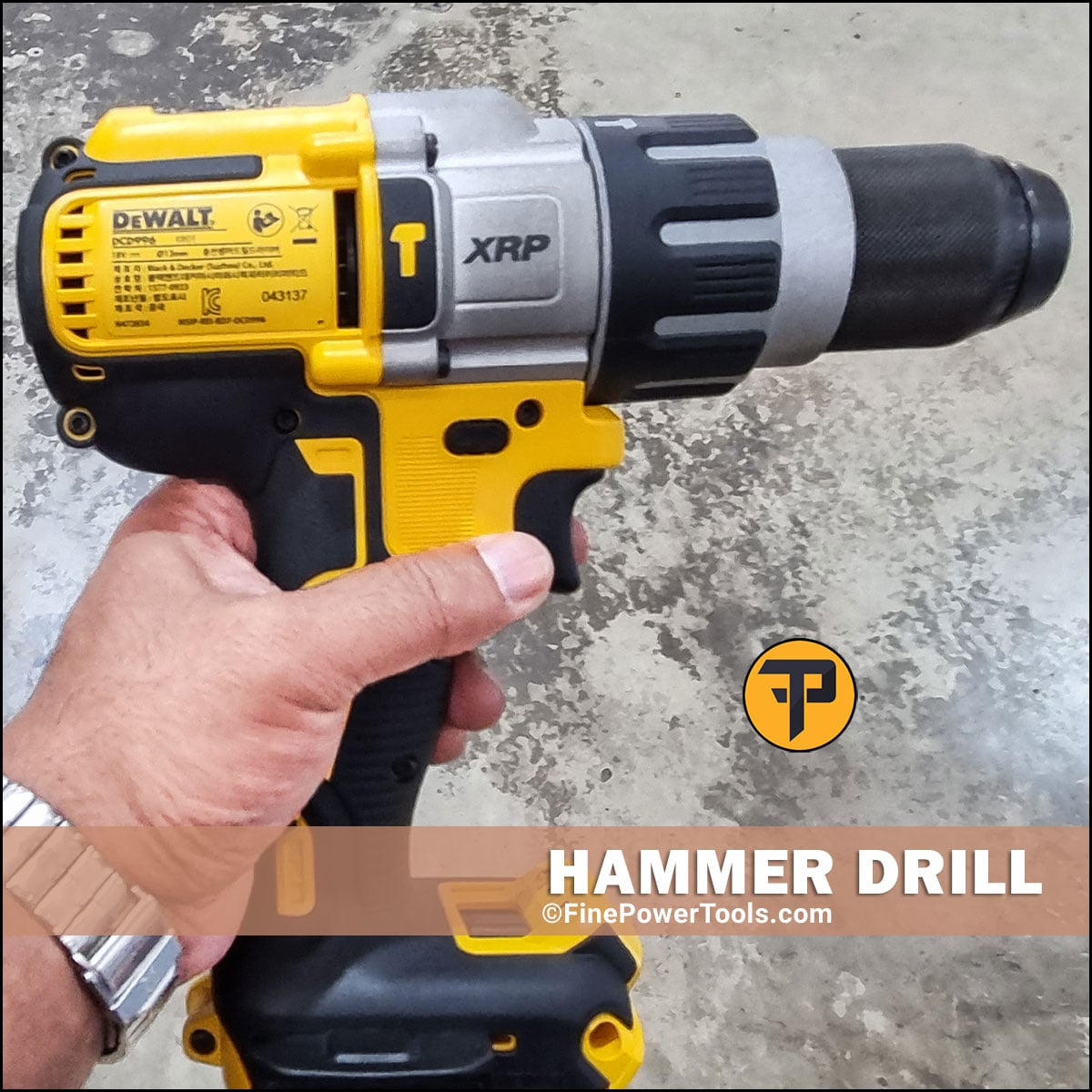
It looks identical to a standard drill driver but contains an internal, internal-tooth clutch mechanism. When switched to “hammer mode,” two ribbed metal discs ride against each other, mechanically forcing the chuck violently forward and backward as it spins.
- Working Mechanism: Continuous rotation combined with mechanical, cam-action axial pounding (BPM).
- Chuck Size: 1/2-inch heavy-duty ratcheting keyless chuck.
- Optimal Materials:
Drill Mode: Wood, MDF, plastic, metal, etc.
Hammer Drill Mode: Brick, mortar, cinder blocks, poured stone, and light-duty concrete.
Uses of a Hammer Drill
Hammer drills are predominantly engineered for masonry work. Common applications include:
- Drilling holes into concrete, brick, mortar, stone, and cinder blocks.
- Setting anchor bolts, concrete screws, and wall plugs into walls or foundations.
- Occasional light-to-medium construction or DIY masonry projects.
Drill/Driver vs. Hammer Drill
Don’t get tripped up by US tool labels.
Not all hammer drills have slip clutches. Many basic traditional corded hammer drills do not have mechanical slip clutches or gears.
If the drill has numbered selector ring right behind the chuck and a hammer icon, that’s a 3-in-1 tool (like a European Combi drill). Most cordless hammer drills have slip clutch which engages only in the driver mode, but locks out when you switch to drill and hammer drill modes.
Dan’s Field Notes 📌
Do not use hammer drilling mode when drilling holes in wood, metal, plastic etc. The high vibration makes it imprecise for precision work.
For heavy-duty masonry work such as thick industrial aggregate or reinforced concrete (rebar), you may need a rotary hammer.
4. Combi Drill (Combination Drill)
A combi drill a 3-in-1 power tool that combines the function of a drill driver and a hammer drill. It can drill holes, drive screws, and has the hammer mode to drill masonry. It normally includes an adjustable clutch for controlling screwdriving torque.
Modes
A Combi Drill has three different modes.
- Driver Mode: In this mode a spring-loaded slip clutch is engaged, which prevents the tool from over torquing the fasteners.
- Drill Mode: This is the direct mode where the drive motor rotates chuck to deliver maximum speed for drilling holes in soft material like wood, plastic, MDF, drywall, etc.
- Hammer Mode: When the tool is set to hammer drilling mode, the internal hammer mechanism which consists of two spring loaded ribbed cam plates, engages to generate rapid axial percussion that allows the tool to penetrate through masonry and bricks.
In Europe, the combi drill is the standard option for cordless drills. In the US, however, the terminology varies; you will often find tools marketed simply as “drill drivers” that might have a hammer mode. These are actually combination drills.
So, how do you identify them?
If you can see a torque clutch (a rotating collar marked with numbers) and a hammer icon (hammer drilling mode), then it is a combination drill.
The next power tool in the list is technically not a drill, but it is tool that is found in most handymen’s toolbox and can be used for drilling.
5. Impact Driver
An impact driver is designed for driving long threaded fasteners (construction wood screws, lag bolts, etc.) into dense hardwood. It has an internal hammer mechanism that strikes the drive anvil in the rotational direction to deliver bursts of torque onto the fasteners.
💡 While the primary purpose of this tool is to drive fasteners, you can use an impact driver to drill holes using the hex shank drill bits.

Common Uses
- Driving deck screws, especially when working with hidden deck fasteners like Camo / Kreg Deck Systems.
- Sinking long constructions screws into dense hardwood. Think of driving 4-inch to 8-inch structural wood screws.
- Driving self threading screws into sheet metals and corrugated metal roofing.
- You can also use for automotive work like removing valve covers, under trays, intake plenums, and you can even use it for removing lug nuts.
Key Advantages
- Prevents Cam-Out: When you apply excess torque to drive a screw, the driver bit could slip and damage the drive slot which is known as cam-out. The repeated rotational hammer blows shock-load the fastener, keeping the driver bit locked tightly inside the screw head which prevents cam-out.
- No Reactive Torque on Your Wrist: When the fastener experience resistance, it will force the spring loaded hammer to move-up. As the drive motor rotates the hammer further, it slips and strikes the anvil. Since the excess torque is forcing the hammer to slip and strike the anvil, the rotation twisting force is not transferred to your wrist, preventing injury.
Maximum Efficiency: The concussive mechanism only activates under high resistance, allowing the tool to spin at high speeds for standard screws while using significantly less battery power under load.
6. Rotary Hammer
A rotary hammer drill, also known as “SDS drill”, is designed for heavy-duty jobs drilling in concrete, stone, bricks, and breaking through masonry.
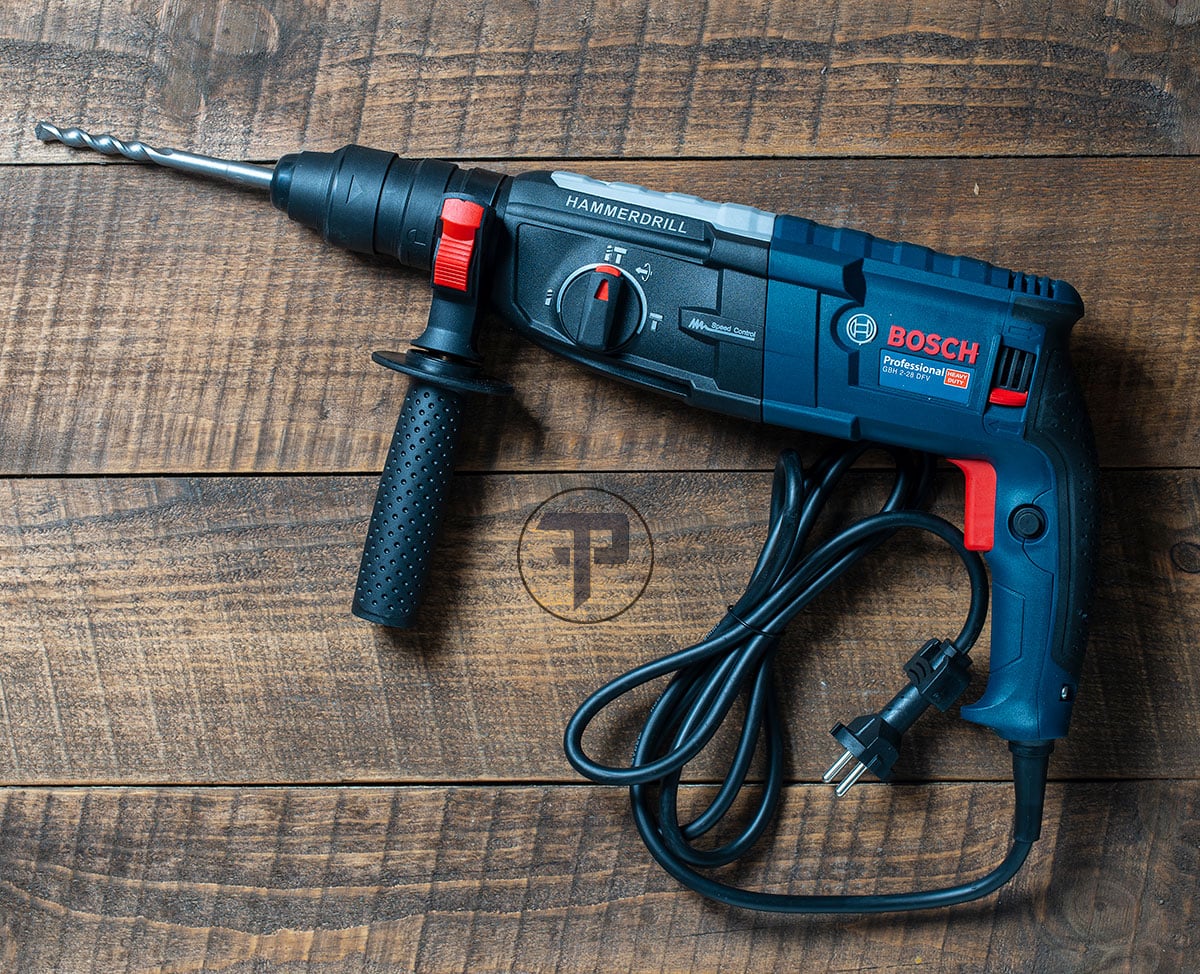
It may sound similar to a standard hammer drill, but there are 5 major differences.
- The internal hammer mechanism works differently.
- It uses an SDS chuck instead of a standard 3-jaw chuck.
- This a drill has a dedicated hammer only mode for chiseling.
- No torque control.
- The rotary hammer is bulky and has the ability to drill larger holes.
Hammer Mechanism:
The internal mechanism of the two tools work in very different ways.
The percussion blows inside a regular hammer drill are created by a mechanical cam system. A rotary hammer uses an electro-pneumatic piston mechanism instead. As the motor runs, it moves a piston that compresses air inside a cylinder. That compressed air then drives a heavy firing pin into the back of the drill bit.
The result is a much stronger impact (measured in foot-pounds) and it allows the tool to break through thick concrete without the operator having to lean heavily into it.
If you spend ten minutes forcing a regular drill and a roatary hammer into a concrete wall you’ll notice the difference immediately.
Tool Holding
Rotary hammers have a quick-change sliding chuck system known as SDS chuck rather than a standard keyless chuck. Most medium-duty models use SDS-Plus, while larger demolition tools typically use SDS-Max.
Once inserted, the SDS-chuck locks on to the groove profile on the drill bit shank but still lets it move slightly forward and backward (axial movement). This small amount of movement helps transfer the full force of each pneumatic strike directly into the material.
Modes
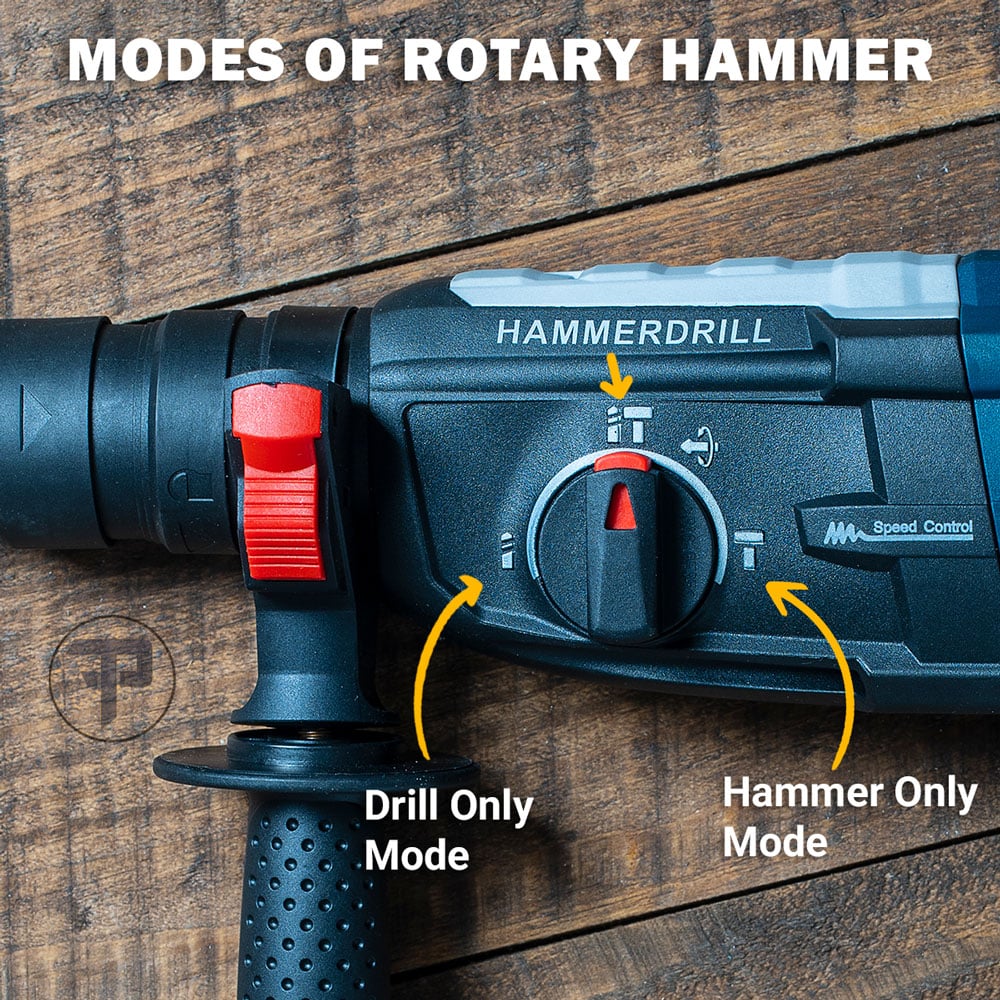
Most rotary hammer drills have 3 modes.
- Drill only mode (without percussion): Used for drilling wood, metal etc.
- Hammer drill mode (Rotation + percussion): For drilling concrete and masonry.
- Hammer only mode (Percussion without rotation): For chiseling and demolition work.
The heavy-duty SDS-Max units usually do not have the drill-only mode.
Capacity
The regular hammer drills are compact tools with which you can drill holes up to 1/2 inch in diameter. The rotary hammer drills are much more powerful and they can drill holes up to ⌀2 inches.
You could also use core bits when you need larger holes up to 4 to 6 inches.
7. Drill Press
A drill press is a stationary machine tool designed to bore precision holes perfectly vertical with repeatable depth accuracy. The main advantage of a drill press is that, unlike handheld drills, which are prone to human error and axial misalignment, a drill press guarantees a perfect 90-degree hole.

It features a heavy cast-iron base and a column on which an adjustable worktable that can be raised, lowered, or tilted to specific angles is mounted. You can clamp the workpiece directly on the worktable or use a vise.
The motor is mounted at the top of a rigid column, driving a vertical spindle assembly through a series of stepped pulleys. To operate the bench drill, you’ll rotate a multi-spoke hand wheel (feed lever), which pushes the non-rotating quill and spinning chuck downward into the workpiece along a vertical axis.
You can see the parts of a drill press for more information.
Features of a Drill Press
- Primary Mechanism: Fixed vertical spindle travel driven by a manual rack-and-pinion feed lever, providing absolute axial alignment.
- Standard Chuck Size: 1/2-inch (metric 13 mm) self-cantering keyless chuck or 5/8-inch keyed chuck mounted on a tapered spindle (typically Morse Taper MT2).
- Optimal Materials: Hardwoods, plastics, plexiglass, metals (structural steels, thick steel plates, cast iron, aluminum, brass, copper, etc.) and for machining precision wood joinery.
- Key Limitation: This is a non-portable machine. The size of the workpiece you can drill is limited by the machine’s “throat depth” (the distance from the column to the center of the chuck), making it impossible to use on large sheet goods or installed materials.
8. Right-Angle Drill
A right-angle drill is a specialized power tool where the drill bit holding chuck is positioned at a 90-degree angle to the body, allowing you to drill holes and drive fasteners in tight, confined spaces where a regular drill driver cannot fit.
How it Works: The gearbox redirects the motor’s rotational axis at a 90-degree angle which minimizes the tool’s head depth allowing the you to operate effectively inside deep cabinetry, under flooring, etc. There are are also right angle drills with pivot head which you can lock into different preset positions between 0 to 90° angles.
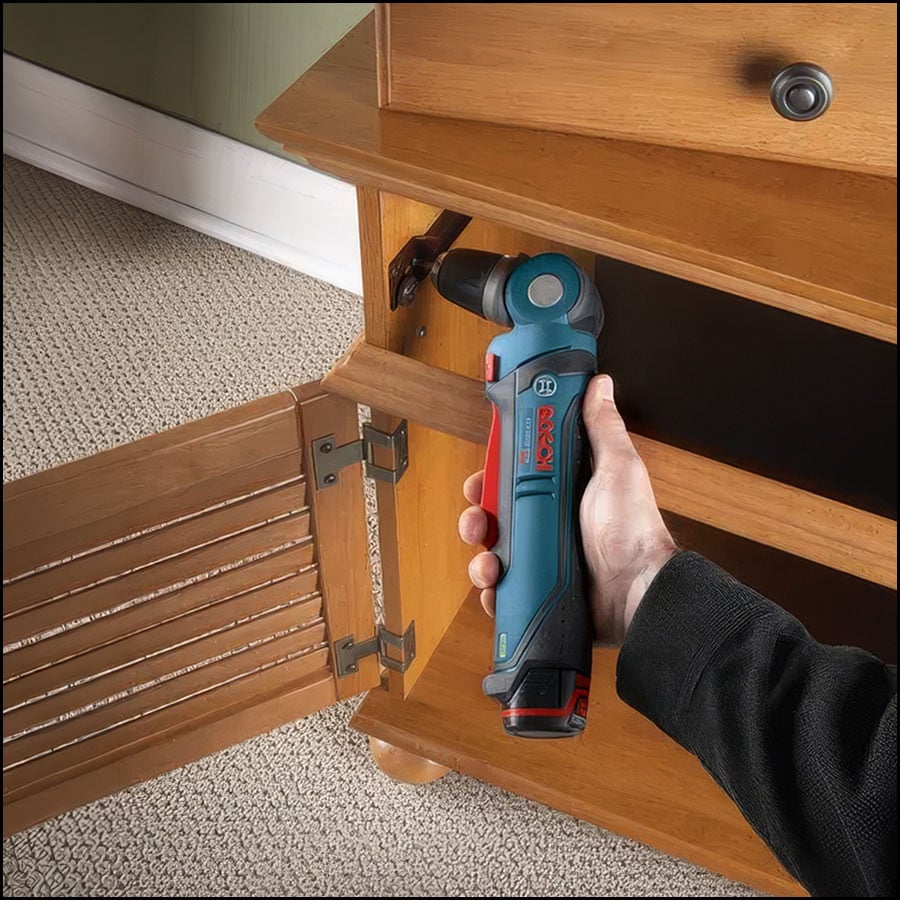
Credit: A right angle drill with 5 position pivot head by Bosch
Key Features
- Primary Mechanism: 90-degree angled bevel gear drive delivering high-torque, low-RPM continuous rotation.
- Standard Chuck Size: 3/8 in or 1/2-inch self centering chuck.
- Optimal Materials: Cabinetry, making furniture, automotive jobs, HVAC wok, appliance installation.
- Key Limitation: Highly specialized ergonomics make it awkward, heavy, and impractical for everyday, open-space drilling or general screwdriver tasks.
The types of right angle drills range from compact, lightweight 12V/18V versions designed for small auto repair and tight cabinet spaces to heavy-duty models like the classic Milwaukee Hole Hawg built for plumbing and electrical rough-ins.
9. Heavy-Duty Joist & Stud Drill
A Joist & Stud Drill is a heavy-duty, high-torque right angle drill designed to bore large-diameter holes through structural wood framework (joists and studs) for plumbing and electrical work.
It is also widely known as a Hole Hawg, which was originally a trademarked model by Milwaukee Tool.
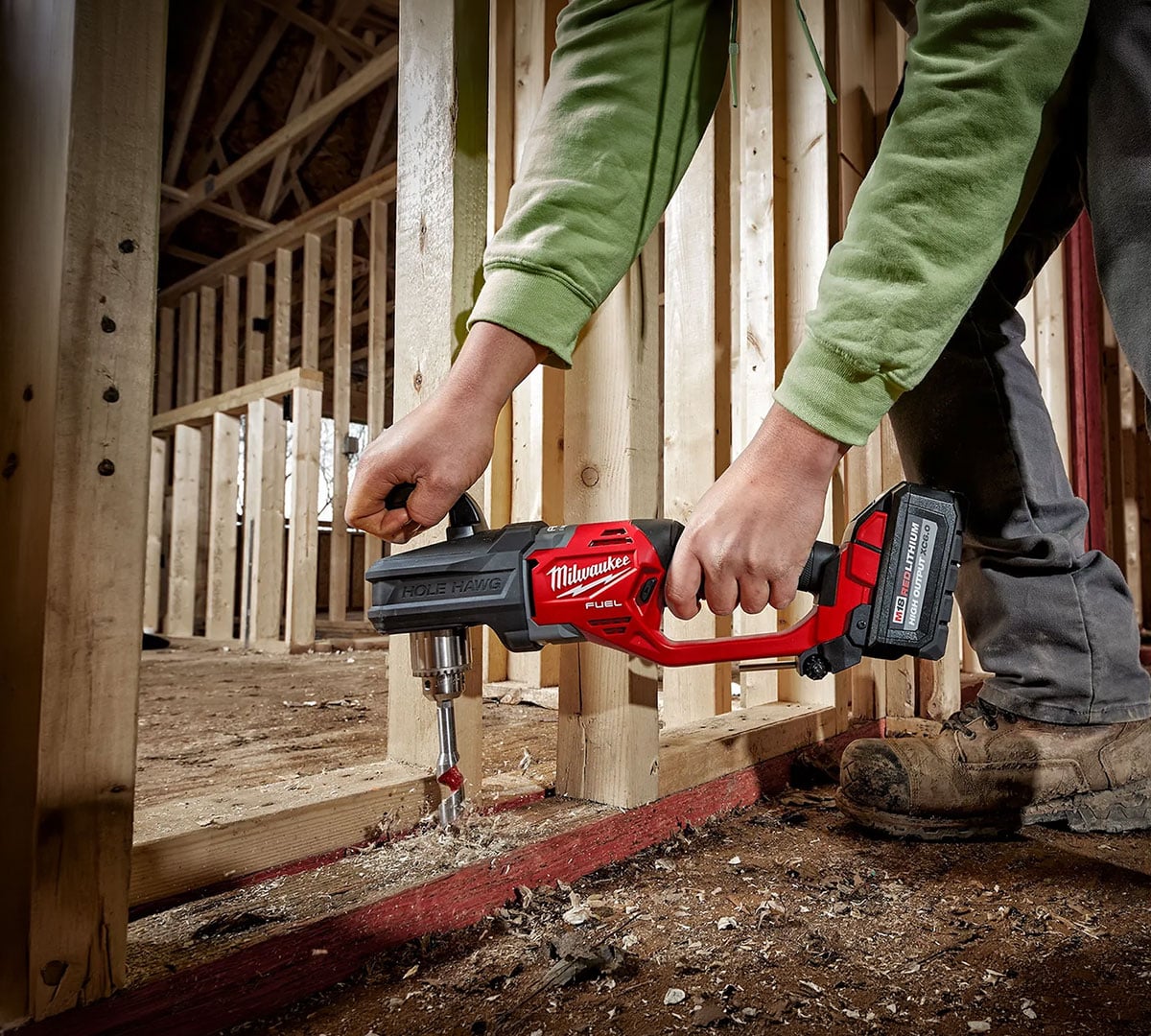
Credit: A 1/2-inch cordless Hole Hawg® by Milwaukee Tools
Key Facts
- Chuck Size: Heavy-duty keyed chuck or special chuck with a 7/16-inch hex quick-change collet.
- Optimal Materials: Framing lumber, joists, studs, dense subflooring, and hidden structural materials.
- Drill Bits: Pair Joist & Stud drills with self-feed bits, auger bits, or hole saws. Compact right-angle drills should stick to standard twist bits, step bits, or small spade bits.
- Safety Precautions: Always maintain a firm, dual-handed grip. Use the side handle or top handle provided on the tool.
If the bit hits a nail or knot you could experience kickback.
Right Angle Drill vs. Hole Hawg
| Feature | Right-Angle Drill | Heavy-Duty Stud and Joist Drill |
|---|---|---|
| Power & Torque | Lower to moderate torque; meant for driving small fasteners or drilling small holes. | Extreme, bone-jarring torque; designed to power large self-feed bits and hole saws (2-9/16″ or wider) through dense framing lumber. |
| Chuck Size | Standard 3/8 inch or 1/4 inch hex chuck for smaller drill and driver bits. | Heavy-duty keyed chuck or specialized quick-change hex (7/16″) to handle thick self-feed or spade bits. |
| Size & Weight | Lightweight, slim, and often single-handed cordless tools. | Bulky, heavy and requires a dual-handle or D-handle design for two-handed control. |
| Safety Features | Standard trigger and clutch mechanisms. | Advanced electronic anti-rotation/binding clutches (e-clutches) to prevent the tool from violently whipping around and breaking the user’s wrist if a massive bit snags. |
| Primary Use Case | Installing cabinet hardware, minor repairs under sinks, or light overhead fastening. | Boring massive rough-in holes through multiple wooden floor joists and wall studs for PVC pipes and electrical cables. |
10. Rotary Tool (Dremel)
A rotary tool (frequently referred by the brand name Dremel) is a high-speed, handheld power tool engineered for precision detailing, intricate carving, light-duty drilling, grinding, and polishing.
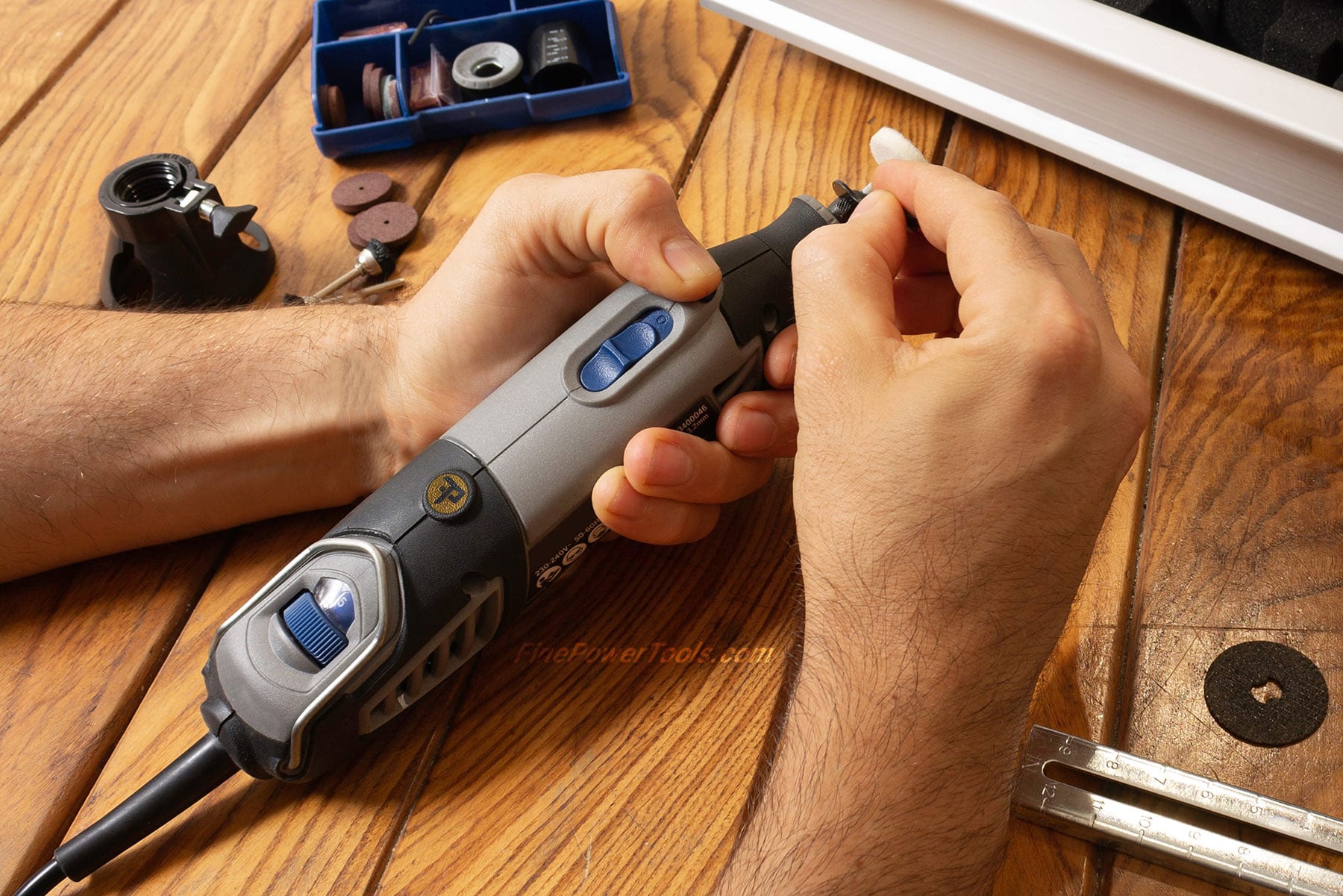
Technically, it is not a drill, but the rotary tool can be used for drilling small holes. While a regular drill driver has high torque and relatively low rotational speeds, a rotary tool runs at very high speeds ranging from 5,000 to 35,000 RPM, but has low torque.

Instead of a traditional adjustable three-jaw chuck, a rotary tool features a precision collet system (most commonly 1/8-inch, 3/32-inch, or 1/16-inch diameters) that can run with near-zero runout (wobble) at extreme speeds.
Because it lacks high rotational torque, attempting to force the tool into a material will stall the motor or break the drill bit; instead, allow the high speed rotation of the bit does the cutting.
Features
- Primary Mechanism: High-RPM, low-torque continuous rotation utilizing high peripheral velocity.
- Standard Chuck Size: Multi-size collet system, typically ranging from 1/32-inch up to 1/8-inch.
- Optimal Materials: Plastics, plexiglass (acrylic), glass, drilling ceramic pottery, soft woods, thin hobby metals, jewelry, and circuit boards.
- Key Limitation: Not suitable for boring large holes because of low torque.
Specialized and Industrial Drills
11. Core Drill
A core drill is a heavy-duty construction machinery designed for cutting large-diameter holes through reinforced concrete, asphalt, stone, pavements, and solid brickwork. Unlike hammer drills that utilize the percussion blows and to pulverize the entire volume of a hole into dust, a core drill utilizes a hollow, barrel-shaped bit embedded with industrial diamond segments along its cutting rim. As the bit rotates, it shaves away only the outer perimeter of the hole, leaving a solid cylinder of core (the waste material) inside the barrel, which is removed when the operation is complete.
Because of the massive torque required for the diamond core bit to cut through masonry, these machines are often securely bolted directly to the floor for stability. On most heavy-duty core drills, water is pumped through the center of the spinning spindle to cool the diamond core bit to prevent it from overheating and wash away hazardous concrete slurry and silica dust.
- Working Mechanism: Heavy-torque, continuous rotation driving a hollow diamond-tipped barrel bit, often paired with an integrated wet-cooling system.
- Chuck Size: Large threaded industrial spindles (1-1/4” – 7 UNC or 5/8” – 11 threads).
- Optimal Materials: Concrete, reinforced concrete with embedded rebar, cured asphalt, marble, granite, engineered stone , stone and brick walls, etc.
- Key Limitation: Extremely expensive, heavy, and messy to operate due to the water requirement. It requires constant setup and anchoring time, making it entirely impractical for standard, small-scale fastening or general workshop utility.
12. Earth Auger
An earth auger (also known as a power earth drill or post-hole digger) is a specialized tool designed specifically to bore large, cylindrical holes into soil or ice.
13. Pneumatic Drill
An industrial pneumatic drill, also known as rotary air drill, is a hand-held air tool that looks and functions just like a standard pistol-grip cordless drill, but it is powered by compressed air instead of an electric motor or battery.
They also come in 90° right-angle versions for tight spaces and straight in-line versions.
The straight pneumatic drills are often hung from bungees above assembly lines for rapid, downward drilling.
14. Magnetic Drill
A mag drill or magnetic drill press is a portable power tool with a powerful electromagnetic base that you can clamp onto flat ferrous metal surfaces so you can drill large holes precisely on the very metal surface that it is seated.
How it Works?
The base of the tool has a powerful electric coil that can generate thousands of Newtons of magnetic holding force to clamp the entire machine onto a flat magnetic metal surface. The motor and spindle assembly are mounted on a vertical rack-and-pinion slide system. Similar to a drill press, you rotate a manual feed handle to feed the rotating bit down into the metal workpiece to cut the hole.
- Chuck: The native tool holder on most mag drills is an arbor built specifically for 3/4-inch Weldon shanks.
- Drill Bit: Mostly used cutting tools are the annular cutters to cut large-diameter holes rapidly by removing only a ring of material. But you can also use the regular twist drill bits for smaller holes with the help of a 1/2-inch drill chuck attached using a 3/4-inch Weldon adapter.
What can you drill?
Ferrous metals only. The magnetic base strictly requires carbon steel, structural steel, cast iron, or an iron alloys to create a secure clamp.
If you want to drill non-magnetic materials like aluminum, copper, or stainless steel, the machine must be mechanically secured using special clamps.
⚡Safety Risk: The powerful localized electromagnetic fields pose a severe health risk to patients with pacemakers.
15. Radial Drill Press
A radial drill press is a heavy-duty industrial drilling machine with a massive vertical column supporting a radial horizontal arm that can be rotated. The heavy workpiece remains securely clamped in one position on the large base table. The spindle and drill head mounted on the radial arm can slide back and forth and can be raised, lowered, or angled.
This combination of radial movement of the arm and the sliding movement of the drill head allows you to drill at different positions accurately without repositioning the workpiece.
Uses:
Used in large metalworking shops for drilling, boring, tapping, reaming holes in large and heavy metal parts that are too difficult to reposition for multiple holes.
16. CNC Drilling Machine
A CNC (Computer Numerically Controlled) drilling machine is an automated industrial machine tool that is run by CNC programs to drill precisely positioned, highly accurate and repeated holes in workpiece.
17. Mill-Drill Machine
A mill-drill machine is a machine tool that combines the vertical plunging capability of a drill press with the lateral, precise X & Y-axis table movement of a milling machine.
Traditional Manual Drills
18. Eggbeater Drill (Hand Drill / Wheel Brace)
A hand drill is a classic rotary tool that relies on mechanical gears rotated by hand lever manually. This manual tool has side-mounted hand crank connected to a large drive gear that meshes with smaller pinion gears attached to the spindle. When you rotate the crank once, the large gear drives the smaller gear to spin several rotations. The reduction gear multiplies the rotational speed of the three-jaw chuck that holds straight shank twist bits.
It is also referred to as an eggbeater drill due to its distinct shape.
While it has been largely replaced by power tools today, it remains highly prized by fine woodworkers, luthiers, craftsmen and hobbyists who love the unparalleled control it offers on intricate workpieces.
19. Brace and Bit
A hand brace drill (often called a carpenter’s brace or brace & bit) is a heavy-duty, manual woodworking tool used primarily for boring large-diameter holes.
Unlike the rotary gears of an eggbeater drill, a brace uses a mechanical crank handle shaped like a crankshaft or the letter “U” (or “C”). You hold the top head stationary with one hand while sweeping the large middle handle in a wide circle with the other.
Anatomy & Features:
- The Head: A free-spinning wooden or plastic mushroom-shaped top knob that you press down on with your palm or chest to apply downward force.
- The Crank: The large offset arm that provides massive leverage. “Sweep size” refers to the diameter of the circle it makes (typically ranging from 8 to 14 inches).
- Chuck Type: Usually features a two-jaw or four-jaw alligator-style chuck designed to grip tapered square shanks (auger bits), though modern universal chucks can also hold round shanks.
- Bit Type: Typically uses auger bits, which feature a threaded screw-point at the tip that pulls the bit into the wood automatically, requiring very little downward pressure.
20. Breast Drill (Chest Drill)
A breast drill (sometimes called a chest drill) is essentially a heavy-duty hybrid between an eggbeater drill and a carpenter’s brace. It is a manual rotary tool designed for larger drilling tasks that require more downward pressure and torque than a standard eggbeater drill can provide, but more speed and convenience than a traditional hand brace.
Instead of a small, pistol-like grip or a top knob meant for your palm, a breast drill features a large, flat, or curved plate (the “breastplate”) at the back.
Anatomy & Features
- Breastplate: A metal or wooden plate that you press firmly against your chest or sternum. This lets you use your entire upper body weight to drive the bit forward.
- Crank Mechanism: Like an eggbeater drill, it uses a side-mounted crank and internal gears (drive gear and pinion gears) to multiply rotational speed. However, the gears are usually larger and built much more ruggedly.
- The Handle: It typically features a second side handle or a D-handle near the top or front to help you steady the tool and control the alignment with both hands.
- Chuck Type: Usually features a robust three-jaw chuck capable of holding larger straight-shank twist bits (often up to $1/2$ inch in diameter) than a standard eggbeater drill.
Manual Drills Comparison
| Feature | Eggbeater Drill (Hand Drill) | Brace and Bit | Breast Drill (Chest Drill) |
|---|---|---|---|
| Mechanical System | Single/double gear drive (high RPM) | Cranked sweep handle (high torque) | Two-speed gear drive + chest leverage |
| Ideal Hole Size | Tiny to Small (< 1/4 inch) | Medium to Extra Large (1/4 to 1.5+ inches) | Medium to Large (1/4 to 1 inch) |
| Primary Advantage | High speed, prevents delicate bits from snapping | Immense mechanical torque from the wide sweep | Massive downward thrust using body weight |
| Best Materials | Light wood, soft plastics | Hardwood framing, deep timbers | Metal, dense iron, tough vertical walls |
| Typical Chuck / Bits | 3-jaw chuck for round twist bits | 2-jaw shell for square-tapered auger bits | 3-jaw chuck for heavy-duty round shanks |
21. Push Drill
A push drill is a screwdriver shaped hand tool that rotates a drill bit when you push the handle straight down. Their main advantage is the compact size and speed for making small holes. Push Drills are also known as a Yankee drill or Archimedean drill.
How Push Drills Work?
Instead of cranking a wheel or turning a brace, you place the bit on your mark and push down on the handle. An internal spiral grooved shaft and a ratcheting mechanism convert your linear pushing motion into rotary motion.
It has a spring that returns the sliding handle after each stroke without spinning the bit in reverse direction, allowing you do make repeated pushes to produce continuous rotation without turning a crank or handle.
Push Drill Uses
It is designed for small, precise pilot holes in softwoods. Traditional woodworkers, cabinetmakers, and hobbyists use push drills to install small hinges, knobs, handles, blinds, curtains and similar fittings where only a few small holes are required.
Specialized Precision Drills
Highly specialized drills also exist for fields such as medical industry (example: dentistal drill, orthopedic drill for surgery, etc.) mining, and manufacturing, but these fall outside the scope of this guide.
Types of Drills by Application
Drills for Woodworking
- Cordless drill/driver is the most versatile choice for general carpentry. Good for drilling holes in wood and driving screws.
- Drill press: Use a drill press for drilling accurate, straight holes. Although not very portable, it is highly useful in a woodworking shop.
- Right-angle drill is useful for drilling in tight spaces, such as between joists or inside cabinets.
Metalworking Drills
- Drill Press: A stationary benchtop drill press or a floor-standing pillar drill is the primary choice for drilling straight, repeatable holes quickly in a metalworking shop. The smaller tabletop drill press may be suitable for lighter metalworking and a home workshop.
- Radial Drill: The heavy-duty drill press with radial arm is used for drilling, tapping, boring and reaming holes at different locations in large and heavy workpieces.
- Magnetic Drill: Suitable for drilling large holes in thick steel, especially structural steel and fabrication work.
- Corded or Cordless Handheld Drill: Good choice when you need a portable drill for making holes in sheet metal, aluminum, mild steel, and general fabrication.
Drill for Masonry & Brick
A hammer drill with masonry bit is recommended for drilling holes in bricks, mortar, cement blocks, and stones for wall plugs, screws, anchors, maintenance work, etc. The hammering action helps to break up masonry.
For softer brick, try drilling in the “drill mode” (no hammering) to avoid damaging the brick.
Concrete Drill
- Rotary Hammer Drill: While a hammer drill would work for drilling small holes in concrete, a rotary hammer drill with SDS bit is recommended for drilling larger and deeper holes in reinforced concrete.
- The SDS-Max rotary hammer is meant for heavy-duty work in thick concrete, or breaking hard concrete.
- Diamond core drill: Recommended for precise large holes, such as holes for electrical conduits, pipes, ventilation, etc.
Drill Types by Job: Quick Reference Table
| Job Type | Typical Material | Recommended Drill Type |
|---|---|---|
| Woodworking | Wood, plywood, MDF | Drill/driver, drill press |
| Metalworking | Steel, aluminum, sheet metal | Drill press, drill/driver |
| Carpentry | Wood, timber | Drill/driver, impact driver |
| Framing | Lumber, engineered wood | Right-angle drill, high-torque drill |
| Construction | Wood, metal, masonry | Drill/driver, impact driver, rotary hammer |
| Structural Steel | Heavy steel | Magnetic drill (mag drill) |
| Masonry & Brick | Brick, block, mortar | Hammer drill |
| Concrete | Concrete, reinforced concrete | SDS rotary hammer |
| Large Concrete Holes | Concrete | Diamond core drill |
| Electrical & Plumbing | Wood, metal, masonry, concrete | Right-angle drill, drill/driver, rotary hammer |
| Earth / Ground | Soil, clay, loose ground | Earth auger |
How Drills Are Classified
By Power Source
- Corded Electric Drills
- Cordless Drills
- Pneumatic Drills
By Chuck and Bit System
Keyed, keyless, hex, SDS-Plus, SDS-Max, Morse taper, etc.
By Motor Type
Brushed vs brushless drills.

Dan Miller is a professional toolmaker with extensive experience in the metalworking and tooling industry.
An avid DIY enthusiast and passionate hobbyist woodworker, Dan shares his expert knowledge here.